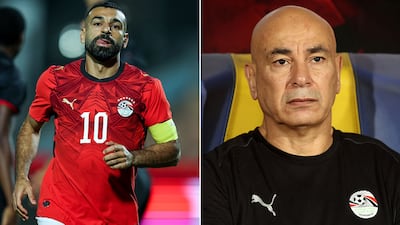

Egypt head coach Hossam Hassan went into full damage control mode on Monday while talking to reporters ahead of the Pharaohs’ Africa Cup of Nations qualifier against South Sudan.
Hassan walked back many of the statements that landed him in hot water with fans, pundits, and even his own players over the past week.
Just two months after he was given a hero’s welcome alongside the Egyptian squad that made a historic run to the last-16 at the 2026 World Cup, Hassan went through a nightmare four-day media storm due to ill-advised comments made during press conferences, a sub-par 0-0 performance against Angola, and the seemingly surprising departure of Mohamed Salah from training camp.
What did Hassan say?
At his pre-match press conference ahead of the Angola game in Cairo on Thursday, Hassan was quizzed about the absence of Mohamed El Shenawy, the Al Ahly goalkeeper and one of the Egyptian national team’s captains, from his squad.
Hassan did not appreciate his decisions being questioned and implied that at some point El Shenawy’s career was “finished” before he managed to revive it through the national team – comments that were interpreted by many as offensive to a player who has earned 76 caps and was Egypt’s first-choice goalkeeper for many years before his teammate Mostafa Shobeir came to the fore this summer.
“Mohamed El Shenawy at one point was finished, and was not playing with his club, yet he returned to his level through the work we did with him with the national team. Not just him, but other players as well,” said Hassan, who has also taken credit for bringing Emam Ashour back to form after illness.
“This was our point of view this time, regardless of whether he [El Shenawy] is injured or not. All respect to all the players, especially since Mohamed El Shenawy is one of the captains of the Egypt national team, and I value him. But this is my choice. I could have made my life easier by saying he is injured. But even if he isn’t injured, this is my choice. It’s high time we trust each other.”
Egyptian Football Association president Hany Abou Rida and Al Ahly, both released statements in support of El Shenawy following Hassan’s press conference.
Other comments that caused great ire among the Egyptian public were Hassan’s views on the Egyptian Premier League, the domestic league that typically provides almost 90 per cent of the players for the national team.
“I wish that the domestic league becomes strong. Looking at the league, do you see any team or any club in the league that has a good technical level? Name one star or one team from the league that you believe can add value or improve the level of the national team,” said Hassan on Thursday.
“Players come to us [at the national team], they improve, and then they return to their clubs. What’s supposed to happen is that they improve at their clubs and they come to us ready and in good shape. So we are truly suffering.
“I hope that all the big and respected clubs in the league can play football at a higher level and can increase the physical conditioning of the players. Because that will ultimately help the national team. Because I don’t have enough time with the players.”
The statements dominated the news cycle on the eve of the Angola game, and things worsened when Egypt were held to a goalless draw at Cairo International Stadium in a homecoming game that saw Hassan inexplicably substitute Salah in the 60th minute.
Hassan later said in the post-game press conference that his decision to take off Salah was for “technical reasons”.
The following morning, news broke that Salah had left the national team camp, despite there being two more games scheduled for this international break – an Afcon qualifier against South Sudan in Juba on Tuesday and a friendly against South Africa back in Cairo on October 4.
Hassan surprised reporters by saying he had nothing to do with arranging the South Africa game and the EFA decided to add it to the agenda; another indication that not everyone is on the same page within the national team ecosystem.
Statements and reaction
Following Salah’s departure, the EFA released a statement saying it was a prearranged decision, made before the Angola game, by the national team's technical staff.
The reason given was that the South Sudan game would be played on an artificial pitch, which, potentially, could increase the Trabzonspor star's risk of injury.
Despite the EFA’s statement, football insiders reported that there was more to Salah’s departure and that he left because of the unrest within the team, caused by Hassan’s comments and actions.
The situation has dominated every news outlet in Egypt since Saturday morning, with many describing it as a “crisis”.
Former Egypt and Tottenham striker Mido said on X he found Hassan’s statements to be “narcissistic”, while ex-Zamalek and Egypt forward Shikabala criticised the coach’s defensive strategy in a home game against Angola and said Hassan was being “stubborn”.
“He wants people to say that ‘I am the one who benched [Omar] Marmoush, I am the one who pulled Salah’. Why would I take off Salah in the 60th minute? What technical part of the game is Salah incapable of doing? Salah sat on a rock [in Turkey]; it became a touristic landmark,” Shikabala added, speaking on MBC Masr.
Another former Zamalek and Egypt star, Hazem Emam, questioned Hassan’s decisions, which he said had divided people rather than united them, and said they were unnecessary given the fanfare and goodwill that surrounded Hassan and the team after their World Cup heroics.
“Captain Hossam, you are a very big player and a very big coach, but you must admit that you have an issue with the statements you make in press conferences. It causes you lots of problems and it ruins all the good work you’ve done. What’s the use of publicly targeting two great players on your own team? It’s so unnecessary,” Emam said on On Sport.
“Captain Hossam has a big problem. He always feels underappreciated; that no one appreciates his work, and I don’t know why. As a player, everyone considered him a legend of the Egyptian game, and at the World Cup, people said he is the best coach to ever manage Egypt.
"I don’t know why he finds the need to recount all of his achievements over and over again. Let the people list your achievements instead. Why take credit for El Shenawy? Why describe him as finished? Why say Emam Ashour would have spent a year recovering from a virus had it not been for you? He plays for a club and it’s normal that the clubs are the ones that prepare their players.
“Calling the league poor, that really upset me. And he would have been upset had he been coaching in the league and someone said that. Ninety per cent of your players are from the league. He shouldn’t say these things.”
Acclaimed TV host and media personality Amr Adib said Hassan went from “national hero to national problem” in the span of 48 hours.
Amid this media storm, Hassan addressed reporters in Juba on Monday and clarified his previous statements.
He said his comments on El Shenawy were “misinterpreted” and that he was simply referring to the goalkeeper’s previous shoulder injury that kept him out for some time.
He also insisted that Salah’s departure was prearranged and that it wasn’t the first time the former Liverpool star had skipped games played on artificial grass, citing past fixtures against Cape Verde and Mauritania as examples.
“There is no conflict,” Hassan assured. “We are in our best state right now. We just got back from the World Cup; this was our first game back.”
The National's view
Hassan claims Salah will be back with the team for the South Africa game on home soil on Sunday, but that remains to be seen.
The EFA, at least publicly, seems to be behind Hassan, who, together with his twin brother Ibrahim, the director of the national team, has renewed his contract until 2030.
Victory against South Sudan on Tuesday will be essential for the noise around the head coach to die down, who has already shown great restraint in his rhetoric during the pre-game press conference in Juba.
As Emam mentioned, Hassan has spent too much time listing his accomplishments and should instead get back to letting the team’s form and results do the talking.
What the Pharaohs were able to achieve in North America over the summer was unprecedented, and it raised the hopes and expectations of 120 million Egyptian fans, who are now dreaming of African glory and further success on the global stage.
Egypt’s Afcon qualification journey had an ominous start, but there is still time to course-correct and get back on track.
What’s important to remember is that the Egyptian national team is not a vanity project and should never be treated as such. Decisions should be based on merit, not personal feelings, but that doesn’t mean words don’t matter and feelings can’t be hurt.
The South Sudan game may not be make-or-break for Egypt’s Afcon ambitions, but it certainly bears a lot of weight for Hassan’s second term with the Pharaohs.

