Ochirvaani Batbold cycled through China, Kazakhstan, Uzbekistan, Azerbaijan, Iran, Turkey, Greece, North Macedonia, Kosovo, Montenegro, Croatia, Hungary, Austria, Germany, Switzerland, France and then finally England to see Manchester United in action at Wembley. Photo: Andy Mitten
Ochirvaani Batbold cycled through China, Kazakhstan, Uzbekistan, Azerbaijan, Iran, Turkey, Greece, North Macedonia, Kosovo, Montenegro, Croatia, Hungary, Austria, Germany, Switzerland, France and then
Meet the Mongolian Man United fan who cycled for 11 months to see his team at Wembley
Ochirvaani Batbold overcame borders, punctures and visa issues to be one of the 83,672 crowd at Wembley on Sunday to see United beat Coventry on penalties to reach the FA Cup final
Ochirvaani Batbold, 26, is a Mongolian Manchester United fan who was at Sunday's dramatic FA Cup semi-final against Coventry City at Wembley. His method of transport was likely different from most in the 83,672 crowd. He cycled. From Mongolia, a journey of nearly 7,000 kilometres.
He set off 11 months ago and was declined a British visa three times until he finally prevailed. The National met him before the game on Wembley Way and had just one question: Why?
“I love football,” he said. “When I was a teenager, I started to play football. Also, I started to dream about playing for Manchester United. I played football for 10 years. The first two years of my career started very successfully and I played in the top league in Mongolia, but in the next three years I suffered a lot of injuries and depression. I just tried to play football for another next five years. For me, United is about dramatic comebacks, The Theatre of Dreams, great players, Sir Alex Ferguson, a great story and a never-give-up mentality.
“So, I started looking for another way to make my dream come true. But I didn’t want it to be easy. I wanted to do something that inspires others a lot. So for two years I made a road plan and prepared my body.
“The decision to travel by bike was only made two weeks before the trip. I knew I was going to make a trip and long considered running, but for me to do that I needed a team, a lot of money and a car. So I changed my plans and decided to cycle.
“My family, friends and others found out about my trip a week before I left. I didn't really want to take other people’s advice, because I thought people wouldn’t understand what I was trying to do. And they will only talk about impossible things. I thought if I believe in what I do, I can achieve my goal. I thought if I will go by bicycle, I can see a lot of places and can meet a lot of people. Also I wanted to create memories that will never be forgotten in my life.”
Batbold’s journey started on May 5, 2023. He would wake at 7am and cycle around 100 kilometres each day. His final destination would be Old Trafford, Manchester.
“That would take me 8-10 hours [each day]. I would eat lunch at a cafe but I also carried Borts, an air-dried meat cut into long strips which were hung in the shade.”
The Mongolian nomadic lifestyle and the local climatic conditions gave rise to specific methods of preserving meat.
“So when I only have water and salt I can cook and eat,” explains Batbold.
“I tried to cycle for three days and then take a day off. But sometimes I went without a break for seven days. I went through many difficult days and had around 40 punctures. But I was usually very happy at every moment of my trip because I knew I was getting closer to my goal every day, step by step.”
Batbold set off during the late spring. Conditions were agreeable for months.
“I travelled through China, Kazakhstan, Uzbekistan, Azerbaijan, Iran, Turkey, Greece, North Macedonia, Kosovo, Montenegro, Croatia, Hungary, Austria, Germany, Switzerland, France and then finally England.
"Central Asia was the most beautiful part of the journey. I met so many good people and I saw so much beautiful nature. In Samarkand city, Uzbekistan, I got the feeling that I went from modern to historical times. I also met a lot of amazing Manchester United fans there. United have fans around the world – I met them everywhere!
“Iran was interesting. Life was very different there from what I imagined, amazing nature and I met kind people. Everywhere I went, not just Iran, I met very wonderful people. The best part of my trip was when I reached the top of a mountain 1,500 metres above and the climb was around 45kms. This felt like the best and worst part of my trip. It was a long and difficult road that seemed endless. In Europe, Austria. Beautiful.”
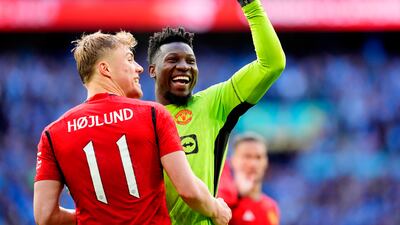
Manchester United's Rasmus Hojlund celebrates after scoring the winning shoot-out penalty in the FA Cup semi-final against Coventry City at Wembley stadium on April 21, 2024. AP
Manchester United players celebrate winning 4-2 on penalties after the FA Cup semi-final finished 3-3 after extra-time. EPA
United goalkeeper Andre Onana celebrates with Rasmus Hojlund after the match. AP
Manchester United's Rasmus Hojlund scores the winning penalty. AP
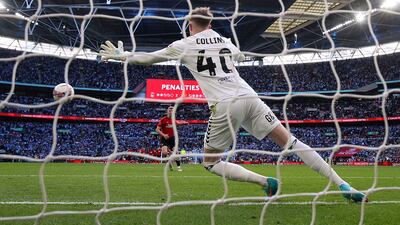
Coventry goalkeeper Bradley Collins saves the first penalty in the shoot-out by Manchester United's Casemiro. AFP
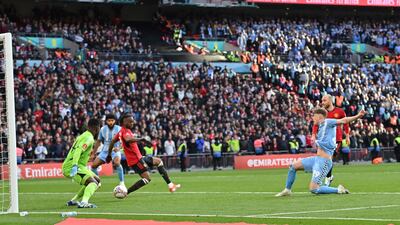
Victor Torp scores for Coventry in the last seconds of extra-time only for the goal to be ruled out by VAR. AFP
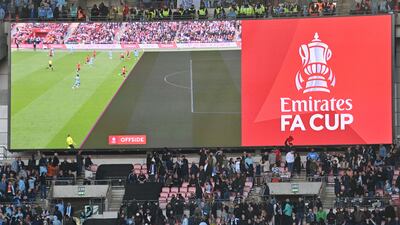
A big screen at Wembley shows the offside call by VAR in the build-up to a goal from Coventry's Victor Torp. AFP
Haji Wright scores from the spot for Coventry City to make it 3-3. Getty Images
Haji Wright celebrates scoring his Coventry's third goal from the penalty spot. Getty Images
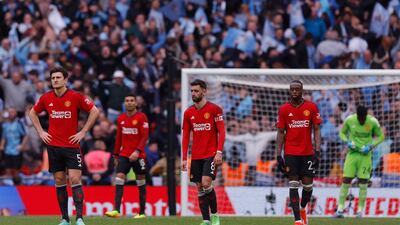
Dejected United players after Coventry's third goal. Reuters
Coventry's Haji Wright, left, celebrates after scoring from the spot. PA
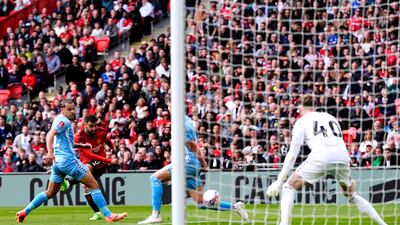
Callum O'Hare's shot deflects off United defender Aaron Wan-Bissaka, left, and into the net for Coventry's second goal. AFP
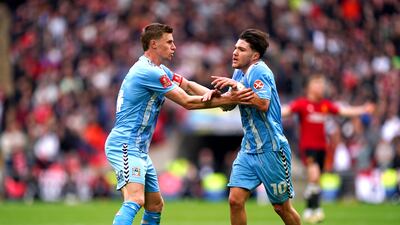
Callum O'Hare, right, celebrates with teammate Ben Sheaf after scoring Coventry's second goal. PA
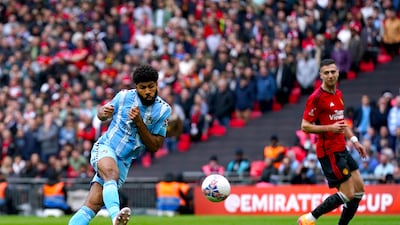
Ellis Simms scores Coventry's first goal. PA
Bruno Fernandes scores Manchester United's third goal. Getty Images
Bruno Fernandes celebrates after scoring Manchester United's third goal. PA
Harry Maguire celebrates scoring Manchester United's second goal. PA
Harry Maguire scores for Manchester United. Getty Images
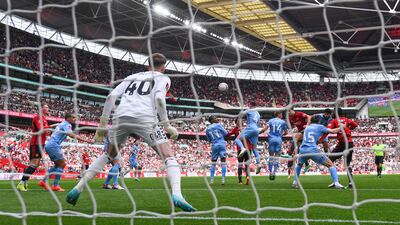
Harry Maguire heads home to put United 2-0 up.
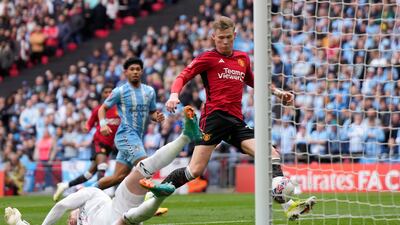
United's Scott McTominay celebrates after scoring. PA
Manchester United's Scott McTominay scores the opening goal. AP
Manchester United co-owners Avram Glazer and Jim Ratcliffe in the stands at Wembley Stadium. Getty Images
Bruno Fernandes scores Manchester United's third goal. PA
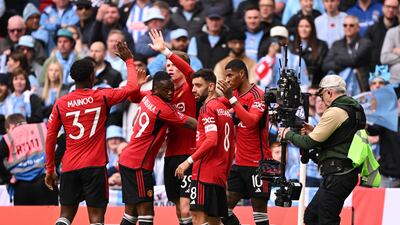
Scott McTominay celebrates with teammates after scoring for Manchester United. Getty Images
But one problem threatened to derail everything.
“I couldn’t get a visa for the UK. Visas were OK until I got to the Schengen area [an area encompassing 29 European countries that have officially abolished border controls at their mutual borders]." His original plan of reaching Manchester in December or January was thus put on hold until he could clear a visa. Finally, the Mongolian Government supported his application and he could reach England.
“It’s wonderful,” he said as he stood on the steps of Wembley Way ahead of seeing United for the first time. And then he watched the game.
“It was incredibly stressful for me because I was hoping to see United win in my first match. When we conceded the goal in the last minute, I thought it was over. But fortunately it was offside. Finally we won on penalties. The game encapsulated all the emotions of football. It was an amazing experience for me.”
Batbold will spend the next three days cycling from London to Manchester via Leicester and Derby. He intends to reach Old Trafford in time for the Premier League game against Burnley on Sunday. There’s only one issue. He doesn’t yet have a ticket for the game.

Play-off fixtures
Two-legged ties to be played November 9-11 and November 12-14
Northern Ireland v Switzerland
Croatia v Greece
Denmark v Ireland
Sweden v Italy
The smuggler
Eldarir had arrived at JFK in January 2020 with three suitcases, containing goods he valued at $300, when he was directed to a search area. Officers found 41 gold artefacts among the bags, including amulets from a funerary set which prepared the deceased for the afterlife. Also found was a cartouche of a Ptolemaic king on a relief that was originally part of a royal building or temple. The largest single group of items found in Eldarir’s cases were 400 shabtis, or figurines.
Khouli conviction
Khouli smuggled items into the US by making false declarations to customs about the country of origin and value of the items. According to Immigration and Customs Enforcement, he provided “false provenances which stated that [two] Egyptian antiquities were part of a collection assembled by Khouli's father in Israel in the 1960s” when in fact “Khouli acquired the Egyptian antiquities from other dealers”. He was sentenced to one year of probation, six months of home confinement and 200 hours of community service in 2012 after admitting buying and smuggling Egyptian antiquities, including coffins, funerary boats and limestone figures.
For sale
A number of other items said to come from the collection of Ezeldeen Taha Eldarir are currently or recently for sale. Their provenance is described in near identical terms as the British Museum shabti: bought from Salahaddin Sirmali, "authenticated and appraised" by Hossen Rashed, then imported to the US in 1948.
- An Egyptian Mummy mask dating from 700BC-30BC, is on offer for £11,807 ($15,275) online by a seller in Mexico
- A coffin lid dating back to 664BC-332BC was offered for sale by a Colorado-based art dealer, with a starting price of $65,000
- A shabti that was on sale through a Chicago-based coin dealer, dating from 1567BC-1085BC, is up for $1,950
A worker is categorised as skilled by the MOHRE based on nine levels given in the International Standard Classification of Occupations (ISCO) issued by the International Labour Organisation.
A skilled worker would be someone at a professional level (levels 1 – 5) which includes managers, professionals, technicians and associate professionals, clerical support workers, and service and sales workers.
The worker must also have an attested educational certificate higher than secondary or an equivalent certification, and earn a monthly salary of at least Dh4,000.
Milestones on the road to union
1970
October 26: Bahrain withdraws from a proposal to create a federation of nine with the seven Trucial States and Qatar.
December: Ahmed Al Suwaidi visits New York to discuss potential UN membership.
1971
March 1: Alex Douglas Hume, Conservative foreign secretary confirms that Britain will leave the Gulf and “strongly supports” the creation of a Union of Arab Emirates.
July 12: Historic meeting at which Sheikh Zayed and Sheikh Rashid make a binding agreement to create what will become the UAE.
July 18: It is announced that the UAE will be formed from six emirates, with a proposed constitution signed. RAK is not yet part of the agreement.
August 6: The fifth anniversary of Sheikh Zayed becoming Ruler of Abu Dhabi, with official celebrations deferred until later in the year.
August 15: Bahrain becomes independent.
September 3: Qatar becomes independent.
November 23-25: Meeting with Sheikh Zayed and Sheikh Rashid and senior British officials to fix December 2 as date of creation of the UAE.
November 29: At 5.30pm Iranian forces seize the Greater and Lesser Tunbs by force.
November 30: Despite a power sharing agreement, Tehran takes full control of Abu Musa.
November 31: UK officials visit all six participating Emirates to formally end the Trucial States treaties
December 2: 11am, Dubai. New Supreme Council formally elects Sheikh Zayed as President. Treaty of Friendship signed with the UK. 11.30am. Flag raising ceremony at Union House and Al Manhal Palace in Abu Dhabi witnessed by Sheikh Khalifa, then Crown Prince of Abu Dhabi.
December 6: Arab League formally admits the UAE. The first British Ambassador presents his credentials to Sheikh Zayed.
December 9: UAE joins the United Nations.
Moon Music
Artist: Coldplay
Label: Parlophone/Atlantic
Number of tracks: 10
Rating: 3/5
RUGBY CHAMPIONSHIP FIXTURES
September 30
South Africa v Australia
Argentina v New Zealand
October 7
South Africa v New Zealand
Argentina v Australia
F1 The Movie
Starring: Brad Pitt, Damson Idris, Kerry Condon, Javier Bardem
Checking: the obsession or thoughts focus on some harm coming from things not being as they should, which usually centre around the theme of safety. For example, the obsession is “the building will burn down”, therefore the compulsion is checking that the oven is switched off.
Contamination: the obsession is focused on the presence of germs, dirt or harmful bacteria and how this will impact the person and/or their loved ones. For example, the obsession is “the floor is dirty; me and my family will get sick and die”, the compulsion is repetitive cleaning.
Orderliness: the obsession is a fear of sitting with uncomfortable feelings, or to prevent harm coming to oneself or others. Objectively there appears to be no logical link between the obsession and compulsion. For example,” I won’t feel right if the jars aren’t lined up” or “harm will come to my family if I don’t line up all the jars”, so the compulsion is therefore lining up the jars.
Intrusive thoughts: the intrusive thought is usually highly distressing and repetitive. Common examples may include thoughts of perpetrating violence towards others, harming others, or questions over one’s character or deeds, usually in conflict with the person’s true values. An example would be: “I think I might hurt my family”, which in turn leads to the compulsion of avoiding social gatherings.
Hoarding: the intrusive thought is the overvaluing of objects or possessions, while the compulsion is stashing or hoarding these items and refusing to let them go. For example, “this newspaper may come in useful one day”, therefore, the compulsion is hoarding newspapers instead of discarding them the next day.
Source: Dr Robert Chandler, clinical psychologist at Lighthouse Arabia
Results
5.30pm: Maiden (TB) Dh82,500 (Dirt) 1,600m, Winner: Panadol, Mickael Barzalona (jockey), Salem bin Ghadayer (trainer)
6.05pm: Maiden (TB) Dh82,500 (Turf) 1,400m, Winner: Mayehaab, Adrie de Vries, Fawzi Nass
6.40pm: Handicap (TB) Dh85,000 (D) 1,600m, Winner: Monoski, Mickael Barzalona, Salem bin Ghadayer
Micro-retirement is not a recognised concept or employment status under Federal Decree Law No. 33 of 2021 on the Regulation of Labour Relations (as amended) (UAE Labour Law). As such, it reflects a voluntary work-life balance practice, rather than a recognised legal employment category, according to Dilini Loku, senior associate for law firm Gateley Middle East.
“Some companies may offer formal sabbatical policies or career break programmes; however, beyond such arrangements, there is no automatic right or statutory entitlement to extended breaks,” she explains.
“Any leave taken beyond statutory entitlements, such as annual leave, is typically regarded as unpaid leave in accordance with Article 33 of the UAE Labour Law. While employees may legally take unpaid leave, such requests are subject to the employer’s discretion and require approval.”
If an employee resigns to pursue micro-retirement, the employment contract is terminated, and the employer is under no legal obligation to rehire the employee in the future unless specific contractual agreements are in place (such as return-to-work arrangements), which are generally uncommon, Ms Loku adds.
Living in...
This article is part of a guide on where to live in the UAE. Our reporters will profile some of the country’s most desirable districts, provide an estimate of rental prices and introduce you to some of the residents who call each area home.
Who is Mohammed Al Halbousi?
The new speaker of Iraq’s parliament Mohammed Al Halbousi is the youngest person ever to serve in the role.
The 37-year-old was born in Al Garmah in Anbar and studied civil engineering in Baghdad before going into business. His development company Al Hadeed undertook reconstruction contracts rebuilding parts of Fallujah’s infrastructure.
He entered parliament in 2014 and served as a member of the human rights and finance committees until 2017. In August last year he was appointed governor of Anbar, a role in which he has struggled to secure funding to provide services in the war-damaged province and to secure the withdrawal of Shia militias. He relinquished the post when he was sworn in as a member of parliament on September 3.
He is a member of the Al Hal Sunni-based political party and the Sunni-led Coalition of Iraqi Forces, which is Iraq’s largest Sunni alliance with 37 seats from the May 12 election.
He maintains good relations with former Prime Minister Nouri Al Maliki’s State of Law Coaliton, Hadi Al Amiri’s Badr Organisation and Iranian officials.
The biog
DOB: March 13, 1987 Place of birth: Jeddah, Saudi Arabia but lived in Virginia in the US and raised in Lebanon School: ACS in Lebanon University: BSA in Graphic Design at the American University of Beirut
MSA in Design Entrepreneurship at the School of Visual Arts in New York City Nationality: Lebanese Status: Single Favourite thing to do: I really enjoy cycling, I was a participant in Cycling for Gaza for the second time this year
COMPANY PROFILE
Name: Mamo
Year it started: 2019 Founders: Imad Gharazeddine, Asim Janjua
Based: Dubai, UAE
Number of employees: 28
Sector: Financial services
Investment: $9.5m
Funding stage: Pre-Series A Investors: Global Ventures, GFC, 4DX Ventures, AlRajhi Partners, Olive Tree Capital, and prominent Silicon Valley investors.
Mercer, the investment consulting arm of US services company Marsh & McLennan, expects its wealth division to at least double its assets under management (AUM) in the Middle East as wealth in the region continues to grow despite economic headwinds, a company official said.
Mercer Wealth, which globally has $160 billion in AUM, plans to boost its AUM in the region to $2-$3bn in the next 2-3 years from the present $1bn, said Yasir AbuShaban, a Dubai-based principal with Mercer Wealth.
“Within the next two to three years, we are looking at reaching $2 to $3 billion as a conservative estimate and we do see an opportunity to do so,” said Mr AbuShaban.
Mercer does not directly make investments, but allocates clients’ money they have discretion to, to professional asset managers. They also provide advice to clients.
“We have buying power. We can negotiate on their (client’s) behalf with asset managers to provide them lower fees than they otherwise would have to get on their own,” he added.
Mercer Wealth’s clients include sovereign wealth funds, family offices, and insurance companies among others.
From its office in Dubai, Mercer also looks after Africa, India and Turkey, where they also see opportunity for growth.
Wealth creation in Middle East and Africa (MEA) grew 8.5 per cent to $8.1 trillion last year from $7.5tn in 2015, higher than last year’s global average of 6 per cent and the second-highest growth in a region after Asia-Pacific which grew 9.9 per cent, according to consultancy Boston Consulting Group (BCG). In the region, where wealth grew just 1.9 per cent in 2015 compared with 2014, a pickup in oil prices has helped in wealth generation.
BCG is forecasting MEA wealth will rise to $12tn by 2021, growing at an annual average of 8 per cent.
Drivers of wealth generation in the region will be split evenly between new wealth creation and growth of performance of existing assets, according to BCG.
Another general trend in the region is clients’ looking for a comprehensive approach to investing, according to Mr AbuShaban.
“Institutional investors or some of the families are seeing a slowdown in the available capital they have to invest and in that sense they are looking at optimizing the way they manage their portfolios and making sure they are not investing haphazardly and different parts of their investment are working together,” said Mr AbuShaban.
Some clients also have a higher appetite for risk, given the low interest-rate environment that does not provide enough yield for some institutional investors. These clients are keen to invest in illiquid assets, such as private equity and infrastructure.
“What we have seen is a desire for higher returns in what has been a low-return environment specifically in various fixed income or bonds,” he said.
“In this environment, we have seen a de facto increase in the risk that clients are taking in things like illiquid investments, private equity investments, infrastructure and private debt, those kind of investments were higher illiquidity results in incrementally higher returns.”
The Abu Dhabi Investment Authority, one of the largest sovereign wealth funds, said in its 2016 report that has gradually increased its exposure in direct private equity and private credit transactions, mainly in Asian markets and especially in China and India. The authority’s private equity department focused on structured equities owing to “their defensive characteristics.”