

Tuesday night's shock defeat to second-tier Middlesbrough in the League Cup semi-finals first leg encapsulated everything about Chelsea since the start of last season, both the good and the bad – mainly the bad.
Let's start with the good (it won't take long): Chelsea once again dominated possession, controlling 72 per cent of the ball, and created a fair few chances, taking 18 shots with five on target.
Now for the bad: Chelsea couldn't score, nor avoid defeat.
The 1-0 loss at Riverside Stadium, courtesy of Hayden Hackney's 37th-minute goal, was Chelsea's 31st defeat dating back to the beginning of the 2022/23 campaign. Of clubs currently in the Premier League, only Bournemouth and Nottingham Forest (32) have lost more matches in that time.
Yet, no top-flight club can match Chelsea's abysmal record of 21 away defeats in that same time period.
Questionable game management and defensive issues have played their part in the Blues' ongoing misery, but the biggest contributing factor continues to be their struggles in front of goal.
A recent overall upturn in league form means Chelsea now have the seventh-best scoring record in the division – a significant improvement on last season, when only four clubs scored fewer goals – but of their eight defeats in the Premier League this campaign, seven could arguably have had different outcomes were the Blues more clinical.
As a consequence, Chelsea languish 10th in the table, and unless Mauricio Pochettino finds a way to solve his team's profligacy then another year without European football surely beckons.
So, how does the Blues manager go about fixing this particular, and glaring, problem? These are the options available to the Argentine.
Time and patience
The very virtues Pochettino has been preaching ever since he was appointed manager last summer.
Chelsea have experienced an unprecedented overhaul in the past 18 months, with 23 senior squad players arriving and 19 leaving on permanent deals in just three transfer windows. Such extreme turnover was only ever going to result in disjointed and inconsistent performances and time is needed for it to all come together as a cohesive unit.
Pochettino's task of gelling the squad has been further complicated by the absence of so many players through injury during his first half-season in charge. At present, eight first-team players are sidelined, led by captain and star player Reece James, while at one stage that number was as high as 14.
Patience is also required when taking a longer-term view of the Chelsea squad. Owners Todd Boehly and Clearlake Capital have focused their transfer strategy on signing some of the most exciting young talents in world football, but that has come at the expense of experience.
Only James, Thiago Silva, Raheem Sterling, the perennially injured Ben Chilwell, Robert Sanchez and arguably Conor Gallagher could be classed as experienced Premier League players, and that has cost Chelsea dearly this season.
While time and patience are needed at Stamford Bridge, in a cut-throat results business like elite football, they are not usually afforded.
-
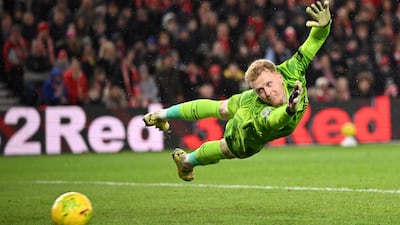
MIDDLESBROUGH RATINGS: Would have conceded in first half had Palmer not forgotten his shooting boots. Handed one chance on plate to Chelsea man after spilling easy shot - which he also did after break - but also produced good save to deny same player. AFP -
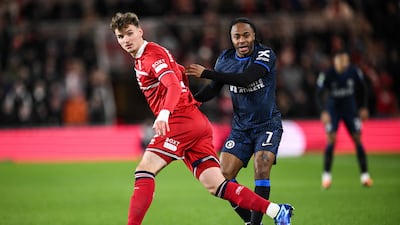
Dutch defender helped limit Sterling’s contribution to the bare minimum and was at the heart of a brave defensive effort that helped Boro seal a narrow advantage going into the second leg at Stamford Bridge. AFP -
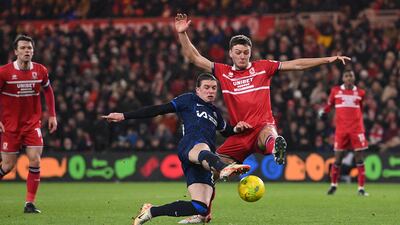
Like all of Boro’s defenders, had home fans' hearts in mouths at times with his determination to play out from the back, although that would change to a no-risk mentality towards end as Chelsea piled on pressure. Getty Images -

Danish defender started in central role but moved out to left due to Bangura’s injury. Up against a tricky customer in Madueke but the fact his oponent was taken off in second half tells whole story. PA -
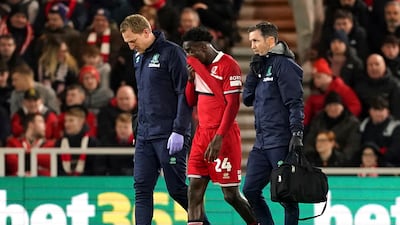
Left-back was second home player in first 20 minutes to come off injured. The Sierra Leonean appeared to damage his hamstring under pressure from Madueke to leave the home side cursing their luck. PA -

Brilliant first-time ball over top to Jones down the right flank started move that led to opening goal. Should have done better with strike from edge of area that he sent high over bar in second half. Getty Images -
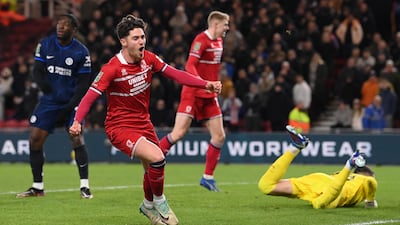
Pulled shot from outside penalty area wide of goal but then produced nice side-footed first-time finish to put his team in front after 37 minutes. Vital tracking back to deny Chelsea substitute Gilchrist free head at goal late on. Getty Images -
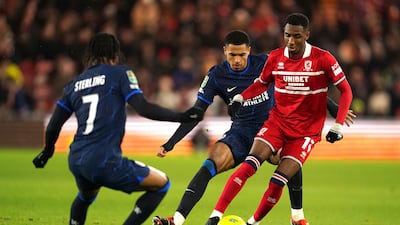
Bundled his way past Colwell down right-hand side of penalty area before providing perfect pass to Hackney who put side 1-0 up. Was always a handful whenever Boro launched a counter-attack. Booked for time-wasting. AP -
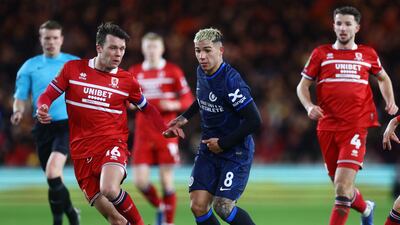
Long-serving midfielder and captain guilty of dreadful pass that handed chance on plate to Palmer and would have been relieved to see Chelsea attacker to miss easy chance. Some vital challenges in backs-to-the-wall final 20 minutes. Reuters -

Key player for Boro this season, with five goals and six assists, and might have added to his tally in second half if Coburn had threaded a ball through to him instead of attempting to get through on goal on his own. PA -

Boro’s top-scorer was gifted chance in opening minute courtesy of Colwill error but failed to connect with shot – and picked up injury from covering Disasi tackle. Tried to play on but soon limped. Getty Images -
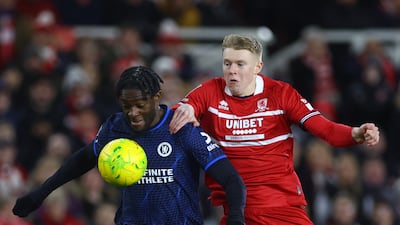
SUBS: (On for Latte Lath 4’) Early introduction for 21-year-old forward who had half a chance to make it 2-0 in first half but could not get show away under pressure from Gusto. Wasted another opportunity when he chose to go alone rather than pass to teammate. Reuters -
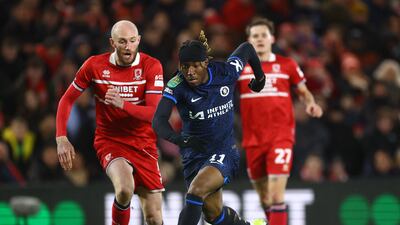
(On for Bangura 19’) Another forced substitution due to injury and centre-back was quickly put under pressure by pace of Mandueke and Palmer. A man mountain at back in second half, though. Reuters -
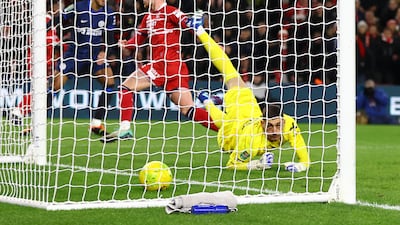
CHELSEA RATINGS: Very quiet evening for Serbian goalkeeper who only had to face two shots on target, one of which was the goal. Reuters -

Had to make recovery tackle on Coburn after his own dreadful pass almost allowed Boro in for second goal in two first-half minutes. Always looking to push forward but crossing and passing often wayward. PA -
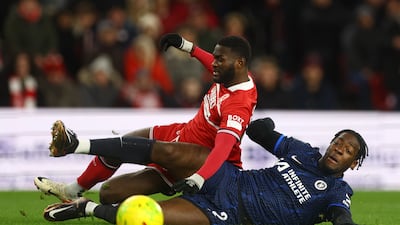
On another day, and with VAR in action, could have given away first-minute penalty for crunching tackle on Latte Lath that ended the Boro’s man’s match. Ludicrous shot for goal in 55th minute from 25 metres out flew high and wide. Reuters -
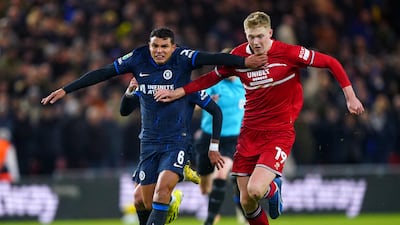
Veteran defender was comfortable up against a side whose attacking forays were limited to counter-attacks. One slip in second half almost let in Coburn but the Brazilian recovered to snuff out chance. Went over to try and calm furious Chelsea fans after final whistle. PA -
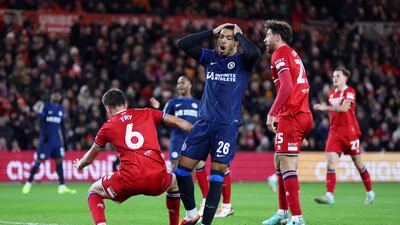
Disastrous first half from defender. Woeful back header in opening minute put Latte Lath through on goal, booked for pulling down Jones and then failed to stop run from same player ahead of opening goal. Better after break but is not natural left-back and needs to be playing in centre. Getty Images -
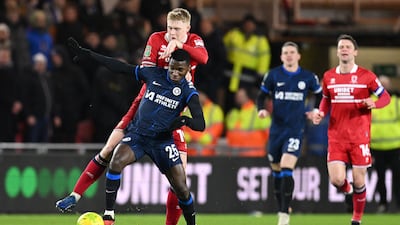
Fizzed low strike just wide of target in first-half injury-time after the £100m midfielder had done little right in the game. Failed to track back with Hackney ahead of midfielder’s first-half goal and is yet to show anything like the form that encouraged Chelsea to fork out such a huge fee. AFP -
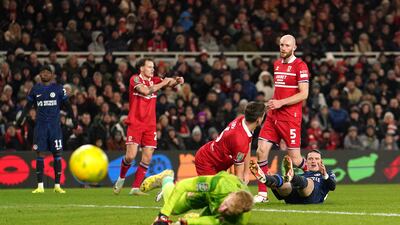
Helped Chelsea dominate possession but there was a distinct lack of passes in behind the home defence from the Blues captain that his team needed to unlock the home defence. England midfielder saw shot on turn fly a few metres wide of target on the hour. PA -

Handled in own box in opening 10 minutes but referee waived away Boro appeals. Saw shot straight at keeper spilled by Glover but Palmer failed to finish. Nowhere near enough impact from World Cup winner who cost Chelsea more than £100m and was hooked in second half. AFP -

Non-existent as attacking threat in opening 45 minutes with all big chances falling to teammate Palmer. Slight improvement after break but still a frustrating 90 minutes for former Manchester City man. Curled one effort wide of target with 15 minutes to go. Reuters -
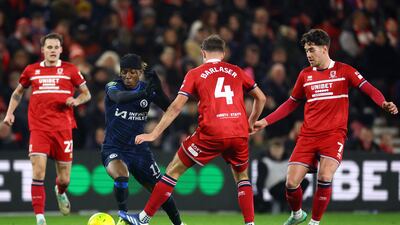
A few flashes of his pace and quick feet but showed lack of composure with final ball, whether that be shot or cross. Saw header just after half-time comfortably saved. Reuters -
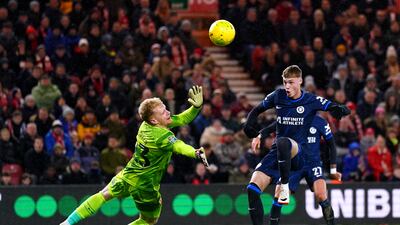
Leading attack due to injuries but should have had first-half hat-trick only to send one shot wide, another over the bar after Glover’s error and have his last effort saved by the keeper. Got himself into the right positions but finishing deserted him on night. PA -
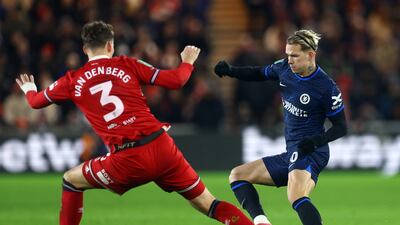
SUBS: (On for Fernandez 62’) Drilled shot straight at keeper after being teed-up on edge of box by Sterling. Reuters -

Chelsea's Armando Broja attempts a shot on goal, during the English League Cup semi final first leg soccer match between Middlesbrough and Chelsea, at the Riverside Stadium, in Middlesbrough, England, Tuesday, Jan. 9, 2024. (Martin Rickett / PA via AP) -

(On for Gusto 90’) PA


Sign a striker
It's symbolic of Chelsea's muddled approach to transfers that despite almost £1 billion spent on players in the past 18 months, the team is still in desperate need of a goalscorer, a focal point of their attack.
Wouldn't some of the £280 million invested in four central midfielders – Moises Caicedo, Enzo Fernandez, Romeo Lavia, and Lesley Ugochukwu – have been better spent on a striker?
The Blues did spend £30 million to sign Nicolas Jackson from Villarreal last summer, but the 22-year-old Senegalese is young and raw and needs much more time to adapt. He is also absent for the next few weeks on Africa Cup of Nations duty. His rival for the No 9 role, Armando Broja, has impressed Pochettino since his return from long-term injury but at the same age also lacks experience.
Should Chelsea turn to the transfer market this month, what are their options? Given the club's recent outlay, Financial Fair Play will have to be a consideration, so big-money arrivals will likely depend on outgoings.
Even if Chelsea were given carte blanche, options to solve their striker problem this month look limited. England international Ivan Toney, valued at more than £100m, has pledged to repay Brentford's support during his ban; Girona have insisted Artem Dovbyk, the Ukrainian who has fired their surprise La Liga title bid, is going nowhere this month; and Nigerian superstar Victor Osimhen recently signed a new contract with Napoli.
Pochettino has revealed Chelsea "are looking for opportunities" in the transfer market and that talks with the owners about new signings have been "really good". But is there a reliable goalscorer available now that can help solve their problems?

Bank on Nkunku
When Christopher Nkunku joined Chelsea last summer, it was hoped the France international would be the solution to their goalscoring woes. While still not a thoroughbred striker, Nkunku has thrived when deployed in the role and his record for RB Leipzig – 58 goals over two seasons – suggests he has no problem finding the net.
He impressed during pre-season when he assumed a key role in Chelsea's new-look attack alongside Sterling and Jackson, but a serious knee injury kept him out for six months. Since making his debut last month, Nkunku has shown promise, scoring off the bench against Wolves in his first league appearance and providing an extra cutting edge in the final third, even while clearly lacking match fitness.
However, the 26-year-old is injured again, this time a hip injury keeping him out of the FA Cup victory against Preston and the League Cup defeat to Middlesbrough. Pochettino is hopeful it's not serious, but it continues a concerning trend for Nkunku, who missed the 2022 World Cup with a knee injury.
When fit and firing, Nkunku has the ability as a scorer and creator to make a huge impact on this Chelsea team. Getting and keeping him fit, however, has proved the biggest challenge so far.

Trust the current squad
In addition to Nkunku, there is no shortage of attacking talent in the Chelsea squad.
Cole Palmer has been a revelation since joining from Manchester City with 15 goal involvements (eight scored, seven assisted). Sterling is, with the exception of last season, a proven reliable Premier League goalscorer. Mykhailo Mudryk may have his detractors but the Ukrainian has the skills, pace and potential to be a terrifying winger. Jackson has shown plenty of promise, even if he's been guilty of missing more than a few chances.
Noni Madueke, meanwhile, has shown his desire to take responsibility in big pressure moments, Broja has the ability to make a difference in the box, and even midfielders like Gallagher and Fernandez are more than capable of contributing goals.
Chelsea have not had any problems creating chances; they have created the fifth-most big chances in the Premier League this season (44). However, they are second in most big chances missed (40).
If options in the January transfer market are not forthcoming, then Pochettino will have no choice but to trust his current players. There is enough attacking quality in the squad to find greater consistency in front of goal, even if it requires time and patience.


