The rescheduled 2023 Asian Cup kicks off this week in Qatar. Three-time champions, Saudi Arabia begin their campaign on January 16 against Oman. Group F also contains Thailand and Kyrgyzstan.
Here we profile Roberto Mancini’s side as they look to snap almost three decades without the trophy.
History
Not making their tournament debut until the 1984 tournament in Singapore, Saudi Arabia announced their status as a major player on the continent by winning the title at the very first attempt. They successfully defended it four years later, then finished runner-up, winner, runner-up in the next three editions. In 10 appearances, Saudi Arabia have both a trio of wins and silver medals – although they last reached a final in 2007.
Best finish
Winner x 3: Saudi Arabia’s inaugural title was sealed when they defeated China 2-0 in the final at Singapore’s National Stadium thanks to goals from Shaye Al Nafisah and Majed Abdullah. Four years later, they needed penalties to get past South Korea in the showpiece in Doha – the match had finished 0-0 – while they prevailed via a shoot-out once more in 1996 to take the title against the UAE. Saudi Arabia triumphed 4-2 on spot-kicks at Sheikh Zayed Stadium in Abu Dhabi after playing out a goalless draw with the hosts.
Last time out - 2019 Asian Cup
Heading into the UAE-based tournament off the back of a notable victory against Egypt at the 2018 World Cup, the Saudis won two of their three opening matches to progress from Group E in second place. Qatar, who defeated them 2-0, won the pool. However, Juan Antonio Pizzi’s side were eliminated in the very next round, losing 1-0 to Japan in Sharjah.
All-time Asian Cup top scorer
Yasser Al Qahtani – 6 goals (12th on tournament’s all-time list).
Memorable moment
Majed Abdullah’s solo effort: Having got to the final in their debut appearance in 1984, Saudi Arabia’s second goal against China is considered one for the ages. With his team already 1-0 up, Abdullah picked up the ball just inside the opposition half, slipped past two defenders, feinted to deceive the goalkeeper and placed home – all on a pitch that resembled a quagmire. Saudi Arabia secured the trophy, and a period of Asian Cup prosperity began.
2023 group fixtures
January 16 – Saudi Arabia v Oman
January 21 – Saudi Arabia v Kyrgyzstan
January 25 – Saudi Arabia v Thailand
Manager
Roberto Mancini – Appointed in August after five years with his native Italy, the former Manchester City manager endured an indifferent start by losing his first four friendlies. Yet twin wins to open 2026 World Cup qualifying steadied the ship, while Saudi Arabia also defeat Lebanon last week in an Asian Cup warm-up match. Mancini, of course, guided City to their first Premier League title, in 2012, won three Serie A crowns with Inter Milan before that, and masterminded Italy’s 2020 European Championship glory.
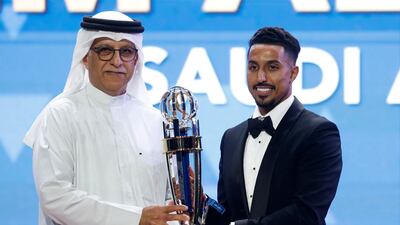
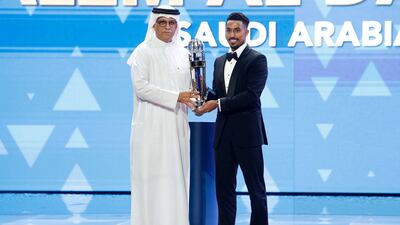
President of the Asian Football Confederation Sheikh Salman bin Ibrahim Al Khalifa presents Saudi Arabia's forward Salem Al Dawsari with the AFC Player of the Year award at the AFC Annual Awards Doha 2022 on October 31, 2023. AFP
Sheikh Salman bin Ibrahim Al Khalifa presents Salem Al Dawsari with the AFC Player of the Year award. AFP
President of the Asian Football Confederation Sheikh Salman bin Ibrahim Al Khalifa presents Salem Al Dawsari with the AFC Player of the Year award. AFP
Saudi Arabia's forward Salem Al Dawsari with the AFC Player of the Year award. AFP
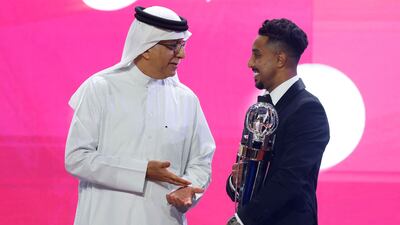
President of the Asian Football Confederation Sheikh Salman bin Ibrahim Al Khalifa with the AFC Player of the Year Salem Al Dawsari. AFP
Star man
Salem Al Dawsari – The Al Hilal forward, 32, has long built a reputation as one of the standout performers on the continent, and goes into the tournament as the reigning Asian Player of the Year. Much of Saudi Arabia’s attacking prowess relies on the hugely talented wideman, who mixes skill with a regular eye for the spectacular goal.
Others to watch
Saud Abdulhamid – The Al Hilal full-back has developed into one of the stars for both club and country, with his marauding runs along the right flank a potent weapon for his sides.
Mohammed Kanno – The Al Hilal midfielder is a dynamic presence at the heart of the team, with the ability to break up play and set the tempo. Can be a goal threat also.
Saleh Al Shehri – The Al Hilal striker has had a difficult season domestically with game time hard to come by following his club’s massive summer spend. But repaid Mancini’s faith in the November qualifiers with four goals.
Breakout star
Firas Al Buraikan – The emerging striker starred in last season’s Saudi Pro League, firing a career-best 17 goals for the unheralded Al Fateh. The haul earned a big-money move to Al Ahli in September, with Al Buraikan finding the net 11 times in 17 league matches this season. Not guaranteed to start for Mancini, but his winner in the January 4 friendly against Lebanon could see him push for a place in the first XI.
Talking point
Can Mancini deliver for Saudi Arabia’s expectant support and end their long wait for the trophy?
Five months is hardly enough time for any manager to have maximum impact on his team, but Saudi Arabia still go into the 24-team tournament among the favourites. Performances at the 2022 World Cup, albeit achieved with Herve Renard in charge, have raised expectations that the team can finally land the trophy – and thus snap a 27-year wait. Mancini, though, is still getting to know his team, while his decision to omit the likes of Salman Al Faraj, Yasser Al Shahrani and Abdulelah Al Amri surprised somewhat. The pressure to deliver a strong showing, and perhaps ultimately the title, is on.
Squad
Goalkeepers: Nawaf Al Aqidi, Raghed Najjar, and Ahmed Al Kassar
Defenders: Hassan Kadish, Aoun Al Saluli, Ali Al-Bulaihi, Ali Lagami, Hassan Al-Tambakti, Saud Abdul Hamid, Fawaz Al Saqour, and Abdullah Al Khaybari
Midfielders: AbdulIlah Al Maliki, Mukhtar Ali, Faisal Al Ghamdi, Eid Al Mawlid, Salem Al Dawsari, Abbas Al Hassan, Nasser Al Dosari, Muhammad Kanno, and Sami Al Naji
Forwards: Fahd Al Mawlid, Ayman Yahya, Abdul Rahman Gharib, Firas Al Braikan, Abdullah Radif, Saleh Al Shehri

Meatless Days
Sara Suleri, with an introduction by Kamila Shamsie
Penguin
THE BIO
Age: 30
Favourite book: The Power of Habit
Favourite quote: "The world is full of good people, if you cannot find one, be one"
Favourite exercise: The snatch
Favourite colour: Blue
It Was Just an Accident
Director: Jafar Panahi
Stars: Vahid Mobasseri, Mariam Afshari, Ebrahim Azizi, Hadis Pakbaten, Majid Panahi, Mohamad Ali Elyasmehr
Sunday, February 3, 2019 - Rome to Abu Dhabi
1pm: departure by plane from Rome / Fiumicino to Abu Dhabi
10pm: arrival at Abu Dhabi Presidential Airport
Monday, February 4
12pm: welcome ceremony at the main entrance of the Presidential Palace
12.20pm: visit Abu Dhabi Crown Prince at Presidential Palace
5pm: private meeting with Muslim Council of Elders at Sheikh Zayed Grand Mosque
6.10pm: Inter-religious in the Founder's Memorial
Tuesday, February 5 - Abu Dhabi to Rome
9.15am: private visit to undisclosed cathedral
10.30am: public mass at Zayed Sports City – with a homily by Pope Francis
12.40pm: farewell at Abu Dhabi Presidential Airport
1pm: departure by plane to Rome
5pm: arrival at the Rome / Ciampino International Airport
A lesson in simple, seasonal eating. Wedges of tomato, chunks of cucumber, thinly sliced red onion, coriander or parsley leaves, and perhaps some fresh dill are drizzled with a crushed walnut and garlic dressing. Do consider yourself warned: if you eat this salad in Georgia during the summer months, the tomatoes will be so ripe and flavourful that every tomato you eat from that day forth will taste lacklustre in comparison.
Badrijani nigvzit
A delicious vegetarian snack or starter. It consists of thinly sliced, fried then cooled aubergine smothered with a thick and creamy walnut sauce and folded or rolled. Take note, even though it seems like you should be able to pick these morsels up with your hands, they’re not as durable as they look. A knife and fork is the way to go.
Pkhali
This healthy little dish (a nice antidote to the khachapuri) is usually made with steamed then chopped cabbage, spinach, beetroot or green beans, combined with walnuts, garlic and herbs to make a vegetable pâté or paste. The mix is then often formed into rounds, chilled in the fridge and topped with pomegranate seeds before being served.
Mercer, the investment consulting arm of US services company Marsh & McLennan, expects its wealth division to at least double its assets under management (AUM) in the Middle East as wealth in the region continues to grow despite economic headwinds, a company official said.
Mercer Wealth, which globally has $160 billion in AUM, plans to boost its AUM in the region to $2-$3bn in the next 2-3 years from the present $1bn, said Yasir AbuShaban, a Dubai-based principal with Mercer Wealth.
“Within the next two to three years, we are looking at reaching $2 to $3 billion as a conservative estimate and we do see an opportunity to do so,” said Mr AbuShaban.
Mercer does not directly make investments, but allocates clients’ money they have discretion to, to professional asset managers. They also provide advice to clients.
“We have buying power. We can negotiate on their (client’s) behalf with asset managers to provide them lower fees than they otherwise would have to get on their own,” he added.
Mercer Wealth’s clients include sovereign wealth funds, family offices, and insurance companies among others.
From its office in Dubai, Mercer also looks after Africa, India and Turkey, where they also see opportunity for growth.
Wealth creation in Middle East and Africa (MEA) grew 8.5 per cent to $8.1 trillion last year from $7.5tn in 2015, higher than last year’s global average of 6 per cent and the second-highest growth in a region after Asia-Pacific which grew 9.9 per cent, according to consultancy Boston Consulting Group (BCG). In the region, where wealth grew just 1.9 per cent in 2015 compared with 2014, a pickup in oil prices has helped in wealth generation.
BCG is forecasting MEA wealth will rise to $12tn by 2021, growing at an annual average of 8 per cent.
Drivers of wealth generation in the region will be split evenly between new wealth creation and growth of performance of existing assets, according to BCG.
Another general trend in the region is clients’ looking for a comprehensive approach to investing, according to Mr AbuShaban.
“Institutional investors or some of the families are seeing a slowdown in the available capital they have to invest and in that sense they are looking at optimizing the way they manage their portfolios and making sure they are not investing haphazardly and different parts of their investment are working together,” said Mr AbuShaban.
Some clients also have a higher appetite for risk, given the low interest-rate environment that does not provide enough yield for some institutional investors. These clients are keen to invest in illiquid assets, such as private equity and infrastructure.
“What we have seen is a desire for higher returns in what has been a low-return environment specifically in various fixed income or bonds,” he said.
“In this environment, we have seen a de facto increase in the risk that clients are taking in things like illiquid investments, private equity investments, infrastructure and private debt, those kind of investments were higher illiquidity results in incrementally higher returns.”
The Abu Dhabi Investment Authority, one of the largest sovereign wealth funds, said in its 2016 report that has gradually increased its exposure in direct private equity and private credit transactions, mainly in Asian markets and especially in China and India. The authority’s private equity department focused on structured equities owing to “their defensive characteristics.”
Concrete wall and windows from the now demolished Robin Hood Gardens housing estate in Poplar
The 17th Century Agra Colonnade, from the bathhouse of the fort of Agra in India
A stagecloth for The Ballet Russes that is 10m high – the largest Picasso in the world
Frank Lloyd Wright’s 1930s Kaufmann Office
A full-scale Frankfurt Kitchen designed by Margarete Schütte-Lihotzky, which transformed kitchen design in the 20th century
Torrijos Palace dome
Three tips from La Perle's performers
1 The kind of water athletes drink is important. Gwilym Hooson, a 28-year-old British performer who is currently recovering from knee surgery, found that out when the company was still in Studio City, training for 12 hours a day. “The physio team was like: ‘Why is everyone getting cramps?’ And then they realised we had to add salt and sugar to the water,” he says.
2 A little chocolate is a good thing. “It’s emergency energy,” says Craig Paul Smith, La Perle’s head coach and former Cirque du Soleil performer, gesturing to an almost-empty open box of mini chocolate bars on his desk backstage.
3 Take chances, says Young, who has worked all over the world, including most recently at Dragone’s show in China. “Every time we go out of our comfort zone, we learn a lot about ourselves,” she says.
What vitamins do we know are beneficial for living in the UAE
Vitamin D: Highly relevant in the UAE due to limited sun exposure; supports bone health, immunity and mood. Vitamin B12: Important for nerve health and energy production, especially for vegetarians, vegans and individuals with absorption issues. Iron: Useful only when deficiency or anaemia is confirmed; helps reduce fatigue and support immunity. Omega-3 (EPA/DHA): Supports heart health and reduces inflammation, especially for those who consume little fish.
Red flags
Promises of high, fixed or 'guaranteed' returns.
Unregulated structured products or complex investments often used to bypass traditional safeguards.
Lack of clear information, vague language, no access to audited financials.
Overseas companies targeting investors in other jurisdictions - this can make legal recovery difficult.
Tonight's Chat is a series of online conversations on The National. The series features a diverse range of celebrities, politicians and business leaders from around the Arab world.
Tonight’s Chat host Ricardo Karam is a renowned author and broadcaster who has previously interviewed Bill Gates, Carlos Ghosn, Andre Agassi and the late Zaha Hadid, among others.
Intellectually curious and thought-provoking, Tonight’s Chat moves the conversation forward.