


All things going to plan, February might be a very special month indeed for Sofyan Amrabat and Hannibal Mejbri. The target: two finals in 14 days. The aim: gold medals at the end of them, one for country, one for club. On the second aspiration, the pair have a common focus.
On Tuesday at Old Trafford, Amrabat made his first start for Manchester United, and by the time he was substituted, a 3-0 victory over Crystal Palace to begin United’s defence of the English League Cup secured, he could hear sustained, heartfelt applause for a performance of resourcefulness and authority.
Hannibal, meanwhile, was making his first home start for United. He distinguished the landmark occasion with trademark energy.
The 20-year-old has been part of United’s set-up, rising through the youth ranks, long enough to be recognised and admired for his high work-rate.
He knows that being in the line-up at the start of this senior League Cup campaign gives him a chance of still being there when it ends. If United make the final, that’s at Wembley on February 25.
Two weeks earlier in Abidjan, Ivory Coast, there’s the final of the Africa Cup of Nations, and for Morocco’s Amrabat, a star of the last World Cup, pursued by United keenly since then and finally transferred from Serie A’s Fiorentina on loan at the tail-end of August, the intention is to be at the Alassane Ouattara Stadium that evening.
In his mind's eye, he'll be commanding midfield and extending Morocco’s momentum from Qatar 2022, when they became the first African or Mena team to reach a World Cup semi-final.
Morocco are ranked the best men’s national side in Africa by Fifa; Hannibal’s Tunisia are two spots behind. Both countries are on the rise, with ambitions to win next year’s Afcon, their managers attentive to the impact their key midfielders make in this, a career-threshold season at a club with global resonance and a huge worldwide following.
So far, so promising. Amrabat and Hannibal look like the catalysts for what United manager Erik ten Hag believes is a turning point for United, after a rickety start to the current campaign, with four defeats in the first six competitive games and issues, offstage, that have left some younger players, such as Jadon Sancho and Antony, distanced from the first team.
Enter Hannibal, young and fearless, to galvanise midfield. At home to Brighton 12 days ago, he came off the bench to score a fabulous long-range goal, a happy memento from an otherwise deflating afternoon, a 3-1 defeat. His elevation to the starting XI then coincided with successive wins at Burnley and against Palace.

Enter Amrabat, who made his United debut as a late substitute at Burnley and against Palace was asked to show sides to his game previously concealed to an expectant Old Trafford.
Short of fit left-backs, Ten Hag turned to Amrabat to cover the position. “I’m not a traditional left-back,” Amrabat, 27, gently reminded an English audience more acquainted with his mastery of central midfield during his excellent World Cup and similar contributions to Fiorentina’s run to last season’s Europa Conference League final.
But the United manager and the new signing know each other’s instincts and capabilities intimately. Ten Hag worked with Amrabat at Utrecht in the Netherlands when the Dutch-born Moroccan was in his early 20s.
Back then, he sometimes asked him to play at full-back, noting his comfort with either foot meant he could marshal the left flank as ably as the right, that his judicious tracking and timing of challenges would look after the defensive aspects of the role.
Man United player ratings against Palace
-
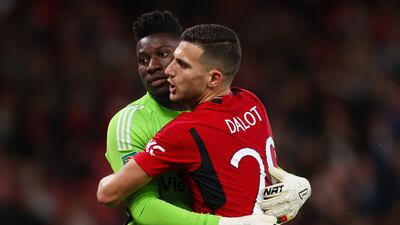
MANCHESTER UNITED RATINGS: Continued his run of playing every game and enjoyed his second consecutive clean sheet, which he needed after conceding threes and fours. Had little to do before a save with his left leg from Mateta on 67 and again from the same player with his chest on 84. Getty -

First start for United for the on-loan Moroccan, he played out of his usual position as a left back. Was cheered after a defensive block stopped an early Palace cross. Physically strong and regularly moved into midfield. Decent start. Getty -
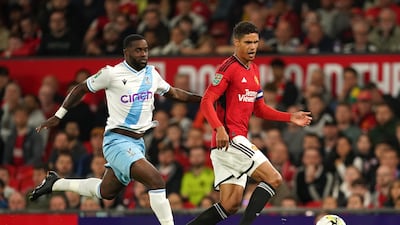
Captain and working his way back to full match fitness. By the time he went off after an hour, Palace hadn’t managed a single shot and only had two touches in the United area. PA -
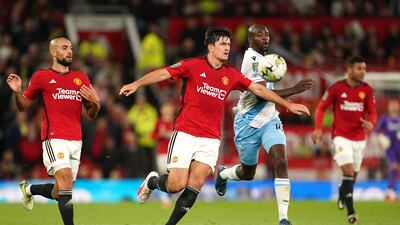
First start of the season for the former captain and he read danger from an early Palace attack well. Not his busiest game but defended well when called on. Intercepted and well positioned. Only Casemiro had more touches. PA -
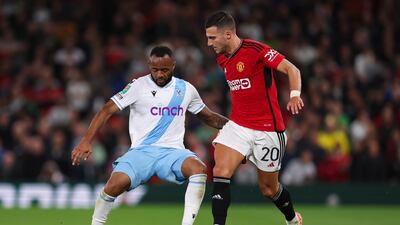
Brilliant setting up the first, pulling the ball back for Garnacho. Pushed inside to lend his support not just to midfield, but also attack. Full of energy and intent. Getty -
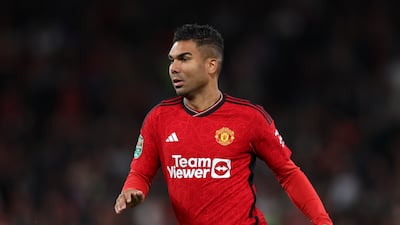
United’s top scorer made it 2-0 for the cup holders on 26, heading in a Mount corner. Played several line-splitting passes and set up United’s third for Martial. Pressed well, intercepted, passed well. Man of the match. Getty -

Industrious as he tried to push forward, but booked for a cynical challenge on 28. Had to be careful that he didn’t get another yellow. AP -

Back after injury and near early combination with Casemiro, who he then set up for the second from a corner. Creative. Off at half time. AP -
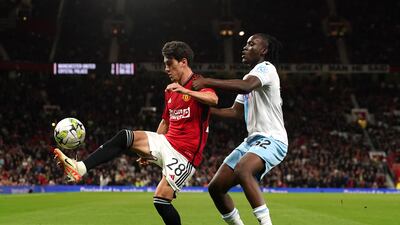
Injuries and absences meant another start and he was heavily involved. He’s getting the minutes he’d been starved off. Ran at players and showed his skill, without much end product. PA -

Fouled in a yellow card challenge in the first half, scored United’s third for his first goal of the season in the second, a super left foot finish from a Casemiro assist after cleverly staying onside then getting behind Clyne. Encouraging. Getty -

Back in the team in one of seven changes since the Burnley win and he put his side ahead after 21, steering a Dalot assist past Johnstone. Lively all night, with a well struck shot on target on 88. Getty -
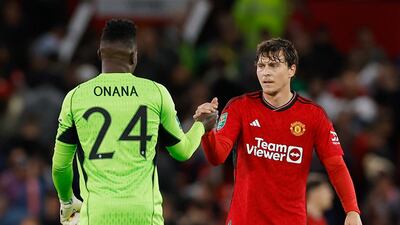
SUBS: Lindelof (Mount, HT). Attacked like Dalot did in the first half. Clean strike towards goal on 88. Reuters -
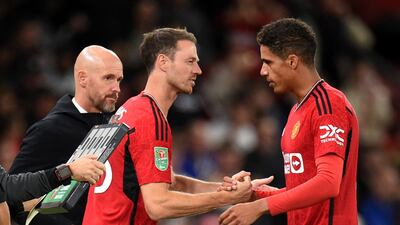
Evans (Varane, 60'). Found space to head on target after 70 as the Stretford End sang his name. Reuters -

Gore (Amrabat, 60'). Debut in United’s senior team. Straight into the centre of midfield for the young Mancunian. Applauded by his manager for winning the ball back. Getty -
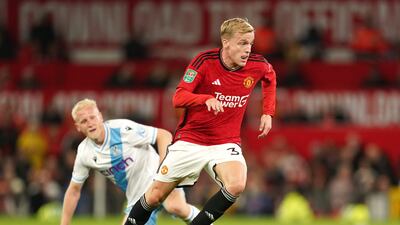
Van de Beek (Hannibal, 69'). First performance of the season and encouraged by Casemiro to play as far forward as possible. PA -

Hojlund (Martial, 74'). Bustled but not much impact. Getty


Some of the finest wide forwards in the game would testify to that. Up against Amrabat, Kylian Mbappe, playing for France, and Rafael Leao, playing for AC Milan against Fiorentina, have both in the last 12 months felt forcefully that Amrabat the tackler will always regard covering the full-back’s space as part of his main job, as midfield patroller.
His temporary return to left-back against Palace featured key interceptions and blocks, loudly cheered, and, in a confident Old Trafford debut, they dovetailed with precise long passing. As United took control of the cup tie, the new signing moved more and more into midfield.
“He brings quality, energy and dynamism,” beamed Ten Hag afterwards. “He’s a warrior, he will play where the team needs him.”
“If he needs me as goalkeeper I’ll play there,” joked Amrabat in a broadcast interview after a night he said he had been looking forward to for years, a fresh peak in a career that has climbed through the leagues of the Netherlands, Belgium and Italy. “United is a huge club, the pressure is high, but this is what we want. I’ve worked very hard for this.”

