

It is not quite 10 years since the Dubai International Stadium opened its doors to cricket fans. But it is close enough, and so the ground’s authorities will be celebrating a decade of existence when Pakistan host Australia for the fourth and fifth one-day internationals this Friday and Sunday.
And why not? These are, after all, the two teams that played when the 25,000-capacity arena that has been the most obvious success story of the Dubai Sports City project was officially inaugurated on April 22, 2009.
Some of the items on the original Sports City blueprint – most notably, the stalled multi-purpose stadium that so conspicuously marks the entrance on its Motor City side – are a cautionary reminder of a different time in ambition’s life-cycle.
The cricket ground, by marked contrast, has assembled an impressive body of work since 2009. Chiefly, its major achievements have come in the one discipline it was created for. The facility was, after all, initially called the Dubai International Cricket Stadium for a reason.
“Cricket” was quietly dropped from the name some years later, though, and its other attractions have been many and varied. There have been pop concerts. Football has been played there. Manny Pacquiao once had discussions about fighting Amir Khan there. And, in August 2015, Indian prime minister Narendra Modi drew perhaps its biggest crowd to date when he gave an address at the stadium.
Modi apart, nothing has been able to draw an audience with quite such regularity as cricket, though.
It is a cruel and unhappy coincidence that the Dubai stadium opened its doors so soon after the attacks on the Sri Lanka cricket team bus happened in Lahore – which meant Pakistan cricket has been in exile for most of the time since.
But, even before that, the UAE had long been a hub for Pakistan cricket, Sharjah its first real home away from home. After the bus attacks happened, Sharjah, Abu Dhabi and Dubai became its de facto home.
The Dubai new-build has been at the centre of cricket’s modernisation over the past decade. No ground, anywhere in the world, comes close to matching the 47 Twenty20 internationals it has staged.
_____________________________
Five classics from Dubai International Stadium
-
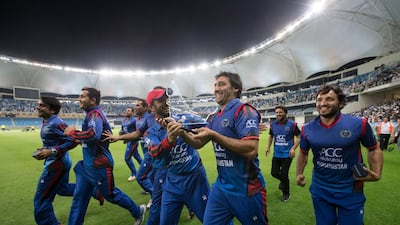
World T20 Qualifier final, February 2010: Afghanistan beat Ireland by eight wickets. It says much about how the sport has changed over the past decade that many of the most vivid memories of this stadium have been created by Afghanistan. Earlier on this day in 2010, Afghanistan (pictured above after winning the Desert T20 at the Dubai International Stadium in 2017) had beaten UAE to qualify for their first global event, the World T20 in the Caribbean. It was met with a pitch invasion, and an outpouring of joy on the outfield. The final, which they won at a canter, brought with it one of the most evocative scenes at any ground ever – that of thousands of new cricket fans scaling the second-tier fences to share in the moment and glimpse their heroes. Ruel Pableo / The National -
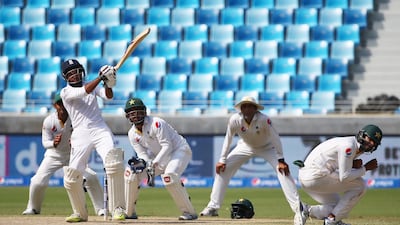
Second Test, October 2015: Pakistan beat England by 178 runs. The margin of victory sounds like a thrashing. And, of course, it was emphatic. But England came oh so near to saving the game. Between them, England’s Nos 8, 9, 10, and 11 batsmen faced 322 balls on the final day. Nearly 54 overs, battling against the wiles of Yasir Shah, and the pace of Wahab Riaz. Then, with four balls left to secure a hard-earned draw, Adil Rashid, who was closing in on four hours at the crease, chipped Yasir to extra cover, and Pakistan had the win. AFP -
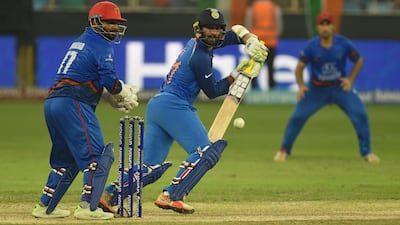
Asia Cup Super Four, September 2018: India tied with Afghanistan. India dominated the Asia Cup for all except one fixture – that against the most recent arrivals to cricket’s top table. Just eight years earlier, the Afghans had been feted for their rise to playing at a first ICC event on this same field. Now, they had a number of established stars. First, opener Mohammed Shahzad hit a blockbusting century, as the Afghans cobbled together 252. India could only match that total, thanks to some nerveless death bowling by Rashid Khan. It was the second tie Dubai had seen, and its first in ODIs. AFP -
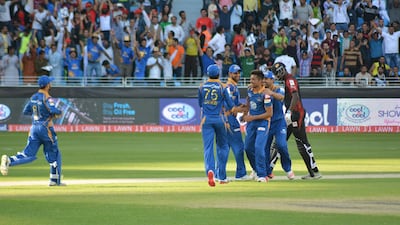
Pakistan Super League, February 2016: Karachi Kings beat Lahore Qalandars by seven wickets. There has been a mushrooming of T20 competitions all over the world since the turn of the decade, and Dubai has seen its fair share of events in that format. The World T20 Qualifier has been staged there, as have the Masters Champions League, IPL, PSL, and the Desert T20. On its first weekend in Dubai, the PSL’s popularity was sealed when Mohammed Amir - only recently returned from his lengthy ban for spot-fixing - picked up a hat-trick for Karachi Kings, as they beat Lahore Qalandars. Courtesy PCB -
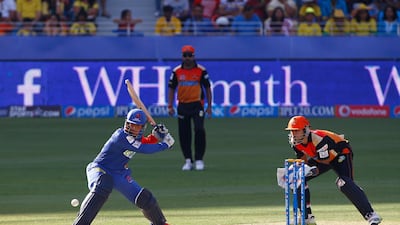
Indian Premier League, April 2014: Sunrisers Hyderabad beat Delhi Daredevils by four runs. Stardust has been liberally sprinkled on the green of the Dubai International Stadium over the years – but never so much as when the IPL came to town. The competition was exiled from India while the security forces back at home dealt with the government elections. In this specific fixture, David Warner, Shikhar Dhawan, Aaron Finch, Kevin Pietersen, Quinton de Kock, Dale Steyn, and Murali Vijay all played a role. No wonder the stands were full. The National


_____________________________
The Indian Premier League and Pakistan Super Leagues have drawn sell-out crowds there. And it has been the site of some of the landmark moments on Afghanistan’s rise to the top of international cricket.
It seems strange to recall, given the present-day celebrity of the likes of Rashid Khan, Mujeeb Ur Rahman and Mohammed Nabi that Afghanistan cricket was just some refugees with an aptitude for the sport back in 2009.
“It is a fantastic achievement of hosting 19 international teams with over 100 international matches in just a span of 10 years,” said Salman Hanif, Dubai Sports City’s senior manager of venues and events.
“It is a happy coincidence that we are hosting the same teams who played the inaugural match in April 2009.
“We'll be marking this anniversary on Friday with the toss for the Pakistan v Australia match with a special gold coin to commemorate a decade of Dubai International Stadium."
The man flipping that coin, Shoaib Malik, is one of two players in this series that remain from 2009. The other, Shaun Marsh, the Australia batsman, faced the first ball bowled in international cricket in Dubai, when Umar Gul sent down the first delivery of a match that Pakistan eventually won by four wickets.
“Playing in Dubai is like playing at home,” Malik said. “There are many memories, because mostly whenever we have played at the Dubai International Stadium we have won all those series. All those memories will be with me forever.”

