

Formulating a plan for how to cope in bio-secure bubbles will be an essential part of the preparation process for international cricketers for some time yet.
That is the view of Sam Billings and Carlos Brathwaite, who believe players need to find a way to be “emotionally consistent” in strange times for their profession.
Each has experience of living in the sealed off environments that have been necessary since the onset of the coronavirus pandemic.
Billings played for England’s one-day side during a UK summer where players stayed on site at grounds in Manchester and Southampton for safety reasons.
Brathwaite was on commentary duty in the UK, before playing in the one-site, Covid-secure Caribbean Premier League in Trinidad last month.
“It is so individual, and it is about self-awareness,” Billings said of coping inside the bubble.
“It is a very different environment, and you have to know what makes you tick.
“What makes me tick is going to be completely different to other players.
“The guys who were most emotionally consistent around cricket were the guys who had put things in place that got them away from the game.
“It sounds ridiculous as you are literally living on the ground, but it was about finding to ways to switch off, and then switch back on for cricket.”
The two players were speaking to promote the Abu Dhabi T10. The next season of the 10-over competition will start at the end of January.
It appears almost certain similar bio-security measures will need to be employed for that tournament.
As a 10-day event, it will be some way short of what the English players experienced during the summer.

“Some of the guys were in it for 11 weeks,” Billings said.
“Jos [Buttler], how he did that for that, and maintained his level of performance throughout, was a credit to what he built around himself, and the support network that he needed for that period of time.
“I will be in that environment again, so how can I get even better with my preparation?”
Brathwaite said the experience is challenging.
“I love being in my room, so there is not much difference there,” Brathwaite said.
“But knowing you have the outlet after you have had a tough game to go and do something out of the hotel – knowing that has now gone, it implored me to lean on my teammates more.
“In my experience in the bubble, I wasn’t playing for Barbados, my home territory, but I had a lot of friends in that team.
“After a tough day, whether win, lose or draw, perform or not, if your body is aching, sometimes you need your wife, or maybe someone on the ground like a childhood friend, to remind you of your good performances.”
________________
2019 Abu Dhabi T10 final
-

Maratha Arabians' Chadwick Walton, right, and Chris Lynn celebrate winning the Abu Dhabi T10 final against Deccan Gladiators at the Zayed Cricket Stadium in 2019. Chris Whiteoak / The National -

Maratha Arabians' Chadwick Walton hit an unbeaten fifty in the Abu Dhabi T10 final against Deccan Gladiators. Chris Whiteoak / The National -

Maratha Arabians captain Dwayne Bravo celebrates the win over Deccan Gladiators in the Abu Dhabi T10 final. Chris Whiteoak / The National -

More than 20,000 fans turned up at the Zayed Cricket Stadium to watch the Abu Dhabi T10 final between Deccan Gladiators and Maratha Arabians. Chris Whiteoak / The National -
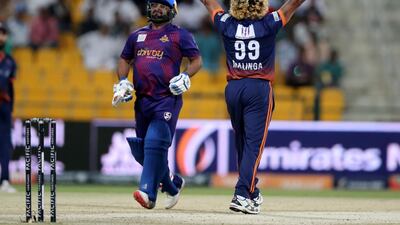
Maratha Arabians' Lasith Malinga after taking the wicket of Gladiators' Mohammad Shahzad at the Zayed Cricket Stadium. Chris Whiteoak / The National -
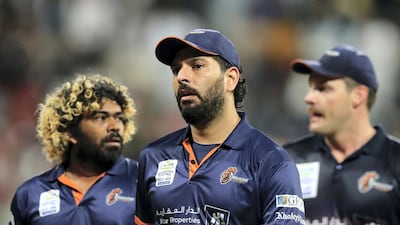
Arabians' Yuvraj Singh during the final against Deccan Gladiators in Abu Dhabi. Chris Whiteoak / The National -
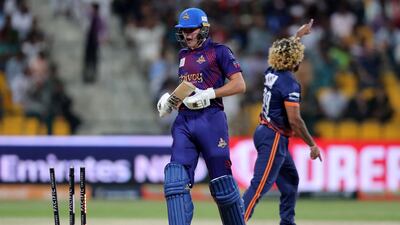
Maratha Arabians' Chadwick Walton runs out Deccan Gladiators' Migael Pretorius in the Abu Dhabi T10 final on Sunday. Chris Whiteoak / The National -
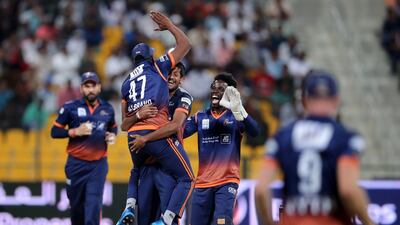
Maratha Arabians' Kasun Rajitha took the wicket of Deccan Gladiators' Kieron Pollard . Chris Whiteoak / The National -
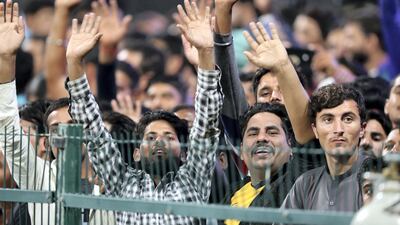
It was a packed house at the Zayed Cricket Stadium in Abu Dhabi on Sunday. Chris Whiteoak / The National -
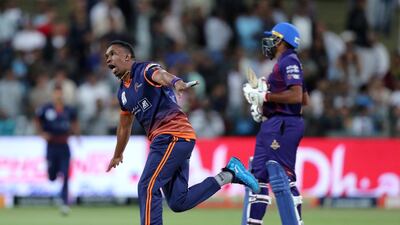
Maratha Arabians' Dwayne Bravo celebrates the wicket of Deccan Gladiators' Dan Lawrence in the Abu Dhabi T10 final. Chris Whiteoak / The National



