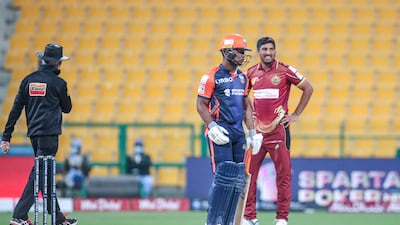
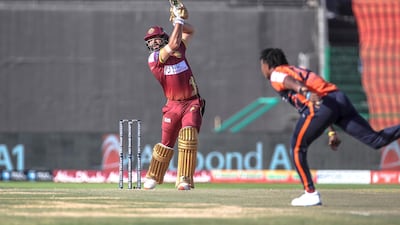
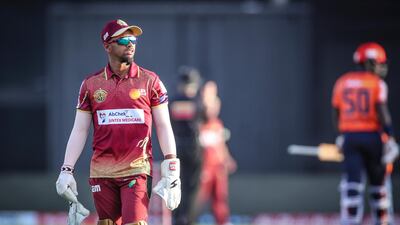
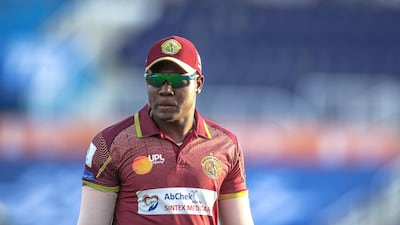
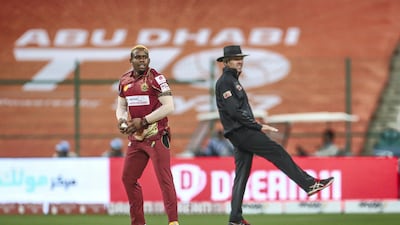
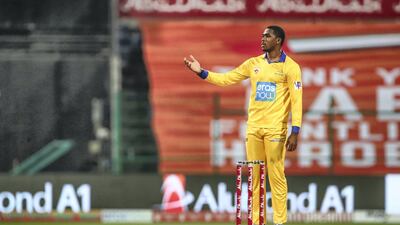
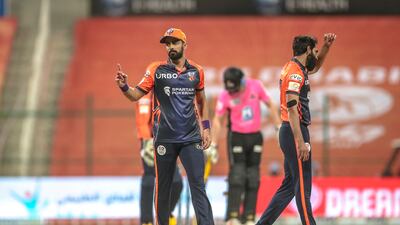
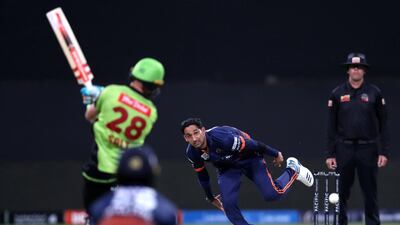
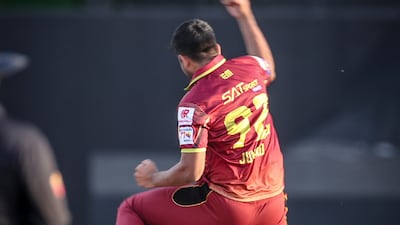
Team Abu Dhabi players wear special jerseys to mark UAE's 50th National Day last year. Photo: Abu Dhabi Cricket

Abu Dhabi T10 announces new franchise


  • English
  • Arabic

Abu Dhabi T10 have announced the addition of another franchise to the roster for the new season.

It was revealed on Wednesday that SAMP Army from the US will acquire a franchise in the T10 league. Named the ‘Morrisville SAMP Army’, the team from North Carolina becomes the eighth franchise in the tournament.

The owner of the Morrisville SAMP Army, Ritesh Patel, is an American-based entrepreneur. He owns several hotels, an indoor cricket and multi-sport complex as well as the SAMP Army Cricket franchise that participates in competitive tournaments across the US.

After joining the Abu Dhabi T10, Patel said: “It is an extremely exciting time for our franchise as the Abu Dhabi T10 is a unique and a highly competitive competition which brings together elite players from across the globe. It gives us the perfect opportunity to compete against the elites of cricket and test ourselves out."

South Africa's star batsman David Miller was announced as the marquee player for the new franchise.

The Abu Dhabi T10 begins on November 23 and will be a two-week long tournament.

It is going to be a bumper season of cricket in the UAE. The 2022 edition of the T10 tournament will take place at the Zayed Cricket Stadium and conclude on December 4.

After that, the UAE will witness the start of a brand new T20 franchise league, which will also attract some of the leading names from the world game.

That event, named the International League T20, will be played in January and February 2023.

2021 Abu Dhabi T10 team of the tournament

  • 1). Evin Lewis (Delhi Bulls) - 216 runs; 242.69 strike rate. Unfortunately for Delhi he only stayed for a good time and not a long time in the final. Hit his first ball for six, but did not stick around past the third over. He had been destructive at the top of the order. All photos Courtesy Abu Dhabi Cricket
    1). Evin Lewis (Delhi Bulls) - 216 runs; 242.69 strike rate. Unfortunately for Delhi he only stayed for a good time and not a long time in the final. Hit his first ball for six, but did not stick around past the third over. He had been destructive at the top of the order. All photos Courtesy Abu Dhabi Cricket
  • 2). Mohammed Wasim (Northern Warriors, UAE) - 212 runs; 225.53 strike rate. Not yet a UAE international, but it won’t be long now. By the end of his breakout tournament, the commentators were saying he and Pooran were the key men for the Northern Warriors. That is illustrious company. Courtesy Abu Dhabi Cricket
    2). Mohammed Wasim (Northern Warriors, UAE) - 212 runs; 225.53 strike rate. Not yet a UAE international, but it won’t be long now. By the end of his breakout tournament, the commentators were saying he and Pooran were the key men for the Northern Warriors. That is illustrious company. Courtesy Abu Dhabi Cricket
  • 3). Nicholas Pooran (Northern Warriors, wicketkeeper) - 241 runs; 243.43 strike rate. The pocket powerhouse has a fair claim to being regarded as the leading player in the short history of T10 cricket to date. His six hitting caught the eye, but he excelled as a leader, too.
    3). Nicholas Pooran (Northern Warriors, wicketkeeper) - 241 runs; 243.43 strike rate. The pocket powerhouse has a fair claim to being regarded as the leading player in the short history of T10 cricket to date. His six hitting caught the eye, but he excelled as a leader, too.
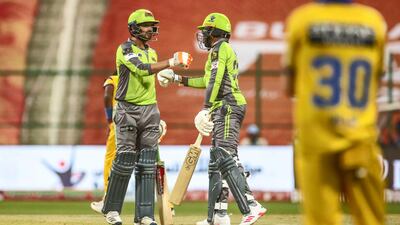
  • 4). Sohail Akhtar (Qalandars) - 248 runs; 187.7 strike rate. Continued his affinity with Abu Dhabi. It was there that he captained the Qalandars to their first silverware, in the AD T20 festival a few seasons back. The leading run-scorer.
    4). Sohail Akhtar (Qalandars) - 248 runs; 187.7 strike rate. Continued his affinity with Abu Dhabi. It was there that he captained the Qalandars to their first silverware, in the AD T20 festival a few seasons back. The leading run-scorer.
  • 5). Rovman Powell (Northern Warriors) - 192 runs; 240 strike rate. Given his frenzied pitch invasion when they beat Team Abu Dhabi on the last ball of the eliminator, this tournament obviously meant a lot to him. Apt that he hit the winning runs in the final.
    5). Rovman Powell (Northern Warriors) - 192 runs; 240 strike rate. Given his frenzied pitch invasion when they beat Team Abu Dhabi on the last ball of the eliminator, this tournament obviously meant a lot to him. Apt that he hit the winning runs in the final.
  • 6). Fabian Allen (Northern Warriors) - 11 wickets; 9.81 economy. It was no fun being a spinner in this tournament. Rohan Mustafa and Sultan Ahmed were thriftier, but Allen’s wickets were crucial in getting his side to the final.
    6). Fabian Allen (Northern Warriors) - 11 wickets; 9.81 economy. It was no fun being a spinner in this tournament. Rohan Mustafa and Sultan Ahmed were thriftier, but Allen’s wickets were crucial in getting his side to the final.
  • 7). Obed McCoy (Team Abu Dhabi) - 10 wickets; 8.17 economy. Other than the UAE players, McCoy was the find of the tournament. The young West Indian left-armer has a slower ball that should be punching tickets to the big leagues.
    7). Obed McCoy (Team Abu Dhabi) - 10 wickets; 8.17 economy. Other than the UAE players, McCoy was the find of the tournament. The young West Indian left-armer has a slower ball that should be punching tickets to the big leagues.
  • 8. Ali Khan (Delhi Bulls) - Seven wickets; 8.93 economy. Deprived a shot at a hat-trick by a combination of split webbing on his bowling hand and a tight hamstring. He had figures of three for none off five balls at that point. Courtesy photo
    8. Ali Khan (Delhi Bulls) - Seven wickets; 8.93 economy. Deprived a shot at a hat-trick by a combination of split webbing on his bowling hand and a tight hamstring. He had figures of three for none off five balls at that point. Courtesy photo
  • 9). Shiraz Ahmed (Delhi Bulls, UAE) - Three wickets; 7.67 economy. Had a great commendation before the tournament even started when Andy Flower took him to his new franchise, after they won the title together last season. He repaid his coach’s faith admirably. Chris Whiteoak / The National
    9). Shiraz Ahmed (Delhi Bulls, UAE) - Three wickets; 7.67 economy. Had a great commendation before the tournament even started when Andy Flower took him to his new franchise, after they won the title together last season. He repaid his coach’s faith admirably. Chris Whiteoak / The National
  • 10). Junaid Siddique (Northern Warriors, UAE) - 11 wickets; 11.50 economy. Only Jamie Overton (12) took more wickets than the UAE pacer. In the final, he took the crucial scalps of Rahmanullah Gurbaz and Sherfane Rutherford
    10). Junaid Siddique (Northern Warriors, UAE) - 11 wickets; 11.50 economy. Only Jamie Overton (12) took more wickets than the UAE pacer. In the final, he took the crucial scalps of Rahmanullah Gurbaz and Sherfane Rutherford
  • 11). Zahoor Khan (Deccan Gladiators, UAE) - Six wickets; 8.27 economy. Surely a move to one of the world’s biggest T20 franchise leagues must be beckoning? He exerts extraordinary control in the T10 format every season.
    11). Zahoor Khan (Deccan Gladiators, UAE) - Six wickets; 8.27 economy. Surely a move to one of the world’s biggest T20 franchise leagues must be beckoning? He exerts extraordinary control in the T10 format every season.
Who's who in Yemen conflict

Houthis: Iran-backed rebels who occupy Sanaa and run unrecognised government

Yemeni government: Exiled government in Aden led by eight-member Presidential Leadership Council

Southern Transitional Council: Faction in Yemeni government that seeks autonomy for the south

Habrish 'rebels': Tribal-backed forces feuding with STC over control of oil in government territory

Bareilly Ki Barfi
Directed by: Ashwiny Iyer Tiwari
Starring: Kriti Sanon, Ayushmann Khurrana, Rajkummar Rao
Three and a half stars

The biog

Hometown: Cairo

Age: 37

Favourite TV series: The Handmaid’s Tale, Black Mirror

Favourite anime series: Death Note, One Piece and Hellsing

Favourite book: Designing Brand Identity, Fifth Edition

Dark Souls: Remastered
Developer: From Software (remaster by QLOC)
Publisher: Namco Bandai
Price: Dh199

Ten tax points to be aware of in 2026

1. Domestic VAT refund amendments: request your refund within five years

If a business does not apply for the refund on time, they lose their credit.

2. E-invoicing in the UAE

Businesses should continue preparing for the implementation of e-invoicing in the UAE, with 2026 a preparation and transition period ahead of phased mandatory adoption. 

3. More tax audits

Tax authorities are increasingly using data already available across multiple filings to identify audit risks. 

4. More beneficial VAT and excise tax penalty regime

Tax disputes are expected to become more frequent and more structured, with clearer administrative objection and appeal processes. The UAE has adopted a new penalty regime for VAT and excise disputes, which now mirrors the penalty regime for corporate tax.

5. Greater emphasis on statutory audit

There is a greater need for the accuracy of financial statements. The International Financial Reporting Standards standards need to be strictly adhered to and, as a result, the quality of the audits will need to increase.

6. Further transfer pricing enforcement

Transfer pricing enforcement, which refers to the practice of establishing prices for internal transactions between related entities, is expected to broaden in scope. The UAE will shortly open the possibility to negotiate advance pricing agreements, or essentially rulings for transfer pricing purposes. 

7. Limited time periods for audits

Recent amendments also introduce a default five-year limitation period for tax audits and assessments, subject to specific statutory exceptions. While the standard audit and assessment period is five years, this may be extended to up to 15 years in cases involving fraud or tax evasion. 

8. Pillar 2 implementation 

Many multinational groups will begin to feel the practical effect of the Domestic Minimum Top-Up Tax (DMTT), the UAE's implementation of the OECD’s global minimum tax under Pillar 2. While the rules apply for financial years starting on or after January 1, 2025, it is 2026 that marks the transition to an operational phase.

9. Reduced compliance obligations for imported goods and services

Businesses that apply the reverse-charge mechanism for VAT purposes in the UAE may benefit from reduced compliance obligations. 

10. Substance and CbC reporting focus

Tax authorities are expected to continue strengthening the enforcement of economic substance and Country-by-Country (CbC) reporting frameworks. In the UAE, these regimes are increasingly being used as risk-assessment tools, providing tax authorities with a comprehensive view of multinational groups’ global footprints and enabling them to assess whether profits are aligned with real economic activity. 

Contributed by Thomas Vanhee and Hend Rashwan, Aurifer

Updated: September 07, 2022, 4:44 PM