


The UAE headed to Aberdeen for their Cricket World Cup League 2 tri-series hoping for the best, but it must have been difficult to guard against fearing the worst.
The scars of past tours to Scotland are many. Across T20 and one-day internationals, the national team have now played eight matches in the country, and lost them all.
They remain winless after three matches of their current tour, with just Tuesday’s final fixture against United States to play.
So insipid has this trip been, they have had nearly as many concussion checks for batters – CP Rizwan twice, and Aryan Lakra – as they have half-centuries – Lakra, Rohan Mustafa, and Vriitya Aravind twice.
And yet the tour has not been a complete dead loss. At least it has brought with it the emergence of two promising debutants.
Lakra made 84 after opening the batting on his bow in international cricket against the United States at Mannofield.
Sabir Ali’s introduction to the international game was less spectacular. Judged by his shy demeanour, it seems like the left-arm fast bowler might prefer it that way.
The Lahore-born bowler took the prized wicket of Kyle Coetzer, the former Scotland captain, on debut against the host team last week.
He finished his day with 2-50. He has slipped back out of the XI since, due to the return to fitness of Junaid Siddique, but his captain and coach were encouraged by what they saw.
Sabir has timed his arrival in international cricket at an exciting time, with UAE potentially set to participate in both the Asia Cup and T20 World Cup over the coming months.
-
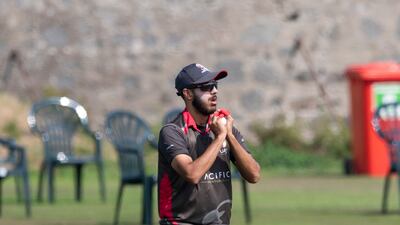
UAE's Chirag Suri takes a catch off Basil Hameed's bowling in the Tri-Nations Series match against Scotland at Mannofield Park, Aberdeen, on August 14, 2022. All pictures courtesy Ian Jacobs/Cricket Scotland -

The UAE's Aryan Lakra takes on a short ball from Scotland fast bowler Chris Sole. -

CP Rizwan was stumped by Matthew Cross off the bowling of Mark Watt. -
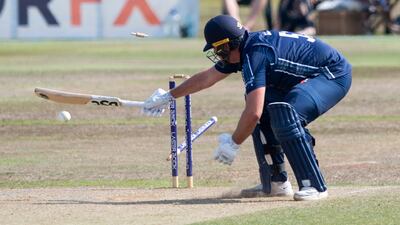
Scotland's Mark Watt has his leg stump uprooted by UAE pace bowler Zahoor Khan. -

Left-arm spinner Mark Watt was outstanding with the ball for Scotland again. -
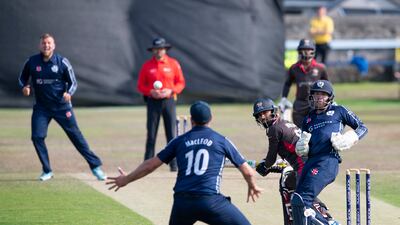
Calum MacLeod took a brilliant slip catch to dismiss Rohan Mustafa off Mark Watt's bowling. -
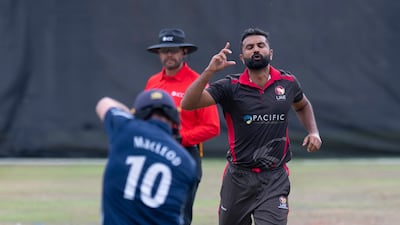
Kashif Daud returned figures of one for 13 as the UAE started brightly against Scotland. -
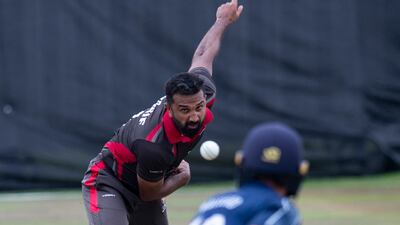
Kashif Daud was hit for six off the second ball he bowled - and took a wicket with his third. -
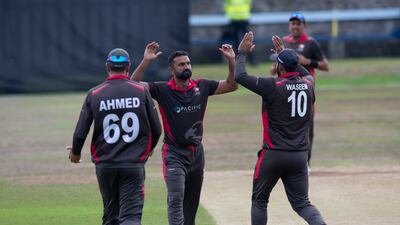
Kashif Daud celebrates after taking the wicket of Craig Wallace. -

Junaid Siddique appeals for a caught behind dismissal off Kyle Coetzer. -

Scotland's Kyle Coetzer is bowled by Junaid Siddique for a disappointing 10 runs. -
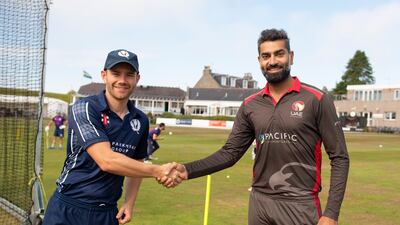
Scotland captain Matthew Cross and UAE skipper Ahmed Raza shake hands before the match. -
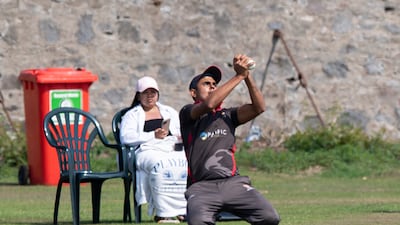
Aryan Lakra caught Chris Greaves off Ahmed Raza's bowling. -
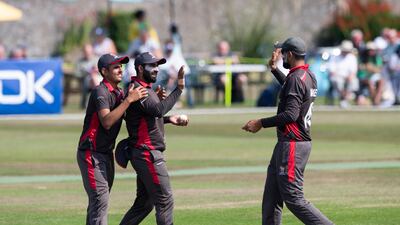
Muhammad Waseem high-fives captain Ahmed Raza after catching Scotland batter Michael Leask. -
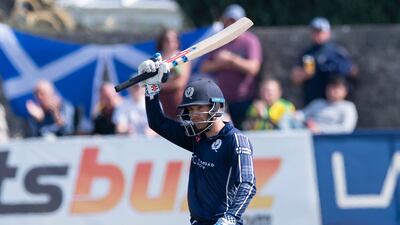
Matthew Cross top scored for Scotland with 85, at the ground where he first started out in cricket. -
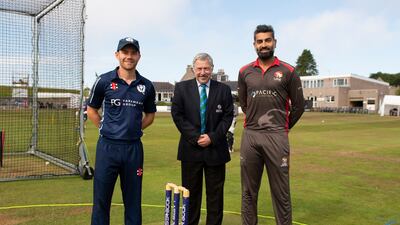
Scotland wicketkeeper Matthew Cross with tournament referee David Jukes and UAE captain Ahmed Raza.


“Getting to debut here was a great feeling,” Sabir said.
“It shows the hard work over the last few years is paying off. I was very proud.
“Now I really want to try to make that cut [for the Asia Cup and World Cup] and do well for the country.”
Originally from Lahore, Sabir qualifies to play for UAE on residency, having moved to Dubai in 2016.
Having played Grade 2, three-day cricket in Pakistan, he switched to the Emirates to work with Mohsin Arif, a formerly Dubai-based coach who has since returned to his native Wales.
“I arrived in Dubai on a visit visa, wanting to explore more opportunities in cricket, and coach Mohsin took me under his wing,” Sabir said.
“From then on I started playing domestic cricket. I did have the confidence from that point that, once I completed the residency period, I could make the [national team] cut.”
Ahmed Raza, the UAE captain, said Sabir has been a valuable addition to his bowling stocks.
“He is very quiet for a fast bowler, which is unusual,” Raza said.
“He just goes about his business. As much as you want him to be in the faces of the batters, he is not. He just wants to focus on his skills.
“Having a left-armer for the first time in a long time brings diversity to our attack.
“He has been unlucky that, after his debut, we couldn’t pick him in the XI just because of the make up of the team.
“But I thought he bowled really well, against a quality Scottish team. For the first time playing away from home, picking up Kyle Coetzer as his first international wicket, I am sure he will remember that for a long time.”
Left-arm fast bowlers have been a rare commodity in UAE cricket, with only Manjula Guruge and Mohammed Ayaz performing the art for the national team in the recent past.
“Having a left-arm quick is something we have been looking out for because of what they can bring to the game,” Raza said.
“A lot of left-armers have done well at our level of the game, if you look at Saurabh [Netravalkar] from USA and Bilal Khan from Oman.
“It is a different angle which batters are normally not used to. If he does well and keeps improving, I am sure he will prove worthy of his selection.”
UAE's final match of the series, against United States, will be broadcast live on icc.tv, starting at 2pm.

