


When Nitin Kumar took to the stage at Alexandra Palace in London, the cathedral of darts known affectionately as 'Ally Pally', he had the hopes of a nation willing him on.
The 40-year-old Indian darts player, nicknamed ‘The Royal Bengal’, had made the trip to the World Darts Championship five times before. Four times he had reached the first round only to lose on each occasion.
But in December 2025, in a pulsating five-set encounter, he beat Dutchman Richard Veenstra, ranked 48 in the world, 3-2 to become the first Indian winner in the tournament's history.

For a Dubai-based marketing professional, for whom darts was once simply a hobby played at home and in local leagues, it was a moment of huge significance. He practices in his living room and plays in the city's leagues three or four nights a week.
Speaking exclusively with The National, Kumar reflected on what it all meant and how he got here, a journey that began with family in Dubai.
Uncharted territory at Ally Pally
For Kumar, whose preparation largely takes place alone, away from the infrastructure of full-time professionals, the scale of playing at Ally Pally is challenging to prepare for.
The key, Kumar says, was mental. He spent close to a month conditioning himself to compete without the psychological weight of expectation back home.
“Darts is such a game where the less mental stress you take, the better you always are going to play. And I just didn't think about it to be honest,” he said.
“That game that I won [against Veenstra], I didn't think about what people were thinking about me. It took me at least close to a month to get myself into that mental state.
“Where it's very different, where you're representing a country, you want to do your best, but then now it's just, 'I don't care what people think of me, I'm going to do my best anyway'.”
When the match ended, the emotions he had spent weeks suppressing came flooding back. He could feel himself shaking.
“I felt like there was a lot of pressure that was on my shoulders, which I didn't feel it at the time because I was training myself not think about it,” he said. “But then towards the end of the game, I just kept feeling it. And I'm like, 'Alright, you're closer to victory right now.' This is the first time you're on uncharted territory. I've never been there. And it's something that was weird.”
Victory over Veenstra set up a second-round tie against Stephen Bunting, one of the tournament's top seeds. Kumar lost that match, but that win over Veenstra, and the manner of it, had already rewritten the record books.
Childhood in Dubai
Kumar arrived to Dubai as an infant. His father worked as an interior designer, and his mother was employed by Al Kabeer, the Emirati food company. “I was here when I was one month old,” he says. “I just went to India just for my university and came back. I've been here all my life. I'm a Dubai boy.”
Darts entered his life around the age of 10 or 11, through the social scene of the Indian community in Dubai. At the time, weekends fell on Thursday and Friday, and families gathered to play cards and spend time together.
On one such gathering, the Kumar family went to the home of a man named Chowdhury, who played in the Dubai Darts League. There was a dartboard there, and from that point, Kumar was hooked.
“My mum, of course, loved playing darts because it's a great stress reliever. You have three boys at home - so my dad, me, and my brother,” he laughs. “So for her, it was a great stress reliever. For my dad, it was a chance to go to the pub.”
In many Indian households, traditional career paths such as engineering and medicine are often seen as stable and secure options. Kumar took a different path.
His first sporting love was basketball, which he pursued seriously enough to return to India for university with professional aspirations, only for that path to close.
A master's in communications followed, specialising in advertising and marketing, and eventually a career that brought him back to Dubai. “I had a very sort of creative mind and I like to think out of the box.”
His family didn’t stand in his way: “They let me do what I wanted to. And in that way, I'm really happy actually. I was lucky in that way. I was blessed.”
Darts disadvantage
Cited as the country’s top-ranked competitor, what makes Kumar's achievement all the more striking is the reality of his daily life. There are no morning training sessions, no coaching staff, no recovery suites. There is an eight or nine-hour working day, and then, in the evening, a dartboard at home.
“Whenever I'm back home, I need to practice at least an hour and a half or two hours every single day,” he says. “Apart from that, we have three nights where we actually play darts over here in the league.
“There is a huge disadvantage, of course. I mean, I work while the world's best players get paid to play darts so they can practice 10 hours a day.
“So if I practice a whole week, an hour and a half or two hours, I practice 10 hours in a whole week while they practice 10 hours in a day. So I'm always fighting a losing battle in that way.”
His first step now is to become a professional darts player and earn a PDC Tour Card through Q School, the Professional Darts Corporation’s annual qualifying event that grants players entry onto the circuit.
Dubai, Kumar argues, may well be one of the best places in the world to develop as a darts player. The city's transient, international character works in the sport's favour.
British, Scottish, Irish and Filipino players cycle through the leagues, bringing experience from some of the most competitive environments in the world.
“Dubai has that aura to it where everyone comes over here, work, and they all bring their own skills and expertise over here,” he said. “The darts scene is really growing over here.”
Abu Dhabi and Ras Al Khaimah are developing their own scenes, and Kumar believes the UAE could rank among the top four teams in the Asia-Pacific World Darts Federation standings. “That's how good we are.”
India takes notice
Back in India, the reverberations of his Ally Pally win have been keenly felt. Kumar is candid about the responsibility that comes with it, and the complicated feelings that go with being so far from the country whose hopes he carries.
“Well, there have been a lot of waves in India,” he said. “Already, two darts academies have opened up since December. There's another one opening next week. So people are taking it very seriously. They have a lot of youngsters in India.
“I sort of feel a little guilty that if I was in India, I could have taught them a little better. They'd always have access to me so I can teach them. There are lots of kids who can be led in a wrong way. Because if you're a professional darts player, you've got to think like a professional darts player. You've got to practice like one.”
Nitin Kumar playing in Dubai - in pictures
-
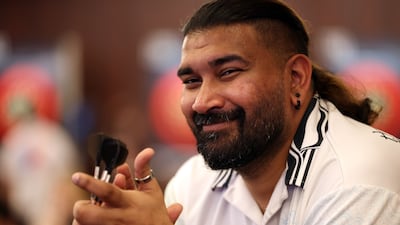
Dubai resident Nitin Kumar became the first Indian to win a match at the World Darts Championship. All images by Chris Whiteoak / The National -
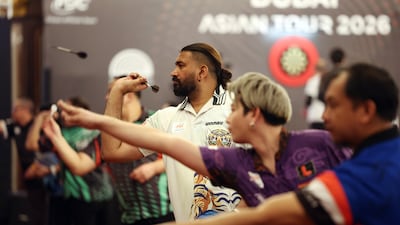
Nitin Kumar playing darts in Dubai -

Darts player Nitin Kumar has the nickname ‘The Royal Bengal’ -
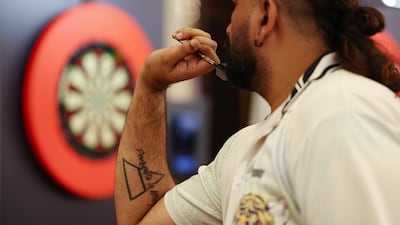
Dubai resident Nitin Kumar became the first Indian to win a game at the World Darts Championship -
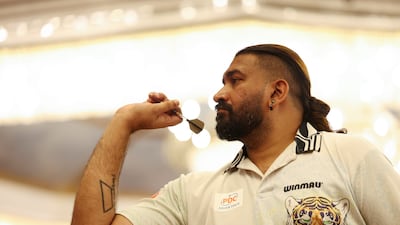
Nitin Kumar taking part in the PDC Asia Tour event at the Le Meridien in Dubai -
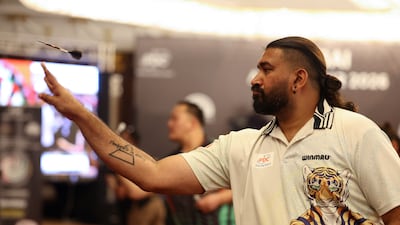
Nitin Kumar taking part in the PDC Asia Tour event at the Le Meridien in Dubai -
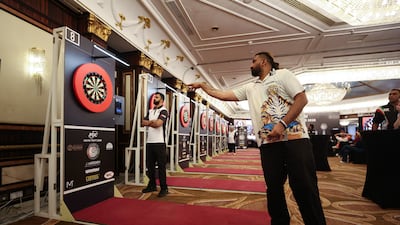
Nitin Kumar taking part in the PDC Asia Tour event at the Le Meridien in Dubai -

Darts player Nitin Kumar has the nickname ‘The Royal Bengal’ -
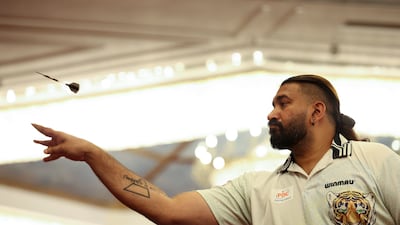
Dubai resident Nitin Kumar became the first Indian to win a game at the World Darts Championship


He reaches for an analogy that captures the sport's unique demands. “The highest score on a dartboard is 180,” he says. “You wake them at 3 o'clock in the morning while they're half asleep and tell them to hit a 180. Give them 10 minutes, they'll hit one.
“I tell the same people to do that in front of screaming fans behind and then you're talking about missing by a millimetre to missing by an inch and that is something that can't be taught. So this is what I have learnt, ideally, how to handle that.”
Yet the appetite for darts is there in abundance. “The love for the game is there, the potential is there, just by looking at sheer size and numbers of people who can actually take up darts in India. They’ve just got to be guided on the right path,” he said.
For Kumar, he has no intention of curbing his enthusiasm or his dreams. “Of course, ambition is always to be a world champion. You've got to shoot for the stars.”

