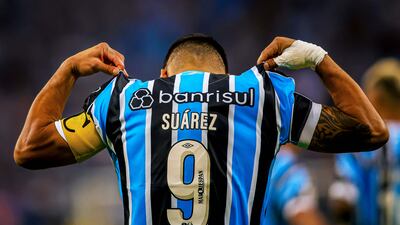
Luis Suarez ended his superb spell in Brazil by scoring twice for Gremio as they beat Fluminense 3-2 at the Maracana Stadium in Rio de Janeiro on Wednesday.
The 36-year-old scored just before half-time to level the scores at 1-1 then later made it 3-1 in the 64th minute with a panenka finish from the penalty spot.
It means Suarez finishes the season with 29 goals across all competitions, helping Gremio seal second spot in Brazil's Serie A, two points behind title winners Palmeiras.
The Uruguayan also finished joint-second in the Serie A scoring charts with 17 league goals in 33 matches, three behind Atletico Mineiro's Paulinho.
But Suarez has decided to cut short his two-year deal with the club, saying his body was struggling to cope with a playing schedule that has seen him play in 54 of the club's 64 matches this season.
“I love this job, but it's hard waking up in pain every morning,” he said after scoring the winner in his final home game last weekend. “I'm hard-headed and I want to keep playing, but I don't know what comes next.”
What comes next is thought to be a move to the United States where he could link up with his old Barcelona teammates, Lionel Messi, Sergio Busquets and Jordi Alba at Major League Soccer side Inter Miami.
But chronic knee problems could yet scupper his reunion plans. “The truth is that the first steps I take in the morning are very painful,” he told the 100% Deporte radio show. “Anyone who sees me thinks it is impossible for me to play a game. My son asks me to play with him and I am not able to.
“On the outside of my knee I have tension that remained from surgery in 2020 when I was in Barcelona. In the last stage of recovery, the pandemic came and I had to do exercises on my own and I couldn't finish stretching my knee.
“On the inside I have cartilage wear and that hits the bone. No liquid is generated but sometimes it gets stuck. Before games I take three pills and inject myself. From there I got the limp.”
Whatever happens now, it is clear Suarez made a big impression in his one season at the Brazilian club.
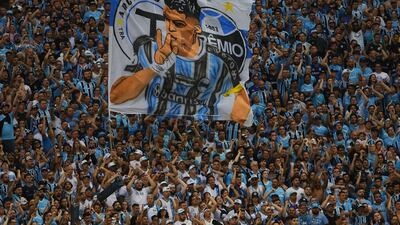
Fans and local politicians tried to talk Suarez out of his decision to leave after he announced his plans in July. And Gremio's strong showing this season means they have qualified for the Copa Libertadores next year, the South American equivalent of Europe's Champions League.
“I would have loved to play in that competition but my body is calling the shots,” Suarez said. “I need rest, recreation and time to think. It's hard to say 'basta' [enough]. Footballers are never ready for retirement.”
Gremio manager Renato Gaucho has admitted Saurez's exit is a blow for the club. “Are we going to miss him? Certainly, without a doubt, he is very loved by everyone,” said the Brazilian coach.
"I had the pleasure of working with a great professional, one of the best in the world, fourth highest scorer in the world. This void will remain for the next year, because it's not easy to find someone of his talent and ability.
“When you find someone else, it's unfeasible to bring him in financially. Unfortunately, as I said before, it was very difficult for him to stay. Everyone wanted it, but only he could reverse this decision.”

The view from The National
Tamkeen's offering
- Option 1: 70% in year 1, 50% in year 2, 30% in year 3
- Option 2: 50% across three years
- Option 3: 30% across five years
Iftar programme at the Sheikh Mohammed Centre for Cultural Understanding
Established in 1998, the Sheikh Mohammed Centre for Cultural Understanding was created with a vision to teach residents about the traditions and customs of the UAE. Its motto is ‘open doors, open minds’. All year-round, visitors can sign up for a traditional Emirati breakfast, lunch or dinner meal, as well as a range of walking tours, including ones to sites such as the Jumeirah Mosque or Al Fahidi Historical Neighbourhood.
Every year during Ramadan, an iftar programme is rolled out. This allows guests to break their fast with the centre’s presenters, visit a nearby mosque and observe their guides while they pray. These events last for about two hours and are open to the public, or can be booked for a private event.
Until the end of Ramadan, the iftar events take place from 7pm until 9pm, from Saturday to Thursday. Advanced booking is required.
For more details, email openminds@cultures.ae or visit www.cultures.ae
High profile Al Shabab attacks
- 2010: A restaurant attack in Kampala Uganda kills 74 people watching a Fifa World Cup final football match.
- 2013: The Westgate shopping mall attack, 62 civilians, five Kenyan soldiers and four gunmen are killed.
- 2014: A series of bombings and shootings across Kenya sees scores of civilians killed.
- 2015: Four gunmen attack Garissa University College in northeastern Kenya and take over 700 students hostage, killing those who identified as Christian; 148 die and 79 more are injured.
- 2016: An attack on a Kenyan military base in El Adde Somalia kills 180 soldiers.
- 2017: A suicide truck bombing outside the Safari Hotel in Mogadishu kills 587 people and destroys several city blocks, making it the deadliest attack by the group and the worst in Somalia’s history.
Mercer, the investment consulting arm of US services company Marsh & McLennan, expects its wealth division to at least double its assets under management (AUM) in the Middle East as wealth in the region continues to grow despite economic headwinds, a company official said.
Mercer Wealth, which globally has $160 billion in AUM, plans to boost its AUM in the region to $2-$3bn in the next 2-3 years from the present $1bn, said Yasir AbuShaban, a Dubai-based principal with Mercer Wealth.
“Within the next two to three years, we are looking at reaching $2 to $3 billion as a conservative estimate and we do see an opportunity to do so,” said Mr AbuShaban.
Mercer does not directly make investments, but allocates clients’ money they have discretion to, to professional asset managers. They also provide advice to clients.
“We have buying power. We can negotiate on their (client’s) behalf with asset managers to provide them lower fees than they otherwise would have to get on their own,” he added.
Mercer Wealth’s clients include sovereign wealth funds, family offices, and insurance companies among others.
From its office in Dubai, Mercer also looks after Africa, India and Turkey, where they also see opportunity for growth.
Wealth creation in Middle East and Africa (MEA) grew 8.5 per cent to $8.1 trillion last year from $7.5tn in 2015, higher than last year’s global average of 6 per cent and the second-highest growth in a region after Asia-Pacific which grew 9.9 per cent, according to consultancy Boston Consulting Group (BCG). In the region, where wealth grew just 1.9 per cent in 2015 compared with 2014, a pickup in oil prices has helped in wealth generation.
BCG is forecasting MEA wealth will rise to $12tn by 2021, growing at an annual average of 8 per cent.
Drivers of wealth generation in the region will be split evenly between new wealth creation and growth of performance of existing assets, according to BCG.
Another general trend in the region is clients’ looking for a comprehensive approach to investing, according to Mr AbuShaban.
“Institutional investors or some of the families are seeing a slowdown in the available capital they have to invest and in that sense they are looking at optimizing the way they manage their portfolios and making sure they are not investing haphazardly and different parts of their investment are working together,” said Mr AbuShaban.
Some clients also have a higher appetite for risk, given the low interest-rate environment that does not provide enough yield for some institutional investors. These clients are keen to invest in illiquid assets, such as private equity and infrastructure.
“What we have seen is a desire for higher returns in what has been a low-return environment specifically in various fixed income or bonds,” he said.
“In this environment, we have seen a de facto increase in the risk that clients are taking in things like illiquid investments, private equity investments, infrastructure and private debt, those kind of investments were higher illiquidity results in incrementally higher returns.”
The Abu Dhabi Investment Authority, one of the largest sovereign wealth funds, said in its 2016 report that has gradually increased its exposure in direct private equity and private credit transactions, mainly in Asian markets and especially in China and India. The authority’s private equity department focused on structured equities owing to “their defensive characteristics.”
((Disclaimer))
The Liechtensteinische Landesbank AG (“Bank”) assumes no liability or guarantee for the accuracy, balance, or completeness of the information in this publication. The content may change at any time due to given circumstances, and the Liechtensteinische Landesbank AG is under no obligation to update information once it has been published. This publication is intended for information purposes only and does not constitute an offer, a recommendation or an invitation by, or on behalf of, Liechtensteinische Landesbank (DIFC Branch), Liechtensteinische Landesbank AG, or any of its group affiliates to make any investments or obtain services. This publication has not been reviewed, disapproved or approved by the United Arab Emirates (“UAE”) Central Bank, Dubai Financial Services Authority (“DFSA”) or any other relevant licensing authorities in the UAE. It may not be relied upon by or distributed to retail clients. Liechtensteinische Landesbank (DIFC Branch) is regulated by the DFSA and this advertorial is intended for Professional Clients (as defined by the DFSA) who have sufficient financial experience and understanding of financial markets, products or transactions and any associated risks.
Sweet%20Tooth
%3Cp%3E%3Cstrong%3ECreator%3A%20%3C%2Fstrong%3EJim%20Mickle%3Cbr%3E%3Cstrong%3EStarring%3A%20%3C%2Fstrong%3EChristian%20Convery%2C%20Nonso%20Anozie%2C%20Adeel%20Akhtar%2C%20Stefania%20LaVie%20Owen%3Cbr%3E%3Cstrong%3ERating%3A%20%3C%2Fstrong%3E2.5%2F5%3C%2Fp%3E%0A