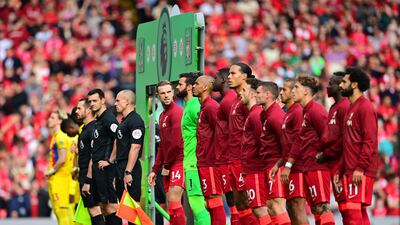
Raheem Sterling said he would be open to moving away from Manchester City to get more game time. PA

Raheem Sterling 'open' to a move away from Manchester City


  • English
  • Arabic

Raheem Sterling has revealed he "would be open" to moving away from Manchester City in order to get more game time.

Sterling, 26, has been with the Premier League champions since 2015 following his move from Liverpool.

However, the England international has started only two of City’s seven games in the title defence and the team dropped points both times.

"If there was the opportunity to go somewhere else [for more game time], I would be open to it at this moment in time," Sterling said at the FT Business of Sport US Summit.

"As I said, football is the most important thing to me - challenges that I have set myself from a young age and dreams as well, to play abroad.

"As an English player all I know is the Premier League and I have always had something down [in me] that maybe one day I would love to play abroad to see how I would come up against that challenge."

Sterling is under contract with City until 2023. Spanish media have reported that Barcelona are interested in Sterling, although a move for the England forward would be hampered by their financial problems which forced them to part ways with Lionel Messi in August.

He may yet get to start on Saturday against Burnley after winger Ferran Torres suffered a fractured foot while playing for Spain at the Nations League.

Manchester City squad has highest valuation in world football

The Intruder

Director: Deon Taylor

Starring: Dennis Quaid, Michael Ealy, Meagan Good

One star

Match info:

Portugal 1
Ronaldo (4')

Morocco 0

Mercer, the investment consulting arm of US services company Marsh & McLennan, expects its wealth division to at least double its assets under management (AUM) in the Middle East as wealth in the region continues to grow despite economic headwinds, a company official said.

Mercer Wealth, which globally has $160 billion in AUM, plans to boost its AUM in the region to $2-$3bn in the next 2-3 years from the present $1bn, said Yasir AbuShaban, a Dubai-based principal with Mercer Wealth.

Within the next two to three years, we are looking at reaching $2 to $3 billion as a conservative estimate and we do see an opportunity to do so,” said Mr AbuShaban.

Mercer does not directly make investments, but allocates clients’ money they have discretion to, to professional asset managers. They also provide advice to clients.

“We have buying power. We can negotiate on their (client’s) behalf with asset managers to provide them lower fees than they otherwise would have to get on their own,” he added.

Mercer Wealth’s clients include sovereign wealth funds, family offices, and insurance companies among others.

From its office in Dubai, Mercer also looks after Africa, India and Turkey, where they also see opportunity for growth.

Wealth creation in Middle East and Africa (MEA) grew 8.5 per cent to $8.1 trillion last year from $7.5tn in 2015, higher than last year’s global average of 6 per cent and the second-highest growth in a region after Asia-Pacific which grew 9.9 per cent, according to consultancy Boston Consulting Group (BCG). In the region, where wealth grew just 1.9 per cent in 2015 compared with 2014, a pickup in oil prices has helped in wealth generation.

BCG is forecasting MEA wealth will rise to $12tn by 2021, growing at an annual average of 8 per cent.

Drivers of wealth generation in the region will be split evenly between new wealth creation and growth of performance of existing assets, according to BCG.

Another general trend in the region is clients’ looking for a comprehensive approach to investing, according to Mr AbuShaban.

“Institutional investors or some of the families are seeing a slowdown in the available capital they have to invest and in that sense they are looking at optimizing the way they manage their portfolios and making sure they are not investing haphazardly and different parts of their investment are working together,” said Mr AbuShaban.

Some clients also have a higher appetite for risk, given the low interest-rate environment that does not provide enough yield for some institutional investors. These clients are keen to invest in illiquid assets, such as private equity and infrastructure.

“What we have seen is a desire for higher returns in what has been a low-return environment specifically in various fixed income or bonds,” he said.

“In this environment, we have seen a de facto increase in the risk that clients are taking in things like illiquid investments, private equity investments, infrastructure and private debt, those kind of investments were higher illiquidity results in incrementally higher returns.”

The Abu Dhabi Investment Authority, one of the largest sovereign wealth funds, said in its 2016 report that has gradually increased its exposure in direct private equity and private credit transactions, mainly in Asian markets and especially in China and India. The authority’s private equity department focused on structured equities owing to “their defensive characteristics.”

Updated: October 15, 2021, 10:53 AM