
Countries around the world are now waging a battle on two fronts to contain the damage of Covid-19. On one track is the fight to stop the spread of the virus and to minimise fatalities. On the other is the struggle to save economies and hard-earned welfare.
For both, the decisions that are made now, under enormous time pressure, will have long-term ramifications. In the short term, containing the spread of the virus rapidly will allow for economic recovery to start faster. But the building blocks of economic recovery, laid in place in the weeks and months ahead, will have a lasting impact on our societies and their future. That is why it is crucial to get the recovery right from the get-go.
-
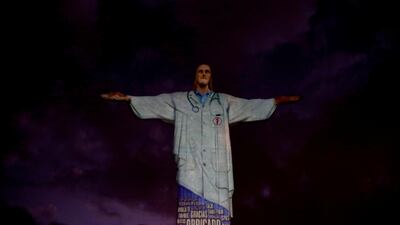
The statue of Christ the Redeemer is lit up with the image of a medical scrub and the word "thank you" in different languages during an Easter Sunday event in Rio de Janeiro, Brazil. Reuters -

People cross a makeshift barrier in Las Pinas, south of Manila, Philippines. EPA -
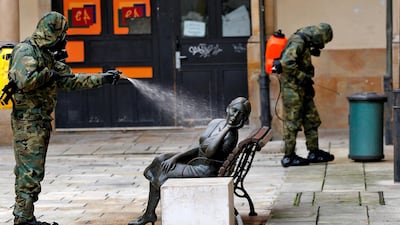
A soldier desinfects the sculpture 'La Bella Lola' in Oviedo, northern Spain. EPA -
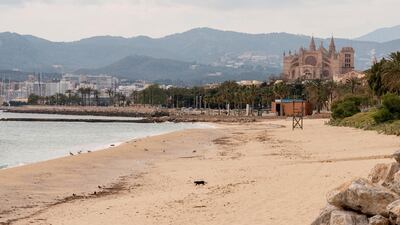
The Can Pere beach is empty in Palma de Mallorca, Balearic Islands, Spain. EPA -
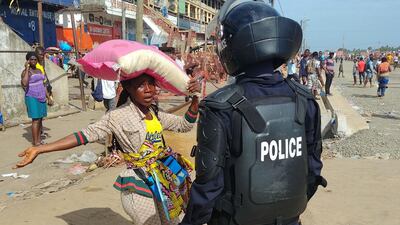
A police officer chases shoppers to clear the streets on the first day of lockdown in Monrovia, Liberia. Reuters -

Italian tenor and opera singer Andrea Bocelli sings during a rehearsal on a deserted Piazza del Duomo in central Milan. AFP -
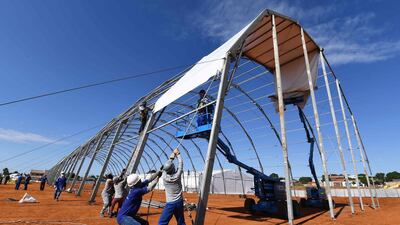
Labourers work at the construction site of a field hospital for people infected with the new coronavirus in Aguas Lindas, Goias State, Brazil. AFP -
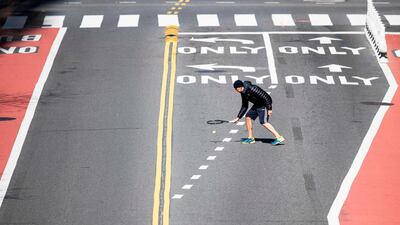
A man plays tennis on 42nd Street in New York City. AFP -
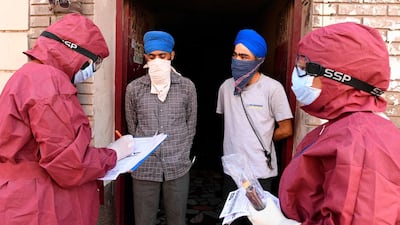
Medical staff wearing protective gears visit a residential area to screen residents in the wake of COVID-19 coronavirus outbreak, during a government-imposed nationwide lockdown as a preventive measure against the COVID-19 coronavirus in Amritsar. AFP -
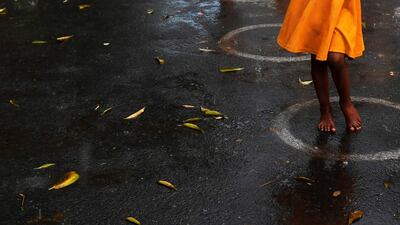
A young girl stands in queue to collect food in the rain in Kolkata. AFP -
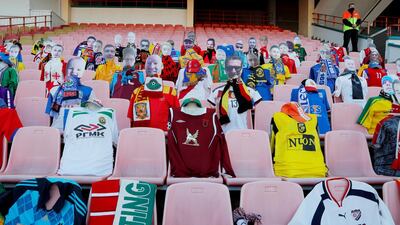
Dummies replace spectators during Dynamo Brest v Isloch Minsk in the Belarus football league. Reuters -
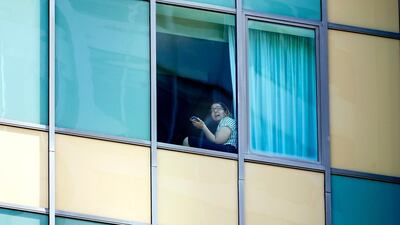
A quarantined traveller looks from a window at the Voco Hotel in Surfers Paradise, Queensland, Australia. EPA -
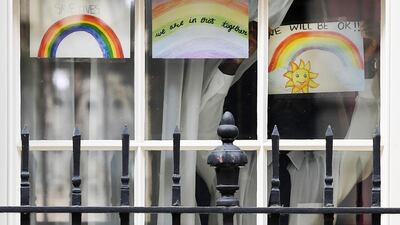
A child places a rainbow drawing in the window of No 10 Downing Street in London, Britain. EPA -
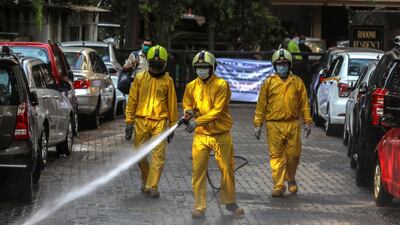
Members of a municipal fire brigade spray disinfectant in Mumbai, India. EPA


The socioeconomic implications of the coronavirus crisis will be “way worse than the global financial crisis” of 2008-2009, as IMF chief Kristalina Georgieva recently recognised. There is an important reason for looking back to that crisis. The Great Recession a decade ago was triggered by greed and bad governance. Governments responded with major stimulus packages and measures to strengthen corporate governance. In hindsight, many feel that bailouts focused too much on companies over people. But economies around the world recovered.
A less remembered outcome of the crisis is the idea of green growth, which was widely promoted by the OECD, World Bank, G8 and G20, among others, as a recovery strategy that would ensure economic growth while benefiting both people and the planet.
Despite scientific consensus confirming that humans are causing global warming, the 2009 Copenhagen climate summit ended in a disastrous failure and delivered a major blow to confidence in multilateralism. Green growth, with its promise of reconciling economic growth with lower emissions, managed to inspire governments as diverse as South Korea, Finland and the UAE to develop strategies for green economic development at a national level.
Halfway through the decade, I co-edited a book examining prospects for green economies in the Gulf. We highlighted that a dramatic change in course was needed globally to keep us within a safe operating space, respecting the Earth’s limits for biodiversity loss, climate change or freshwater use.
We predicted that “the time of ‘brown’ economies may be over much sooner than the world’s top oil exporters are willing to admit.” We also highlighted the benefits of clean energy, sustainable cities and just workforce transitions. Much progress has been made since.
At the same time, today we are still far from a global green economy, with emissions and biodiversity destruction at record highs. On top of this, we are faced again with a major crisis triggered by greed and bad governance – this time as a perfect storm of ecosystem disruptions, wildlife trafficking, and misguided agricultural policies. And, as a decade ago, we have now started to hear calls for green recovery.

References to economic stimulus measures that support Green Deals are multiplying in the US and Europe. But there are also indications of upcoming bailouts for auto industries and relaxations of pollution regulations, which would take us in the wrong direction.
The time of ‘brown economies’ is not yet over. Oil demand will rise sooner or later as, unlike the global energy transition required to avert a climate catastrophe, the impact of the coronavirus crisis on overall energy demand will largely be temporary.
The current crisis, however, provides an important moment of reflection for countries regarding their energy policies, which could have long-term ramifications for fossil fuels. Here in the Gulf, governments have a golden opportunity to reinforce policies that prepare the region’s economies for the post-oil era.
-
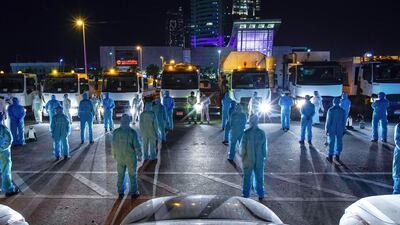
Sanitation workers from Tadweer on the first day of the UAE cleaning campaign. Victor Besa / The National -
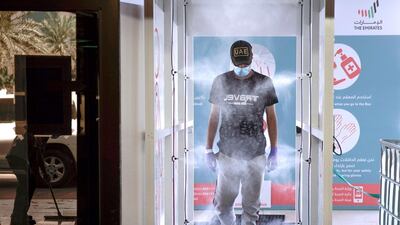
A commuter enters the new sterilisation area at the entrance of the Abu Dhabi Central Bus Terminal.Victor Besa / The National -

A woman and her children seen during cloudy skies in Al Furjan area in Dubai. Pawan Singh / The National -
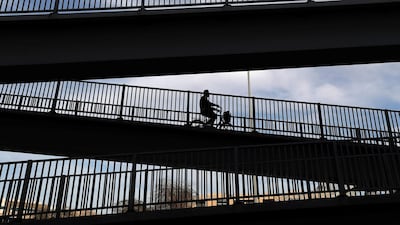
A man wearing a protective face mask crosses the foot bridge near Al Karama area in Dubai. Pawan Singh / The National -
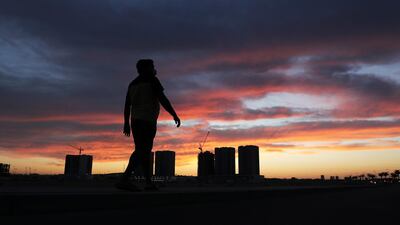
A man seen during the evening in Al Furjan area in Dubai. Pawan Singh / The National -
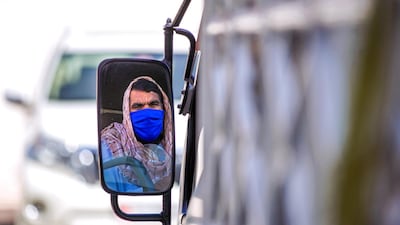
A delivery driver wearing a face mask at downtown Abu Dhabi. Victor Besa / The National -

The view of the Burj Khalifa without any visitors in Downtown Dubai in Dubai. Pawan Singh / The National -
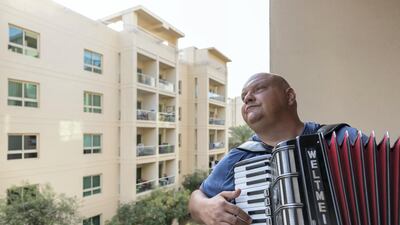
Boki Prekovic plays each afternoon from his balcony to keep residents stuck at home entertained. Chris Whiteoak / The National -
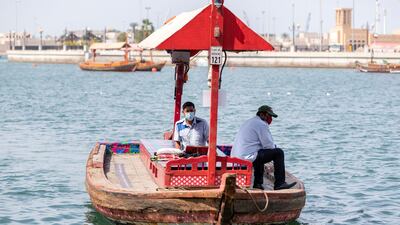
Two men on a boat wear face masks on Dubai Creek. Chris Whiteoak / The National -
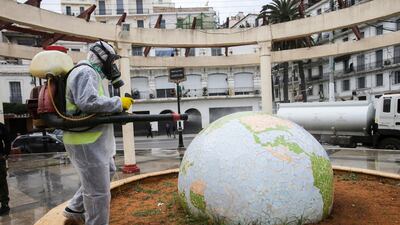
A worker wearing a protective suit disinfects a globe in a public garden, in Algiers. Reuters -
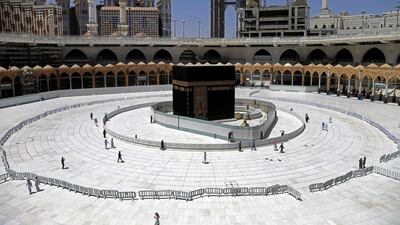
Muslim worshippers circumambulate the sacred Kaaba in Makkah's Grand Mosque. Saudi Arabia extended curfew restrictions on Islam's two holiest cities. AFP -
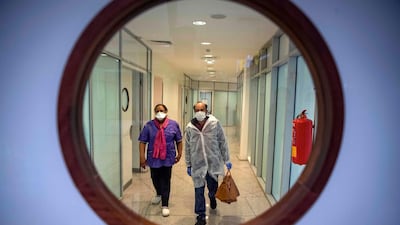
Moroccan health workers scan passengers arriving from Italy on March 3. AFP -

A Jordanian police officer is seen at a checkpoint on March 25. Reuters -
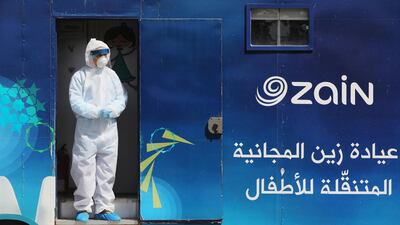
A Jordanian health worker pictured on March 31. Reuters -
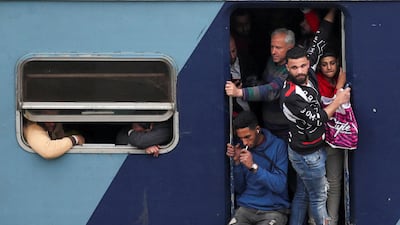
People travel on an overcrowded train on the outskirts of before a curfew ordered by the Egyptian Prime Minister Mostafa Madbouly on March 26. Reuters -
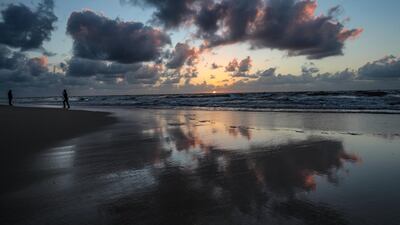
Palestinians gather at the beach as the sun sets over Gaza City on March 28. EPA -
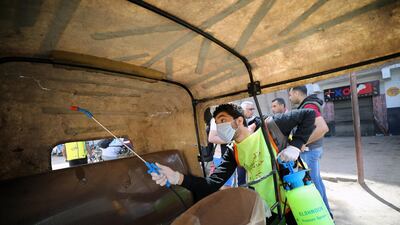
A member of a medical team sprays disinfectant as a precaution against the coronavirus outbreak at a tuk-tuk three wheel motorcycle in Shobra district in Cairo, Egypt on April 3. EPA -
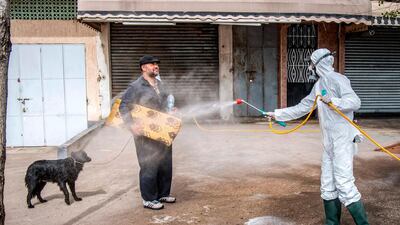
A Moroccan health ministry worker disinfects a man walking a dog in the capital Rabat on MArch 22. AFP -
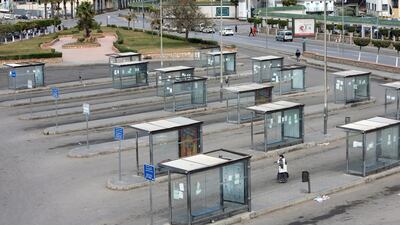
In Algiers, Algeria, a woman seen in an empty bus station. Reuters -
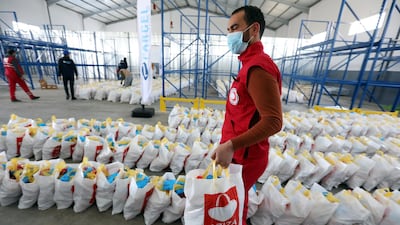
A Tunisian Red Crescent member prepares food packages to be delivered to the elderly and needy families on March 31. EPA -
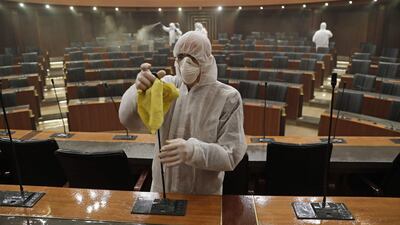
Workers disinfect desks and chairs in the Lebanese Parliament in central Beirut on March 10. AFP -
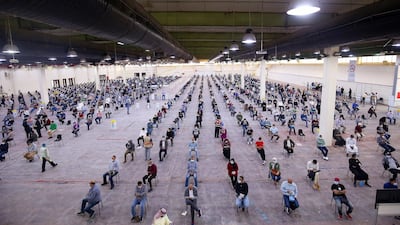
Travellers returning to Kuwait from Egypt, Syria and Lebanon arrive to be re-tested at a Kuwaiti health ministry containment and screening zone in Kuwait City on March 16. AFP -

A worker disinfects a house in a neighbourhood in the central Iraqi holy city of Najaf on March 23. AFP -
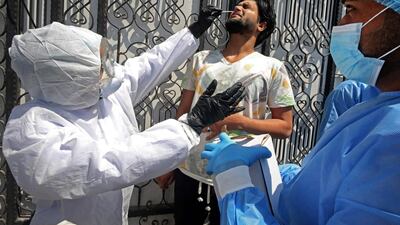
Doctors test a resident of Baghdad's suburb of Sadr City for the coronavirus on April 2. AFP -

Kuwaiti policemen wearing protective masks wait at Sheikh Saad Airport in Kuwait City,b efore transferring Kuwaitis arriving from Iran to a hospital to be tested for coronavirus on February 22. AFP -
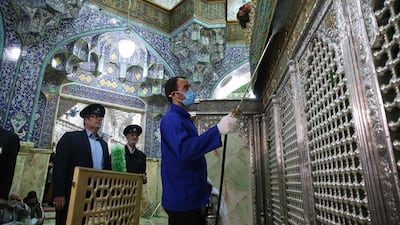
Iranian sanitary workers disinfect Qom's Masumeh shrine on to prevent the spread of the coronavirus on February 25. AFP -
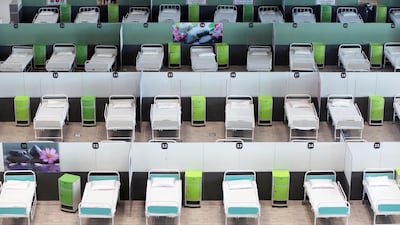
A view of beds at a shopping mall, one of Iran's largest, which has been turned into a centre to receive patients suffering from the coronavirus disease (COVID-19), in Tehran on April 4. Reuters -
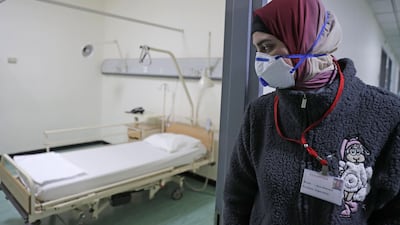
A Lebanese employee wearing a protective mask looks at a bed in a ward at the Rafik Hariri University Hospital where the first coronavirus case was admitted on Feburary 22. AFP -

Medical staff in protective gears distribute information sheets to Iraqi passengers returning from Iran at Najaf International Airport on March 5. AFP -

Employees of the Fatih Municipality wearing protective suits disinfect the Hagia Sophia in Istanbul on MArch 13. AFP -
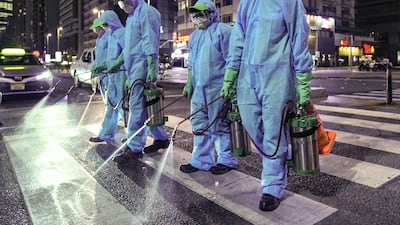
Sanitation workers from Tadweer spraying the pedestrian crossing on Hamdan and Fatima Bint Mubarak Street on March 27. Victor Besa / The National -
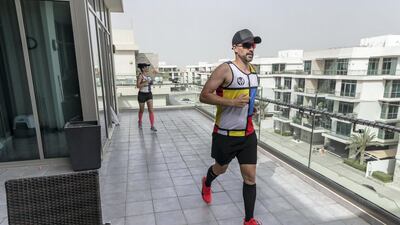
Colin and his wife Hilda run a marathon on their balcony on March 28 while the City of Dubai is under a Stay At Home policy to keep residence safe from the spread of Covid-19. Antonie Robertson / The National -
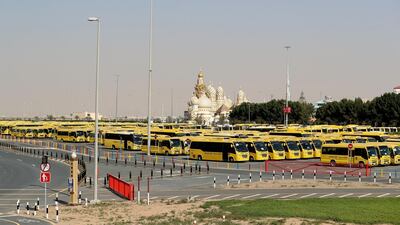
school buses parked outside Global Village on April 1. Chris Whiteoak / The National -
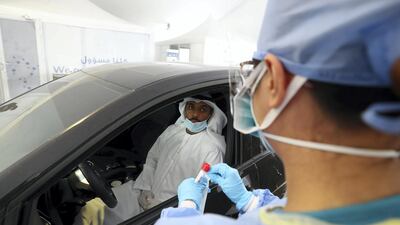
The new screening drive-thru for COVID-19 at Zayed Sports City, Abu Dhabi. Chris Whiteoak / The National


Let it be clear, as stressed by the UN environment chief Inger Andersen, “Covid-19 is by no means a ’silver lining’ for the environment.” The air is now cleaner, and scientists suggest 2020 could see a several percentage point drop in global carbon dioxide emissions. But if economic stimulus packages are designed to support polluters, this could become a mere blip on an upward trajectory. The UN estimates that limiting global temperature rise to 2°C, which is considered as the ultimate safe limit, requires emissions to fall by 2.7 per cent per year through 2030. And this obviously needs to happen without severe restrictions to movement and disruptions to markets.
The coronavirus has forced us to pause. It is creating havoc and tragedy on many levels. Although it has no silver linings, it gives us a chance to revisit lessons of the past to rebuild something better. Metaphorically, as for us as individuals, for economies too it is time for self-reflection and housecleaning. This way, we can all re-emerge as improved versions of ourselves when life returns to normal.
A powerful lesson of the 2008 financial crisis for all countries is that good intentions to build more sustainable and inclusive economies can easily get side-lined when structures and incentives prioritising economic growth over environmental and social sustainability are allowed to rebound.
Fortunately, over the past decade, many countries have already figured out their roadmaps to green economies. Thanks to the private sector, clean technologies and solutions have multiplied and become cost-effective. People are better educated about the environmental externalities of our consumption. And, most promisingly, we now have tangible evidence of our collective ability to change course when needed. Hopefully, building green economies will require far fewer sacrifices and bring lasting benefits.
Mari Luomi is an expert on climate policy in the Gulf

