


Malcolm Glazer was an extremely successful businessman. He was worth tens of millions of dollars, thanks to interests in all manner of businesses and real estate, from shopping malls to mobile caravan parks.
What defines joining the senior tier of tycoon, one of the ways anyway, in the US is to own a major sports franchise. In 1992, Glazer bid for the right to put on NFL games in Baltimore. Except that he was not content with sticking to one city – his franchise would hold matches in four major American cities, spread across the country. It would be, as he told an interviewer in a rare foray into the media, “America’s team”.
The fact his plan went against the grain of community, of a team playing for one place and being identified with that location, and its inhabitants seeing the team and its players as “theirs”, did not faze him in the slightest.
In the end, he lost. Even the NFL found his scheme too hard to stomach. Sitting in on the interview was a young Joel Glazer, one of Malcolm’s five sons (he also had a daughter, Darcie). Malcolm boasted he could write a cheque for $150 million for the franchise. Just like that. But when he was asked for $50,000 to help the Baltimore municipal authorities mount a PR campaign to bring NFL back to their city, he refused. It wasn’t in his budget, he said.
Anyone who wonders how the Glazers tackled owning Manchester United, the club they bought in 2005, would do well to study Malcolm’s attempts to land a US major league franchise. Not only did he make the ‘four cities, one team’ proposal, but he tried to buy into any sport going. It didn’t matter what it was – football, baseball or basketball – anything would do.
In 2006, Malcolm uttered his only words in public about buying the world’s biggest football club, one with a history and pedigree like no other, that had hundreds of millions of followers (333 million was the finding from United’s research) across the globe, that induced an outpouring of passion every occasion its players donned the iconic red shirt and went on the pitch at Old Trafford, United’s temple of a home.
Malcolm said: “We are enjoying it [owning United] greatly, it is a wonderful franchise, we just love it. I just want to say hello to the fans. It is a great franchise. It will do just great.”
That’s "great" three times and "franchise" twice. There’s no mention of club, players, team, the glorious past and the tragedy of the Munich air crash that saw players and club officials perish, the phoenix-like rebirth that made legends of Bobby Charlton, George Best and Denis Law, followed by the Alex Ferguson years. It’s empty, shallow, Trumpian, especially that last, “It will do just great”.
The Glazer family's ownership of Manchester United - in pictures
-
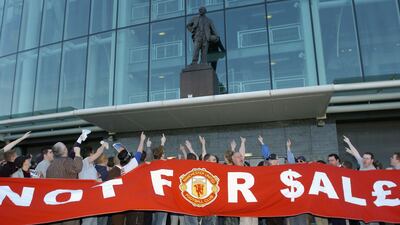
Fans outside Old Trafford show their feelings towards Malcolm Glazer's bid to purchase Manchester United in May 2005. All photos: Getty Images -
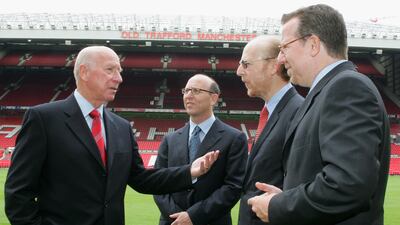
The Glazer brothers with Manchester United legend Sir Bobby Charlton at Old Trafford. Getty Images -

Bryan Glazer chats with Manchester United manager Sir Alex Ferguson in June 2005 during a pre-season tour of China -
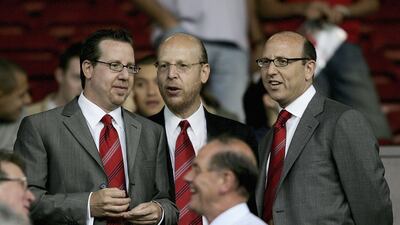
Joel Glazer, Avram Glazer and Bryan Glazer at Old Trafford to watch a match in August 2005 -
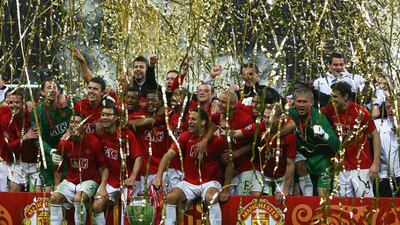
The early years of the Glazer family ownership saw Manchester United win a number of trophies, including the UEFA Champions League in May 2008, after defeating Chelsea in Moscow -
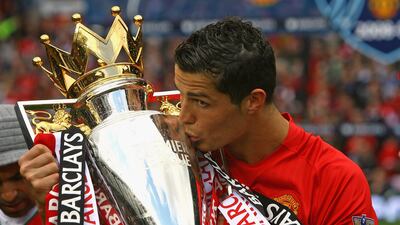
Cristiano Ronaldo lifts the Premier League trophy at Old Trafford in 2009 -

Manchester United fans make their feelings toward club owner Malcolm Glazer known during a Premier League match between Aston Villa and Manchester United at Villa Park in 2010 -
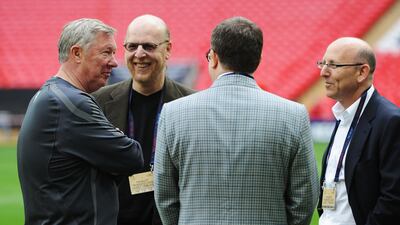
Sir Alex Ferguson speaks with Avram, Bryan and Joel Glazer during a training session prior to the UEFA Champions League final against Barcelona at Wembley Stadium in 2011 -
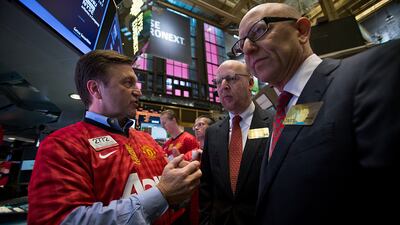
A trader wearing a Manchester United shirt speaks with Avram and Joel Glazer at the New York Stock Exchange in 2012 -
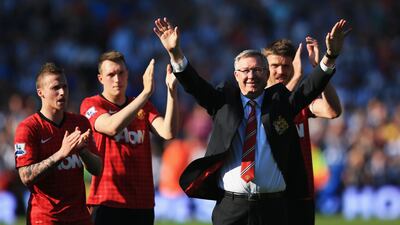
Sir Alex Ferguson is applauded by players after his 1,500th and final match in charge of the club in 2013. Manchester United were crowned Premier League champions as Ferguson retired, but have not won the league since -
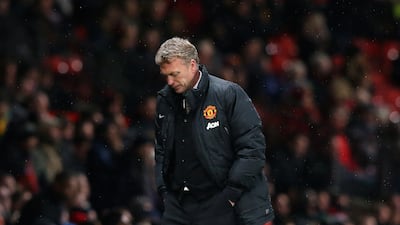
David Moyes was selected to take over from Sir Alex Ferguson as manager in 2013, but was sacked in April 2014 after only 10 months in charge -
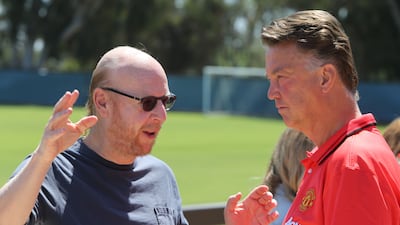
David Moyes was followed by Dutch manager Louis van Gaal, pictured here speaking with Avram Glazer, however he too was fired in May 2016 after winning the FA Cup -
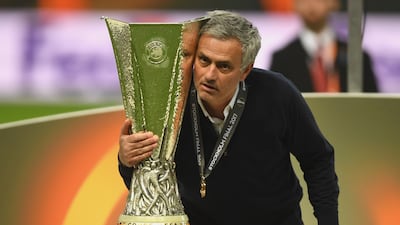
The next manager through the door at Manchester United was Jose Mourinho in May 2016. He won the Europa League (above), the League Cup, and the Community Shield as manager but was dismissed in December 2018 after a poor start to the season -
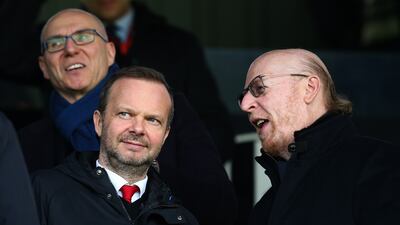
Manchester United chief executive Ed Woodward speaks to Avram Glazer in 2019 -
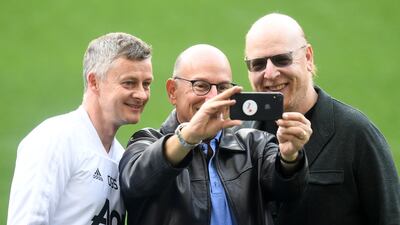
Former Manchester United player Ole Gunnar Solskjaer, posing above with Avram Glazer, was brought in as caretaker manager following Mourinho's sacking. After a bright start he was given the role on a permanent basis, before being sacked himself in November 2021 -

A plane trailing a banner that reads "2bn Stolen Glazers Out" is flown over the stadium prior to the Premier League match between Leeds United and Manchester United in April 2021 -
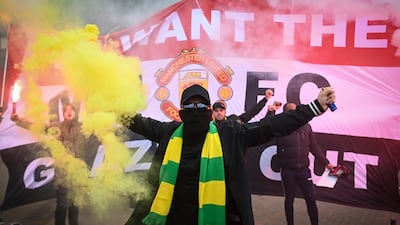
Fans protesting against the Glazer's ownership are seen outside Old Trafford prior to a Premier League match against Liverpool in May 2021 -
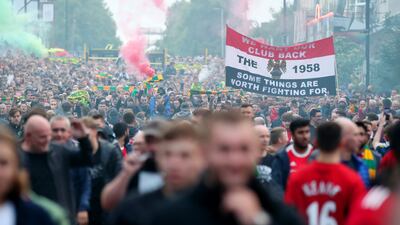
More anti-Glazer protests take place prior to another Premier League match against Liverpool in August 2022 -
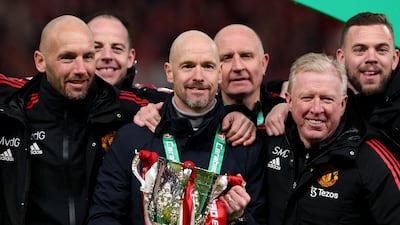
Dutchman Erik ten Hag was brought in as manager in April 2022, winning the League Cup, above, in his first season -
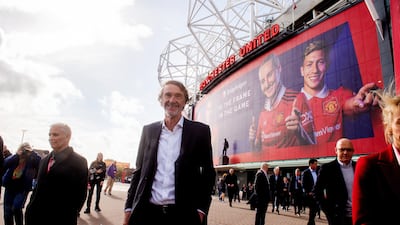
Potential buyer Sir Jim Ratcliffe tours Old Trafford in March, after the Glazer family announced in November 2022 that they were conducting a strategic review, with the sale of United one option being considered -
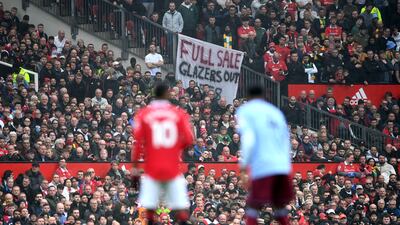
An anti Glazer banner is hung by Manchester United fans during a Premier League match in April


Talk to any of the fans who protest so vigorously and sometimes violently against the Glazers’ ownership of United and the reason for the dislike will boil down to the feeling the proprietors just do not care. Joel and his siblings (Malcolm died in 2014) hardly ever attend games; they’re invisible, removed, remaining thousands of miles away in the US.
They took a profitable, debt-free club and loaded it with £558 million of debt (equivalent £918 million in 2022), which they used to buy the club. Since they made their leveraged buy-out in 2005, the club has forked out £771 million in interest payments. During their tenure, too, the Glazers have received pay-outs in dividends and consultancy fees.
It's not as if United has been short of cash. In that period, the club took in £7 billion of revenue, it’s spent more on player transfers than any other Premier League rival, proven world-class managers have been recruited at vast expense.
No, it’s not the money. At Chelsea, Roman Abramovich also saddled the club with large borrowings. But the Russian oligarch was an ever-present at Stamford Bridge stadium and the training ground. Chelsea mattered hugely to him and the supporters applauded and sang his name approvingly as a result.
At United they also chant about the Glazers, but in a manner that is full of loathing and contempt. The fans feel used, that the club at the centre of their lives was seized by a group of people for the sole purpose of profit.
That calculating, mercenary approach trickles down, permeating throughout the organisation. United has acquired star players all right but generally they’ve not performed; same with the managers who have been and gone. A fish rots from the head, and the United spirit, that other teams could not begin to equal, is lacking.
It's there in the banners around Old Trafford, it was evident at the commemorations for the recent death of Charlton, but it’s not on show in the directors’ box in the seats reserved for the absent landlords.
It’s very much on display in the fans’ outrage, but, hard as it is to say, those demonstrations have not worked. The Glazers have owned United for 18 years and from day one they suffered abuse. Throughout all the opprobrium they have carried on regardless. The fury has become self-defeating – one of the reasons the Glazers give for not journeying to Manchester is fear for their own safety.

The commercial side of United under them was turned into a machine. Aided by Ed Woodward, the former JP Morgan banker turned United executive, sponsorship deals galore were struck. United set new standards in monetising; virtually every aspect of the club was available, for a price.
While that strengthened United’s financial base, it only served to add to the fans’ disillusion, that here was a team, their team, being exploited entirely for monetary ends.
For all their distance, the Glazers – well, at least three of the siblings, Joel, Avie and Bryan – relished owning United. It was a calling card, one they could use to great effect at Davos, where United, alone among football clubs, took a pavilion. They had recognition, able to rub shoulders with the world’s business and political elite.
Which partly explains why letting go has proved so difficult. After the Glazers saw what US financier Todd Boehly paid Abramovich for Chelsea, a smaller club, they decided to test the water themselves.
Chelsea fetched £4.25 billion ($5.4 billion). Those around the Glazers were murmuring that United with its vast marketing clout and reach was worth around twice that, $10 billion. New AR, or augmented reality viewing technology, using micro-cameras and enabling fans to follow a match as if they were a particular player, plus online betting, still in its relative infancy, threaten to pour even more lucre into the bank balances of the biggest clubs – and there is none bigger than United.
The Glazers, who always operate by consensus, so all six must agree, were in no rush to sell. Only two firm bids were received, from Sheikh Jassim bin Hammad Al Thanim of Qatar and Britain’s Sir Jim Ratcliffe. There was interest from investment groups looking to inject funding and partner the owners.
Of the two, Sheikh Jassim’s sought outright control while Ratcliffe’s entailed him taking a minority, possibly in return for full ownership further down the line. One suggestion is that Ratcliffe will oversee the footballing side while leaving the commercial portion to the Glazers. It’s difficult to see how this would work in practice – Ratcliffe would own, say, 25 per cent, so on a player purchase 75 per cent of the fee would effectively be the Glazers’ money, not his.
Ratcliffe should be warned, too, that Malcolm did not do collaborations, it wasn’t in his nature. If he did, they did not last. His children may be different, but on the evidence of almost two decades in charge at United, they carry many of their father’s traits.
Chris Blackhurst is the author of The World’s Biggest Cash Machine – Manchester United, the Glazers, and the struggle for football’s soul (out now)

