


German officials as presidents of the G7 convened a snap press conference on Friday to announce the rich nations forum had agreed a price cap on the exports of Russian gas.
In fact it’s a fair bet that the decision to go for the dramatic measure on Russia’s prime hydrocarbon export was taken in Washington days before during a meeting between Janet Yellen, the US Treasury Secretary, and Nadhim Zahawi, the British Chancellor of the Exchequer.
American newspaper headlines demonstrate why this was the key meeting. Reporting progress on the “US-led” plan, The Wall Street Journal said: “The UK, a maritime insurance hub, commits to cap price of Russian oil”.
The business newspaper's reports quoted Bruegel, a Brussels-based think tank, in estimating that 90 per cent of the world’s ships are insured through London’s syndicates. That is key leverage to impose a ceiling on the price Russia can charge customers in Africa or India for output that must be carried by tankers across the seas.
While shipping is global, Europe is at the heart of the cap on the oil trade gambit.
The US has pursued the plan for strategic goals to intensify pressure on Russia to change course on the Ukraine war. US oil prices have dropped for a record 70 days in a row and are now below the pre-Ukrainian invasion level.
For the Europeans the issue is far more pressing, particularly as Moscow has shut for an indefinite period the Nord Stream gas pipelines that Western Europe depends on for its winter fuel.
As former Russian president Dmitry Medvedev, now deputy national security adviser, put it on Friday: “There will simply be no Russian gas in Europe”.
Europeans are putting a brave face on the coming winter, caught between Russia and a less-compromised US.
Robert Habeck, Germany's energy minister, revealed this week the gas storage facilities were nearly 83 per cent full. Levels would hit 85 per cent later this month and are on course to reach the 95 per cent target by November. It will still be touch and go if disruption is to be avoided.
The crisis has forced Europe to set a 15 per cent target for reducing consumption of energy in the next few months. A set of new terminals are under construction to offload LNG supplies from around the world. It has also triggered a rush to diversify away from gas, either bringing back coal and nuclear or pushing faster on renewables.

The only tool the Europeans have is to tell Russia that it is shutting itself off from its main long term market. European Commission President Ursula von der Leyen took this line during the week as she revealed that storage facilities across Europe were four fifths full.
“At EU level, we diversify sources, save energy and store it. Our gas storage is already filled at 80%,” she tweeted. “But to cut our dependence on Russian fossil fuels, we need renewables.
“The commitments taken today would already deliver 1/3 of our 2030 target for offshore wind in the EU.”
France is also scrambling. Prime Minister Elisabeth Borne gave a warning that in a worst-case scenario this winter could lead to rolling two-hour power cuts in French homes.
The country should be well placed. It relies on nuclear energy for about 67 per cent of its electricity — more than any other country — and on gas for about 7 per cent.
At the moment, 32 of France's 56 nuclear reactors are shut down for usual maintenance and, in some cases, to repair corrosion problems.
-
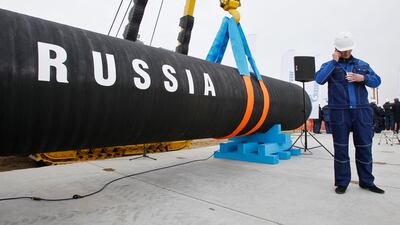
A Russian construction worker speaks on a mobile phone during a ceremony marking the construction of the Nord Stream pipeline in Portovaya Bay, 170 kilometres north-west of St Petersburg in Russia. AP Photo -

A turbine of the Nord Stream 1 pipeline at the Siemens Energy plant in western Germany. AFP -
The logo of Russia's energy giant Gazprom is pictured at one of its petrol stations in Sofia, Bulgaria. AFP -
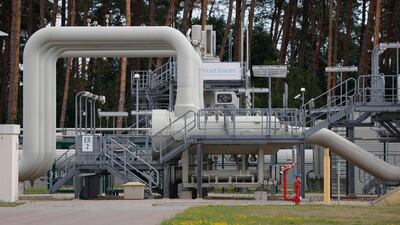
Facilities to receive and distribute natural gas are pictured on the grounds of gas transport and pipeline network operator Cascade in Lubmin, north-eastern Germany, close to the border with Poland. AFP -
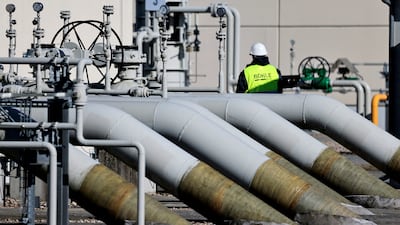
Pipes at the landfall facilities of the 'Nord Stream 1' gas pipeline in Lubmin. Reuters -
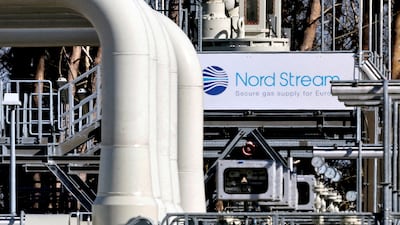
The Nord Stream 1 gas pipeline in Lubmin, Germany. Reuters


“There’s a schedule that provides that starting from October, each week, a new (nuclear) plant is operational again,” Energy Minister Agnes Pannier-Runacher said on Friday.
Meanwhile, in the UK projections for household energy bills are reaching eye-watering levels for this winter. One consultancy, Cornwall Insight, has raised its annual projection from £3,500 in October to £5,300 next April.
Even if the country's next prime minister, to be announced on Monday, intervenes to cap prices and underwrite suppliers purchases of gas, there will still be pain, with the cost of any plan estimated between £30 billion and £60 billion.
The UK's foreign policy interests mean it is unlikely back down from confrontation with Russia. Departing Prime Minister Boris Johnson has been very open with the public that their income squeeze can be laid at the door of the confrontation with Putin.
It is not know where the price cap on Russian oil will be set. Key to the issue will be how protection and indemnity insurers implement the plan.
Crucially, a carve out for Sakhalin island supplies has got Japan on board with the US price cap plan.
Washington is asking its friends in Europe to bear an immense burden this winter. A backlash from the public, forced to endure power cuts and cold showers, cannot be ruled out.
A very windy but not too cold winter in Europe could yet be the most important geopolitical event of the year.

