


Get ready for wall-to-wall jingoistic sabre-rattling. It has already started but is going to get a whole lot worse.
Russian President Vladimir Putin sends his troops into two breakaway states in eastern Ukraine held by pro-Moscow separatists, an action considered to be an inflammatory attack on the country’s sovereignty, as a possible precursor to an all-out invasion, and Boris Johnson is on the airwaves.
Russia, says the UK prime minister, can expect a “barrage of sanctions” for this escalation. In Washington, US President Joe Biden is said to be preparing the “mother of all sanctions” programmes against Russia. EU Commission President Ursula von der Leyen and Council President Charles Michel are promising tough measures.
OMG, I want to scream. Mr Putin must be quaking in his handcrafted boots. But then I resort to another piece of social media shorthand, LOL. He knew they would do this, of course he did. Yet, he still went ahead regardless, and judging buy his bellicose address, this won’t be the last incursion — it could be the start of something much bigger. Still, in the face of all manner of threats from the West, he persists.

There could be a simple explanation for this, that Mr Putin is mad, that he would rather inflict enormous financial pain and suffering, a cost that would far outweigh the benefits of securing those two states and more. To him, adding to Russia’s territory, restoring the former borders, adding to the greater glory of the motherland, greatly exceeds any economic hurt.
The banks identified in the overnight announcements are not the biggest — the major Russian banks are tied up with the UK, US and EU investment banks, and the unravelling would be complex and costly. This is a reason given for the reluctance to block Russians from using the Swift banking-transactions network, that the fallout would severely impact upon their trading partners in the West.
Plenty of international businesses will suffer because of the clampdown. But Mr Putin believes Russia is better prepared than in the past when embargoes were imposed and can ride out this current storm — he thinks there will some damage but it is a price worth paying.
Putin's calculations
Mr Putin is no fool, he is not insane. His calculation is that the western steps will not cause so much agony.
In recent years, Mr Putin has been trying to create fortress Russia, strengthening the economy against likely attack, preparing for days such as these. Russia’s reserves have grown while the proportion held in dollars has decreased.
It has made strides to develop its own technology industry, so Russia is not so reliant on imports of chips and hardware, and on the software side, its programming and apps development have advanced.
Russia has been cosying up to China as a ready market for its commodities and fossil fuels, which remain its biggest source of foreign exchange.
Influence and hardships
Nevertheless, to pretend Russia is immune from what the West could do is foolhardy. The EU accounts for 27 per cent of all Russian exports; despite improvements, Russia is dependent on western technology imports (just because Russia is portrayed in the Western media as being capable of launching sophisticated cyber- attacks does not mean it is so versed in equipping its own people).
-
Firefighters arrive at a military building in Kiev that was damaged in an explosion. EPA -

A man looks at the debris of an unidentified object in the aftermath of an explosion in Kiev. EPA -
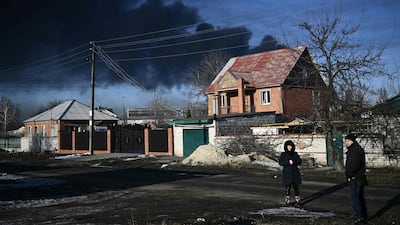
Black smoke rises from a military airport in Chuguyev near Kharkiv. AFP -

People take shelter in a Kiev subway station, after Russian President Vladimir Putin authorised a military operation in eastern Ukraine. Reuters -
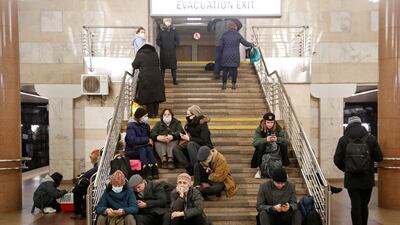
A Kiev underground train station provides some shelter. Reuters -

Clear airspace over Ukraine, shortly after the attack began, as shown on the Flightradar24 website. AP -

Kiev residents leave the city following pre-offensive missile strikes by the Russian armed forces and Belarus. Getty -
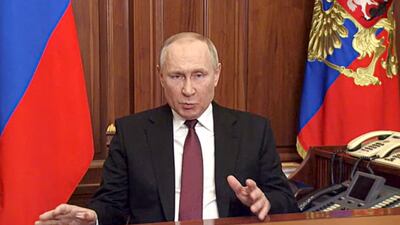
Russian President Vladimir Putin justified the attack in a televised address, saying it was to protect civilians in eastern Ukraine. AP -
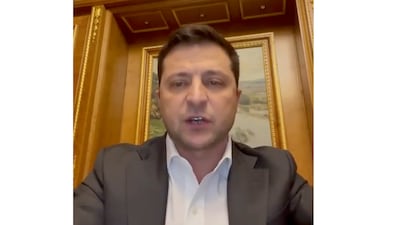
Ukrainian President Volodymyr Zelenskyy addresses the nation in Kiev. He has declared martial law, saying Russia has targeted Ukraine's military infrastructure. AP -
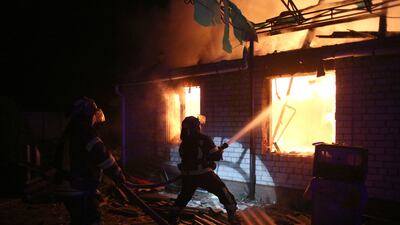
Firefighters extinguish a blaze at a house in Muratovo, in Ukraine's Luhansk enclave. AFP -

The house is said to have been hit during shelling by Russian-backed separatists. AFP -

The coffin of Capt Anton Sidorov is carried by members of the honour guard during a ceremony held at the Ministry of Defence in Kiev, Ukraine. Getty -
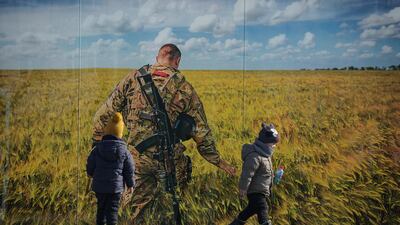
A picture memorial for those killed in the confrontation between Ukraine's military and pro-Russia separatist forces, in the Luhansk region in eastern Ukraine. AP -

UN Secretary General Antonio Guterres and Russia's Ambassador to the UN, Vassily Nebenzia, attend a Security Council meeting in New York to discuss the crisis in Ukraine. Reuters -
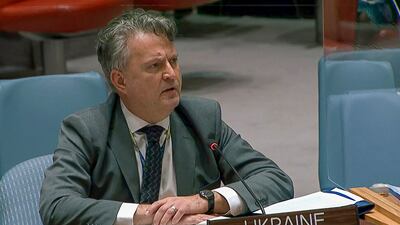
Ukraine's UN ambassador Sergey Kyslytsya speaks during an emergency meeting of the Security Council. AP -
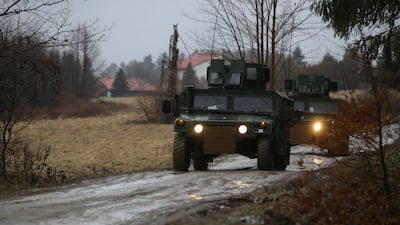
US Army soldiers from the 82nd Airborne Division head towards an air base near Arlamow, Poland. Reuters -

An employee works at the gun counter of a tactical equipment shop in Kiev, Ukraine. Getty -
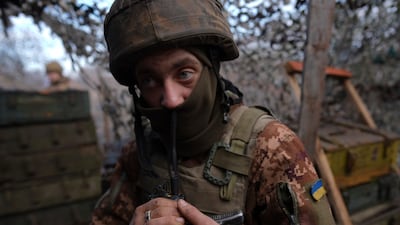
A Ukrainian soldier speaks on a walkie-talkie at his position at the line of separation between Ukraine-held territory and rebel-held territory near Svitlodarsk, eastern Ukraine. AP -
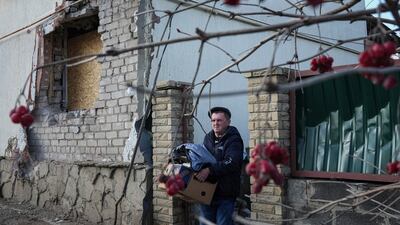
A man removes his belongings from his house after it was struck by artillery shells in Novoluhanske, eastern Ukraine. AP -
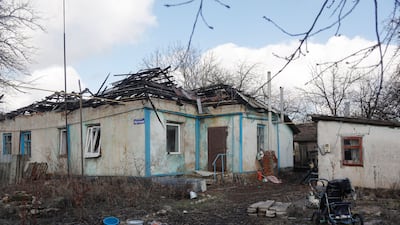
A damaged house in Vibrovka village. EPA -
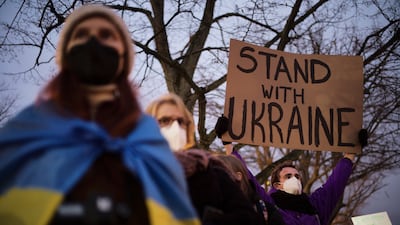
A man shows a poster in support of Ukraine as he protests against the escalation of the tension between Russia and Ukraine, in Berlin. AP -

Soldiers carry the coffin of Capt Anton Sydorov, 35, after he was killed in eastern Ukraine. AP -
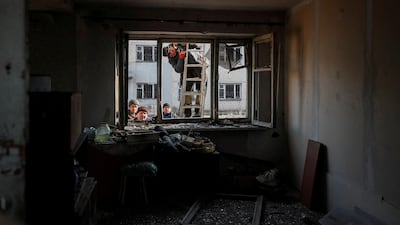
Workers look into a destroyed house after shelling near the city of Novoluhanske in Donetsk. Reuters -

Destroyed buildings in Krasnogorivka, Ukraine. AFP -
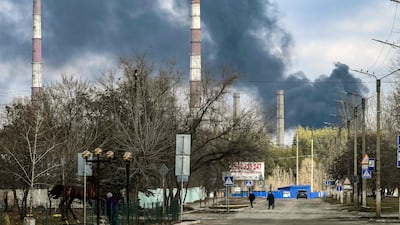
Smoke rises from a power plant after shelling outside the town of Schastia, a day after Moscow recognised two Ukrainian separatist republics and ordered the Russian Army to send in troops as ‘peacekeepers’. AFP -
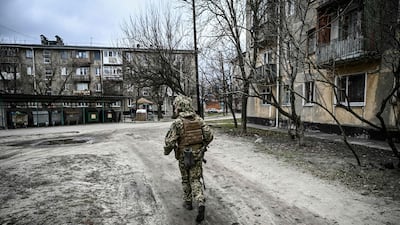
A Ukrainian Army soldier trudges through the wintry streets of Schastia on patrol. AFP -
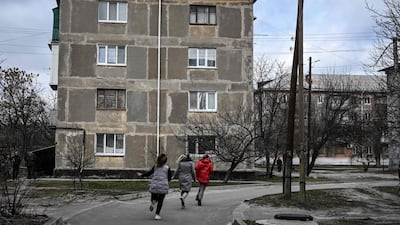
Three women run for cover during shelling in Schastia, eastern Ukraine. AFP -
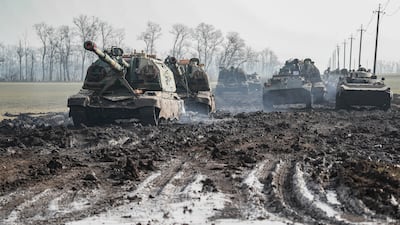
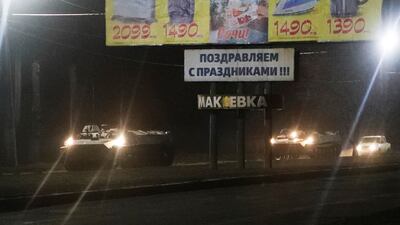
Russian tanks and armoured vehicles on the road in Rostov. EPA -
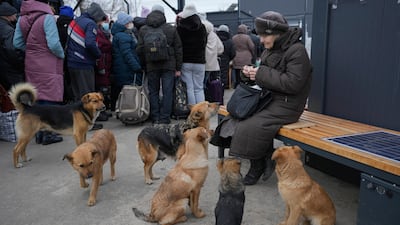
A woman shares food with dogs in Stanytsia Luhanska, a crossing point between Ukrainian government-controlled areas and pro-Russian separatists' territory. AP -
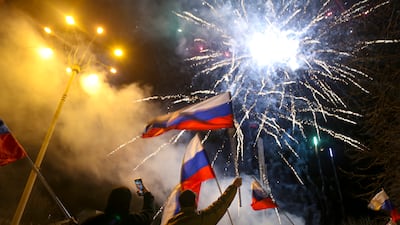
People wave Russian flags in Donetsk, the territory controlled by pro-Russian militants, in eastern Ukraine. AP -
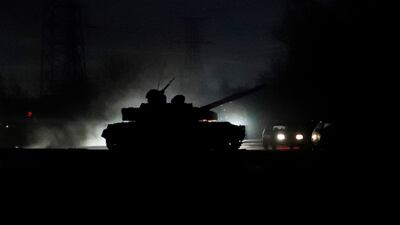
A tank drives along a street in the city of Donetsk. Reuters -
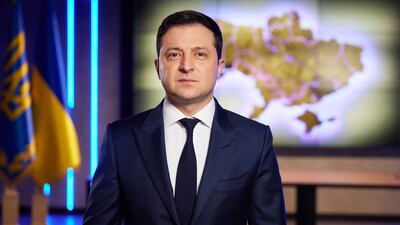
Ukrainian President Volodymyr Zelenskyy addresses the nation on TV and says 'we are not afraid' after Russian President Vladimir Putin ordered troops into Donetsk and Luhansk, two Moscow-backed rebel regions of Ukraine. AFP -
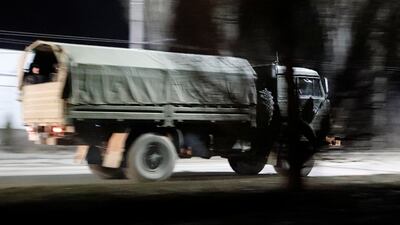
A military truck in Donetsk after Mr Putin ordered the deployment of Russian troops to the city. Reuters -
Russian state television showed Mr Putin signing a decree recognising the independence of the two Ukrainian breakaway regions. Reuters -
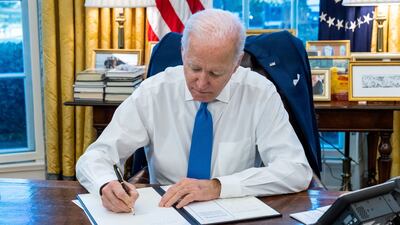
US President Joe Biden signs an executive order at the White House to prohibit trade and investment between US individuals and the two breakaway regions of eastern Ukraine. Reuters -
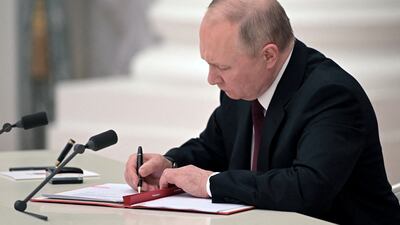
Mr Putin signs documents, including the decree recognising two Russian-backed breakaway regions in eastern Ukraine. Reuters -
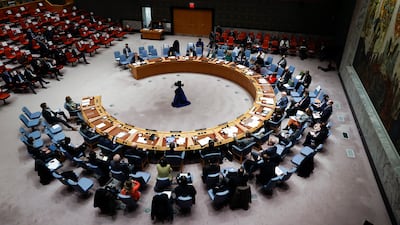
Ukraine ambassador to the United Nations, Sergiy Kyslytsya, addresses an emergency meeting of the UN Security Council on the situation between Ukraine and Russia in New York. EPA


Germany’s barring of the Nord Stream2 gas pipeline is expected to affect Russia more than Germany, at least in the short-term. And turning towards China, too, has its downside. There is no question as to which would be the junior partner. The notion of his Russia falling under China’s outwardly friendly but baleful influence would be unpalatable for Putin.
Moving against some Russian banks and individuals will inflict hardship on them, although in truth, listing friends or known close associates of Putin and being seen as attempting to close down their dealings and freeze their assets in London, New York and other centres in the West may appear tough but that is all it is: an appearance. It is for show, for making headlines, rather than to get anywhere near rocking Putin.
The fact is we have had sanctions lists in the UK, UK and EU for years and there has been no meaningful drop in Russian influence or activity. London is the pre-eminent global centre for washing Russian money; City firms are just as busy serving Russian clients; large parts of prime luxury residences continue to be owned by Russians; those people cited have long been able to put their affairs in order, working closely with their City advisers, so their lives can carry on as normal.

This will not be lost on Mr Putin. Where a country as large and as connected and as wealthy as Russia is concerned, bringing sanctions is a two-way street.
How sanctions (do not) work
There may be a third aspect to Mr Putin’s planning, which is that sanctions do not work. Professor Lee Jones at Queen Mary London has published a paper: Societies Under Siege: Exploring How international Economic Sanctions (Do Not) Work.
A professor in international politics, Mr Jones’s thesis is that sanctions rarely achieve their stated aims.
“Statesmen do not really say what sanctions are meant to do. It is not possible to test their claims because they are never clearly specified. Often leaders will say something very simplistic like, ‘Oh, we’ll put pressure on the government.’”
Added Jones: “A classical liberal understanding is that sanctions will work in one of two ways. The first is by provoking an immediate response on behalf of the targeted government by changing its cost-benefit analysis. The second is that sanctions will cause economic suffering among the population, which will lead them to turn against the government, and the government will have to change course as a result. In practice, both of these mechanisms rarely, if ever, trigger.”
By his estimate, the success rate could be as low as 5 per cent.
He looked at what happened when Russia invaded and annexed Crimea in 2014. Jones took the view that Mr Putin’s intention was to seize Crimea, then stop and reach a settlement with Ukraine.
So, in that sense, sanctions did not change his aims — he was never going to invade all Ukraine, he was always going to confine himself to Crimea. Certainly, that time round, Russia was wounded economically, but there was also an upside: anti-American sentiment increased, pro-Putin sentiment increased, and so did support for Moscow's policy in Ukraine. Mr Putin knows this.
The West would be foolish to put too much store by sanctions.

