


In his two years in office so far – a period he regards as naggingly too short – Boris Johnson has only done what was to be expected of him. At every turn, he has manipulated, threatened, cajoled and occasionally charmed his way through the business of government. The law is for losers; it applies to everyone in the land bar one.
Now, as the senior civil servant Sue Gray prepares to deliver her dramatic report and as Conservative MPs contemplate ousting him, is he about to face his reckoning? Will the conjuror who “got Brexit done” and tried to make Britons feel better about themselves by waving a flag finally run out of road?
In recent days, the British Prime Minister has been likened to a rat and a Rottweiler, chewing or biting his way out of danger. He signalled he would not go down without a fight, clearing the decks to spend the past weekend holed up at his official country residence of Chequers with a small band of die-hards, manning the phones to persuade recalcitrant backbenchers not to demand his resignation, and, in the event of a no-confidence vote taking place, not to support it.
This is a fast-moving crisis with a proliferation of quickening streams. Nusrat Ghani, a well-regarded former minister, opened up the latest set of sluice gates when she accused the leadership of using her “Muslimness” as a justification for her sacking in early 2020. It says something that two Cabinet ministers from Muslim backgrounds had to make a stand to get Downing Street to take her complaint seriously. By Sunday evening, Mr Johnson was on the phone with Ms Ghani offering yet another inquiry by officials into the conduct of his own government.
That was followed on Monday by the resignation of a Treasury minister, Lord Agnew, over the handling of fraudulent Covid-19 business loans then another allegation of parties in Downing St, this time for the prime minister’s birthday.
Politics as practised at Westminster has always been a dark art. Some revere the costumes, the customs. In my years as a political journalist there, I saw it as epitomising the struggle of a country trying, and largely failing, to come to terms with its diminishing status as a middle-ranking power. Yet the UK Parliament’s intrinsic hubris has an effect on even the most grounded of individuals.
The PM would never want to be described as being grounded. As a boy, Alexander Boris de Pfeffel Johnson vowed to become “world king”. Being a newspaper columnist, TV quiz show host and after-dinner speaker was lucrative and ego-enhancing, but he wanted to become an MP, to become prime minister, to be like Winston Churchill. His chaotic public personality was artfully devised as a vehicle for that endeavour.

His ambition has also been accompanied by a marked lack of political conviction. As Mayor of London, he was delighted to be seen in the vanguard of David Cameron’s efforts to make the Conservatives “cool”. Labour, still reeling from the Iraq war and long years of Tony Blair and Gordon Brown, was at the tail end of its era in power. In 2012, during the successful London Olympics, Mr Johnson was happy to get stuck on a zip wire, waving as he indulged the photographers. Many on the liberal left gushed about him at the time.
Four years later came the great schism, Brexit. Mr Johnson saw it as his one, perhaps only, opportunity to get to 10 Downing Street. He knew that Cameron was keeping the seat warm for his chancellor and good friend George Osborne. He knew he had to do something dramatic. He was torn between his head – even he realised that leaving the EU might be a risk too far – and his heart, to go for it. He had two speeches prepared, one for Remain, the other for Leave. At the 11th hour, he opted to disrupt the UK’s place in the world on the altar of his vanity. He campaigned brilliantly, making sure that he didn’t let the truth (such as more money for the National Health Service) get in the way of an appeal to the public. But he didn’t imagine his side would actually win and was taken aback when it did.
Buoyed by that unlikely success, he undermined negotiations led by Mr Cameron’s successor, Theresa May, opting for a deal more economically and constitutionally damaging. But he succeeded in getting rid of her – and that was what mattered.
Over the past decade, Tory supporters affixed to Mr Johnson whatever they wanted: low-tax true-believer or redistributor of wealth to poorer regions, culture warrior or social liberal. Yet the more he was required to dig into the detail, the more he was exposed. The new generation of MPs from the “Red Wall” of former Labour seats in England’s North and Midlands were furious when much trumpeted railway investment turned out to be a chimera. Meanwhile, free-marketeers wondered whether he understood the meaning of Conservatism as he pledged ever more fanciful amounts of cash to anyone who wanted it – as long as they supported him.
After his stunning general election victory of December 2019, albeit against the implausible Labour left-wing leader Jeremy Corbyn, Mr Johnson was supposed to waft over politics, playing to his strengths as national feel-good galvaniser in-chief. Then Covid-19 intervened. He spent several crucial days in March 2020 hiding at Chequers writing his book on Shakespeare, fearing that he would have to pay back his advance, with maintenance payments to meet for his ex-wives and children.
Houdini-style, he then allowed himself to take the credit for the smart early distribution of vaccines at the start of last year. For the first time, the UK was the envy of much of the world, allowing supporters of Brexit to indulge in their favourite pastime, flag-waving schadenfreude, as they watched the countries of the EU floundering.
Yet unbeknown to all but a few on the inside track, Britain’s response to the pandemic was being managed in – how to put it politely – a somewhat esoteric fashion. While the nation was being required by law to lock down, the Downing Street clan were partying.
Britons have indulged themselves over the past month with memes at Mr Johnson’s expense, usually involving inebriated people after attending a “work event”. In chancelleries around the world, the UK has been renamed “the party island”.
-

The Metropolitan Police have announced a formal investigation into alleged lockdown-breaching parties in Downing Street, dealing a heavy blow to Boris Johnson's authority as he faces fresh calls to step down as British Prime Minister over the 'partygate' scandal. Getty Images -
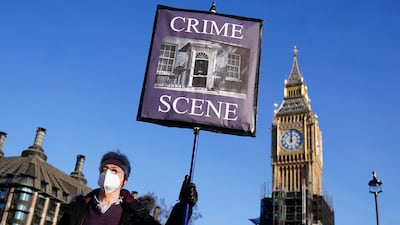
A protester in Parliament Square, London. PA -
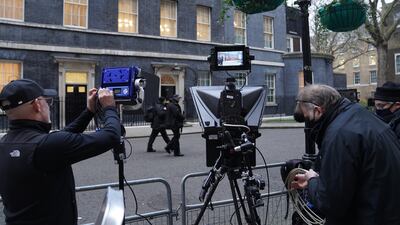
Armed police officers walk past the gathered media outside No 10 Downing Street on Tuesday morning. PA -
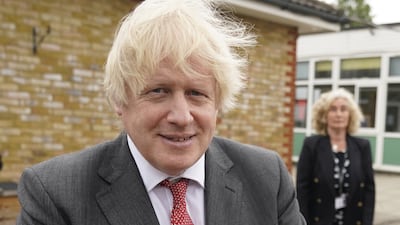
Mr Johnson holds up a birthday cake - baked for him by school staff - during a visit to Bovingdon Primary Academy in June 2020. The prime minister is facing new allegations of breaking coronavirus rules after it was reported that a gathering to wish him a happy birthday was held inside No 10 during the first nationwide lockdown. PA -
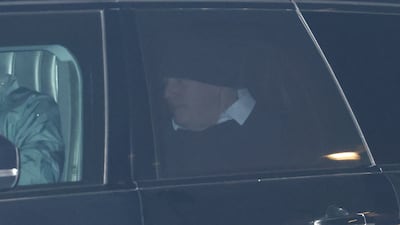
Mr Johnson is driven from Downing Street. Reuters -
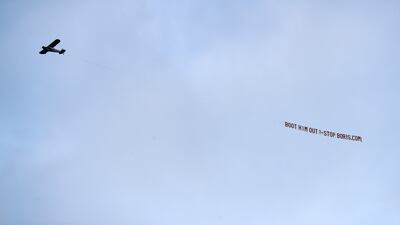
A plane flies over Elland Road stadium in Leeds with a message directed to Mr Johnson during the Premier League match between Leeds United and Newcastle United. Getty Images -
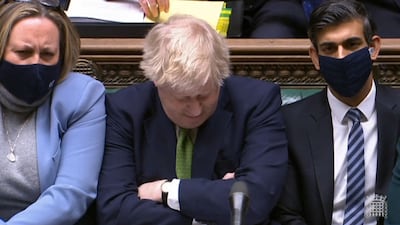
The prime minister seems unimpressed as Britain's main opposition Labour Party leader Sir Keir Starmer speaks during Prime Minister's Questions in Parliament. AFP -
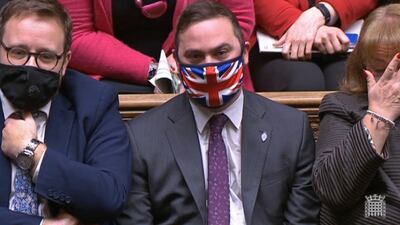
Labour MP for Bury South, Christian Wakeford, who defected from the Conservative Party earlier that day, attending Prime Minister's Questions. AFP -
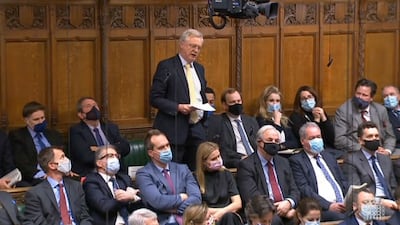
David Davis, Conservative MP for Haltemprice and Howden, quoted a comment made to Neville Chamberlain before his 1940 resignation as prime minister, telling the beleaguered Mr Johnson: ‘I will remind him of a quotation all too familiar to him ... 'in the name of God, go'.’ AFP -

Dominic Cummings, former adviser to Mr Johnson, speaks to the media outside his home. Getty Images -
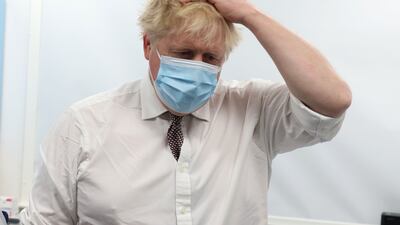
Mr Johnson looks as if he is feeling the pressure on a visit to Finchley Memorial Hospital in London. Getty Images -

The shuttered constituency office of Mr Wakeford in Radcliffe, Bury, after he switched his party political allegiance. Getty Images -
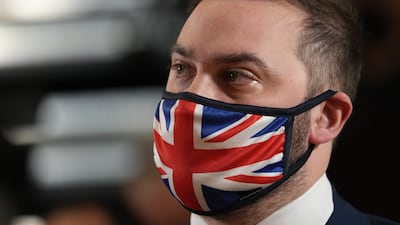
Mr Wakeford looks on during a visit by Labour’s Shadow Chancellor, Rachel Reeves, to Bury. Getty Images


Mr Johnson and his allies are living hour by hour, fearing the next headline detailing drinking and other rule-breaking. They are trying to divert attention by unveiling dramatic policy decisions on the hoof, such as ending public funding for the BBC and sending the navy to deal with migrants at sea. An invasion of Ukraine by Vladimir Putin would certainly divert attention.
The government’s poll ratings are poor. Mr Johnson’s personal standing is terrible. Conservative MPs are accusing their own government of blackmail and coercion. Potential successors to the crown are jockeying into position. Keir Starmer, once dismissed as a wooden leader of the opposition, is finally finding his voice. Labour insiders say they want to prise Mr Johnson out, but not too quickly. The longer the Tories stay in the mire, the harder it will be for them to recover.
Meanwhile, Mr Johnson’s nemesis and source of many revelations is waiting to pounce. Dominic Cummings, chief Brexit campaign strategist, is variously described as Rasputin or Svengali. The mesmeric grip he once had on Mr Johnson, he now has on the media.
Politics as theatre: the final act is about to begin. Underlying the drama, though, are more deep-seated problems. How will Britain begin to restore its reputation after this mess? And what will happen to the Conservative Party? Mr Johnson was supposed to be the quick fix, binding it together in a patriotic Brexit endeavour. Now what? The search – and, at some point, it will come – is not just for his successor but for the soul of a once-sensible party that allowed itself to be hijacked by a populist clown.

