

Peter Hellyer, the author, columnist and cultural historian, died peacefully on Sunday. He was 75.
Over the course of a decades-long association with the UAE he was a key figure in the development of the country’s English-language media, a prolific author of books and research, and a great explorer of the Emirates' heritage and champion of its national story.
He was granted UAE citizenship for his services to the country in 2010 and was later the recipient of an Abu Dhabi Award, the highest honour that can be bestowed upon a civilian in the emirate, in recognition of his years of historical research.
His professional links with the region began when he moved to the UAE in 1975, initially to develop documentaries about the overseas visits of Sheikh Zayed bin Sultan Al Nahyan, the nation’s Founding Father.
In 1977, he helped establish the English-language service of Wam, the government news agency. He also headed foreign language broadcasting for Abu Dhabi and served as managing editor of Emirates News for many years.
After the paper closed, he continued his work in news and communications, becoming an information adviser to the National Media Council, and had an office at its headquarters.
Visitors fondly remember the piles of newspapers stacked around its perimeter and the assorted papers that cluttered his desk. Hellyer was always generous with story ideas and contacts for journalists and foreign correspondents.
He was the author and editor of numerous books, including Waves of Time, a maritime history of the UAE, and volumes on Al Ain, Abu Dhabi and Fujairah.
-
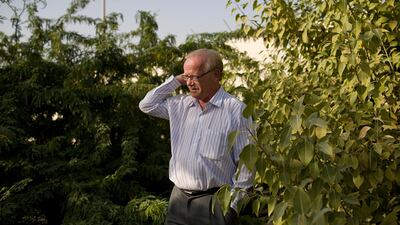
Tributes have been paid to UAE historian Peter Hellyer, who died on Sunday aged 75. The National -

Mr Hellyer, pictured here in 2009, was a respected author, columnist and chronicler of the UAE's past. The National -
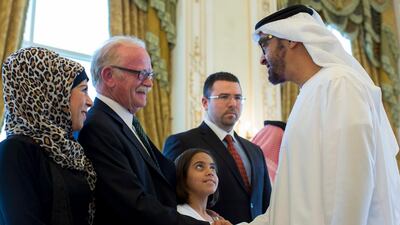
Mr Hellyer and his family meet President Sheikh Mohamed, then serving as Crown Prince of Abu Dhabi, in 2014. Photo: Crown Prince Court -
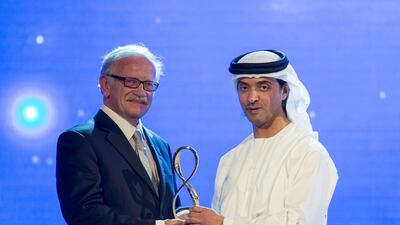
Peter Hellyer with Sheikh Hazza bin Zayed, now Deputy Ruler of Abu Dhabi, in 2014. Photo: Crown Prince Court -
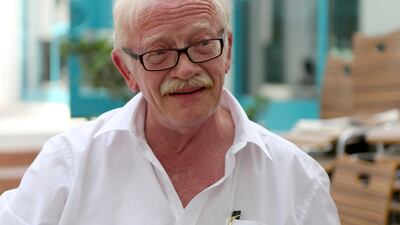
Peter Hellyer began a decades-long association with the UAE in the 1970s. The National -
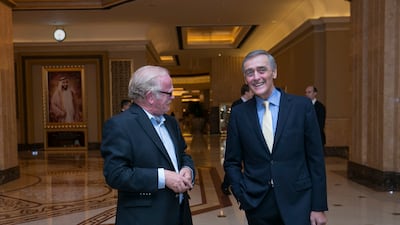
Peter Hellyer meets Maj Gen Gerald Cavendish Grosvenor, 6th Duke of Westminster, at Emirates Palace in Abu Dhabi in 2014. The National -
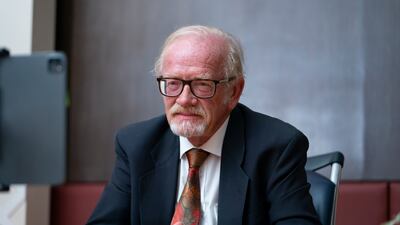
Peter Hellyer attends an online lecture titled "Spirit of a Nation: Community of Many Faiths” in 2021. Photo: Ministry of Presidential Affairs -
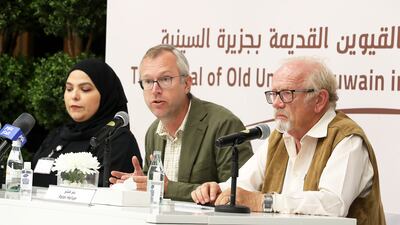
Peter Hellyer with Rania Hussein, head of the Archaeology Department at UAE University, and Associate Professor of Archaeology Dr Timothy Power in 2022. Pawan Singh / The National


Hellyer had a passion for heritage and history – one of his books, Hidden Riches, provided an archaeological guide to the country – and he was chairman of the Emirates Natural History Group for many years. He was editor of the group’s journal, Tribulus, for several decades. A keen student of nature throughout his life, he once took the UK's Prince of Wales, now King Charles, birdwatching.
In 1992, Hellyer also cofounded and led the Abu Dhabi Islands Archaeology Survey that identified some of the most important historical sites in Abu Dhabi.
These included the 1,400-year old monastery site on Sir Bani Yas Island and Neolithic villages on the islands of Dalma and Marawah and many more finds that underlined the rich archaeological history of the UAE.
It was for this work that he later received an Abu Dhabi Award in 2013.
The testimonial video that accompanied the gala awards ceremony described him as a “real life Indiana Jones” and featured footage of Hellyer at the Sir Bani Yas site wearing his signature look of light-coloured shirt, multi-pocketed explorer’s gilet and broad brimmed floppy hat.
His interest in documenting the rich and, at times, forgotten history of the country, never dulled.
He was a frequent participant at commemorative events in Fujairah at the memorial to a RAF airman who died during the Second World War.
And as adviser on culture heritage with the Ministry of Culture and Youth, supported the archaeological work in Umm Al Quwain that has revealed further striking finds such as another ancient monastery in 2022 and the Arabian Gulf’s oldest pearling village in 2023.
He also wrote the history of The Club in Abu Dhabi for its 40th anniversary in 2002 and remained one of its members throughout his life.
Hellyer’s connection with the Middle East began in the late 1960s, several years before he moved to the UAE.
As international vice chairman of the National League of Young Liberals in the UK during his student days in Sussex, he followed the unfolding tensions of the 1967 Arab-Israeli conflict closely, leading him to campaign for greater support for the Palestinian cause within the political party’s policies. He subsequently served as an aide to David Steele, who later became leader of the Liberal party.
He also never lost his deep affection for Jersey, one of the Channel Islands, where he had spent large parts of his upbringing. He often summered there and helped facilitate trade missions from the island to the Gulf.
From 2008, he began writing a fortnightly column in The National, having earlier provided advice to the organisation in the months before the newspaper’s first issue was published in April that year.
Regular readers will remember he pursued a wide range of interests in his contributions to the opinion pages, although his central themes were often heritage, archaeology, the environment, politics and society.
One of his early columns was critical of a textbook used in schools, which prompted the commissioning and development of a new Arabic and English language history volume, co-authored by Hellyer with Mohamed Al Mubarak and Peter Magee, that was later entered into the curriculum.
A multipart, five-hour TV documentary series – History of the Emirates – was also developed and narrated by Academy Award winner Jeremy Irons.
Another column recalled the time when, as a member of the Executive of the Anti-Apartheid Movement in the UK, he invaded the pitch during a 1969 rugby test match between England and South Africa at London’s Twickenham stadium, to protest against Apartheid-era South Africa.
He wrote that he managed to get a long way onto the muddy turf before being brought to the ground by a Springbok player. The policeman who escorted him from the pitch reportedly told him: “I won’t bother to arrest you, I think you’ve been dealt with already.”
Hellyer also took great pride in reminding his commissioning editors at The National that he never missed a deadline, something he said he had learnt from his late father, Arthur Hellyer, who wrote a weekly gardening column for the Financial Times for more than 30 years.
It was Hellyer’s own decision to step back from regular contributions to The National in 2022 and it was, perhaps, fitting that his last column reflected on a “golden year” for archaeology in the Emirates. He signed it off with the words: “There’s still much more to learn about the history of this land.”
Few people have devoted as much time as Hellyer did to developing and articulating such a deep understanding of this nation’s rich and fascinating history.

