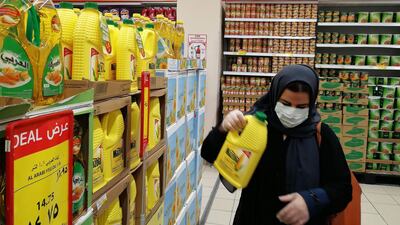
A picture taken on March 25, 2020 shows a veiled woman wearing a protective mask as she shops at a supermarket in the Saudi capital Riyadh. Saudi Arabia has reported 767 coronavirus infections -- the highest in the Gulf -- and faces the double blow of virus-led shutdowns and crashing oil prices. / AFP / FAYEZ NURELDINE
A picture taken on March 25, 2020 shows a veiled woman wearing a protective mask as she shops at a supermarket in the Saudi capital Riyadh. Saudi Arabia has reported 767 coronavirus infections -- the

How face coverings have gained acceptance during the pandemic


  • English
  • Arabic

Developments in Lombardy, the northern Italian region worst affected by the novel coronavirus, are rich in tragic irony. Over the weekend, it introduced a law to compel citizens to wear face masks outside their homes. But in December 2015, Lombardy became the first Italian region to outlaw face coverings in public offices and hospitals.

Austria has also executed a similar U-turn. On March 30, it joined several European countries – Slovakia, the Czech Republic and Bosnia-Herzegovina – in making face masks compulsory in public. But in 2017, a legal ban on clothing that covers the face was adopted by the Austrian parliament.

For at least a decade, face coverings have been considered dangerous. That they are now increasingly seen as de rigueur is indicative of the speed with which cultural perceptions can change

That was in line with the prevailing view of face coverings in many parts of the western world. Led by France, which in 2010 became the first in Europe to ban covering one’s face in a public place, mask-like articles of clothing became faintly sinister. It was as recently as August that the Netherlands’ 2016 Partial Ban on Face-Covering Clothing Act came into force.

The law prohibits the wearing of ski masks, full-face helmets, balaclavas, niqabs and burqas in public buildings including schools and hospitals and on public transport.

Such bans go beyond Europe. Sri Lanka instituted one in April 2019, soon after the Easter bombings. Hong Kong banned face masks in autumn 2019 after protests raged across the territory for most of the year, with masks worn both as a symbol of defiance and protection against tear gas. It was later rescinded by Hong Kong’s high court.

For at least a decade, face coverings have been considered dangerous. That they are now increasingly seen as de rigueur is indicative of the speed with which cultural perceptions can change.

The US is encouraging people to take measures to cover their faces, although president Donald Trump insists he won’t adopt the new look. But Joe Biden, the former US vice president and probable Democratic presidential nominee has said he would wear a mask in order to “follow the science”. Spain and Germany too are considering new recommendations.

Face masks have become a desirable commodity, with countries squabbling over the alleged hijacking of supplies. New online tutorials are on offer to help fashion face masks at home in a mere 15 minutes. Those who help form opinion in wide swaths of the world are suggesting that fashion and social mores adapt to allow widespread mask-wearing to limit the spread of infectious droplets in the air and discourage people from touching their faces. Everywhere, from Hong Kong to Vienna, masks are now seen as a protection rather than a threat.

Are we witnessing a cultural shift, even if in a minor key? The main point to note is that the basis for the prohibitions on face coverings is totally unrelated to the reason they are now in vogue. They were, for the most part, instituted at the height of the extremist threat in Europe and elsewhere. The original bans, which remain in force, sometimes explicitly target the niqab and burqa, and thereby some conservative Muslim women. Even when they don’t, the restrictions are seen as “burqa bans”, which is the way they are popularly described. They have consequently become a flashpoint in western debate on integration, extremism and freedom of religion. Belgium’s five-year-old ban is focused on Muslim articles of clothing. So is Latvia’s four-year-old ban and Norway’s 2018 legislation. Two Swedish municipalities have similar prohibitions. The troubling implications of a “burqa ban” were summed up by Italy’s justice minister when Lombardy’s right-wing governor introduced the region’s ban on face coverings five years ago. The minister deplored the measure as “propaganda – a domain in which the Islamist extremists are unbeatable”.

A woman wearing face mask walks in front of closed shops, in Cairo, Egypt, 03 April 2020. EPA

That was then. Public perception of face masks is changing around the world. Now, they are seen as a social good, with some experts suggesting that covering the nose and mouth may be useful in stopping the spread of the Covid-19 disease. As Austria’s chancellor Sebastian Kurz said when announcing the distribution of free masks at supermarket entrances: “It's clear that the wearing of masks will be a big change, but it is necessary”.

It is obvious that priorities and prescriptions will change in the dramatically altered circumstances of a once-in-a-century pandemic. The real question is as follows: Will it lead to a more generous interpretation of different cultural habits?

Perhaps. Already, sociologists are calling for face masks to be seen as symbols of collectivism. In the context of the coronavirus, that could mean social solidarity, banding together against contagion, neither spreading nor getting the infection. Philippines university anthropologist Gideon Lasco, an expert on mask culture, recently noted the “symbolic efficacy” of masks, which he said cover deep, unvoiced feelings about “cultural values, perceptions of control, social pressure, civic duty, family concerns, self-expression, beliefs about public institutions, and even politics”. He added that “masks are likely to become increasingly common as the climate crisis exacerbates wildfires and other natural disasters, as air pollution worsens in many cities, and as global connectivity heightens the risk of pandemics”.

That is a good point, considering the raging Australian bushfires prompted companies to fashion respirator masks infused with the scent of eucalyptus. The pandemic might similarly trigger a reassessment of the ultimate fashion statement, just as young Japanese wear masks patterned with anime or army camouflage. So, are we likely to see more broadly acceptable variations in a face veil? Might the “burqa bans” be reassessed too and more crucially, the attitude to culturally distinct customs of dress and behaviour?


COMPANY PROFILE

Name: Grubtech

Founders: Mohamed Al Fayed and Mohammed Hammedi

Launched: October 2019

Employees: 50

Financing stage: Seed round (raised $2 million)


KEY%20DATES%20IN%20AMAZON'S%20HISTORY
%3Cp%3E%3Cstrong%3EJuly%205%2C%201994%3A%3C%2Fstrong%3E%20Jeff%20Bezos%20founds%20Cadabra%20Inc%2C%20which%20would%20later%20be%20renamed%20to%20Amazon.com%2C%20because%20his%20lawyer%20misheard%20the%20name%20as%20'cadaver'.%20In%20its%20earliest%20days%2C%20the%20bookstore%20operated%20out%20of%20a%20rented%20garage%20in%20Bellevue%2C%20Washington%3C%2Fp%3E%0A%3Cp%3E%3Cstrong%3EJuly%2016%2C%201995%3A%3C%2Fstrong%3E%20Amazon%20formally%20opens%20as%20an%20online%20bookseller.%20%3Cem%3EFluid%20Concepts%20and%20Creative%20Analogies%3A%20Computer%20Models%20of%20the%20Fundamental%20Mechanisms%20of%20Thought%3C%2Fem%3E%20becomes%20the%20first%20item%20sold%20on%20Amazon%3C%2Fp%3E%0A%3Cp%3E%3Cstrong%3E1997%3A%3C%2Fstrong%3E%20Amazon%20goes%20public%20at%20%2418%20a%20share%2C%20which%20has%20grown%20about%201%2C000%20per%20cent%20at%20present.%20Its%20highest%20closing%20price%20was%20%24197.85%20on%20June%2027%2C%202024%3C%2Fp%3E%0A%3Cp%3E%3Cstrong%3E1998%3A%3C%2Fstrong%3E%20Amazon%20acquires%20IMDb%2C%20its%20first%20major%20acquisition.%20It%20also%20starts%20selling%20CDs%20and%20DVDs%3C%2Fp%3E%0A%3Cp%3E%3Cstrong%3E2000%3A%3C%2Fstrong%3E%20Amazon%20Marketplace%20opens%2C%20allowing%20people%20to%20sell%20items%20on%20the%20website%3C%2Fp%3E%0A%3Cp%3E%3Cstrong%3E2002%3A%3C%2Fstrong%3E%20Amazon%20forms%20what%20would%20become%20Amazon%20Web%20Services%2C%20opening%20the%20Amazon.com%20platform%20to%20all%20developers.%20The%20cloud%20unit%20would%20follow%20in%202006%3C%2Fp%3E%0A%3Cp%3E%3Cstrong%3E2003%3A%3C%2Fstrong%3E%20Amazon%20turns%20in%20an%20annual%20profit%20of%20%2475%20million%2C%20the%20first%20time%20it%20ended%20a%20year%20in%20the%20black%3C%2Fp%3E%0A%3Cp%3E%3Cstrong%3E2005%3A%3C%2Fstrong%3E%20Amazon%20Prime%20is%20introduced%2C%20its%20first-ever%20subscription%20service%20that%20offered%20US%20customers%20free%20two-day%20shipping%20for%20%2479%20a%20year%3C%2Fp%3E%0A%3Cp%3E%3Cstrong%3E2006%3A%3C%2Fstrong%3E%20Amazon%20Unbox%20is%20unveiled%2C%20the%20company's%20video%20service%20that%20would%20later%20morph%20into%20Amazon%20Instant%20Video%20and%2C%20ultimately%2C%20Amazon%20Video%3C%2Fp%3E%0A%3Cp%3E%3Cstrong%3E2007%3A%3C%2Fstrong%3E%20Amazon's%20first%20hardware%20product%2C%20the%20Kindle%20e-reader%2C%20is%20introduced%3B%20the%20Fire%20TV%20and%20Fire%20Phone%20would%20come%20in%202014.%20Grocery%20service%20Amazon%20Fresh%20is%20also%20started%3C%2Fp%3E%0A%3Cp%3E%3Cstrong%3E2009%3A%3C%2Fstrong%3E%20Amazon%20introduces%20Amazon%20Basics%2C%20its%20in-house%20label%20for%20a%20variety%20of%20products%3C%2Fp%3E%0A%3Cp%3E%3Cstrong%3E2010%3A%3C%2Fstrong%3E%20The%20foundations%20for%20Amazon%20Studios%20were%20laid.%20Its%20first%20original%20streaming%20content%20debuted%20in%202013%3C%2Fp%3E%0A%3Cp%3E%3Cstrong%3E2011%3A%3C%2Fstrong%3E%20The%20Amazon%20Appstore%20for%20Google's%20Android%20is%20launched.%20It%20is%20still%20unavailable%20on%20Apple's%20iOS%3C%2Fp%3E%0A%3Cp%3E%3Cstrong%3E2014%3A%3C%2Fstrong%3E%20The%20Amazon%20Echo%20is%20launched%2C%20a%20speaker%20that%20acts%20as%20a%20personal%20digital%20assistant%20powered%20by%20Alexa%3C%2Fp%3E%0A%3Cp%3E%3Cstrong%3E2017%3A%3C%2Fstrong%3E%20Amazon%20acquires%20Whole%20Foods%20for%20%2413.7%20billion%2C%20its%20biggest%20acquisition%3C%2Fp%3E%0A%3Cp%3E%3Cstrong%3E2018%3A%3C%2Fstrong%3E%20Amazon's%20market%20cap%20briefly%20crosses%20the%20%241%20trillion%20mark%2C%20making%20it%2C%20at%20the%20time%2C%20only%20the%20third%20company%20to%20achieve%20that%20milestone%3C%2Fp%3E%0A
360Vuz PROFILE

Date started: January 2017
Founder: Khaled Zaatarah 
Based: Dubai and Los Angeles
Sector: Technology 
Size: 21 employees
Funding: $7 million 
Investors: Shorooq Partners, KBW Ventures, Vision Ventures, Hala Ventures, 500Startups, Plug and Play, Magnus Olsson, Samih Toukan, Jonathan Labin

Pakistanis%20at%20the%20ILT20%20
%3Cp%3EThe%20new%20UAE%20league%20has%20been%20boosted%20this%20season%20by%20the%20arrival%20of%20five%20Pakistanis%2C%20who%20were%20not%20released%20to%20play%20last%20year.%20%0D%3Cbr%3E%0D%0D%0D%3Cbr%3E%3Cstrong%3EShaheen%20Afridi%20(Desert%20Vipers)%20%3C%2Fstrong%3E%0D%3Cbr%3ESet%20for%20at%20least%20four%20matches%2C%20having%20arrived%20from%20New%20Zealand%20where%20he%20captained%20Pakistan%20in%20a%20series%20loss.%20%0D%3C%2Fp%3E%0A%3Cp%3E%3Cstrong%3EShadab%20Khan%20(Desert%20Vipers)%20%3C%2Fstrong%3E%0D%3Cbr%3E%0DThe%20leg-spin%20bowling%20allrounder%20missed%20the%20tour%20of%20New%20Zealand%20after%20injuring%20an%20ankle%20when%20stepping%20on%20a%20ball.%20%0D%3C%2Fp%3E%0A%3Cp%3E%3Cstrong%3EAzam%20Khan%20(Desert%20Vipers)%20%3C%2Fstrong%3E%0D%3Cbr%3EPowerhouse%20wicketkeeper%20played%20three%20games%20for%20Pakistan%20on%20tour%20in%20New%20Zealand.%20He%20was%20the%20first%20Pakistani%20recruited%20to%20the%20ILT20.%20%0D%3C%2Fp%3E%0A%3Cp%3E%3Cstrong%3EMohammed%20Amir%20(Desert%20Vipers)%20%3C%2Fstrong%3E%0D%3Cbr%3EHas%20made%20himself%20unavailable%20for%20national%20duty%2C%20meaning%20he%20will%20be%20available%20for%20the%20entire%20ILT20%20campaign.%20%0D%3C%2Fp%3E%0A%3Cp%3E%3Cstrong%3EImad%20Wasim%20(Abu%20Dhabi%20Knight%20Riders)%20%3C%2Fstrong%3E%0D%3Cbr%3EThe%20left-handed%20allrounder%2C%2035%2C%20retired%20from%20international%20cricket%20in%20November%20and%20was%20subsequently%20recruited%20by%20the%20Knight%20Riders.%26nbsp%3B%3C%2Fp%3E%0A
The President's Cake

Director: Hasan Hadi

Starring: Baneen Ahmad Nayyef, Waheed Thabet Khreibat, Sajad Mohamad Qasem 

Rating: 4/5

The specs

Engine: 3.9-litre twin-turbo V8

Transmission: seven-speed

Power: 720hp

Torque: 770Nm

Price: Dh1,100,000

On sale: now

ABU DHABI T10: DAY TWO

Bangla Tigers v Deccan Gladiators (3.30pm)

Delhi Bulls v Karnataka Tuskers (5.45pm)

Northern Warriors v Qalandars (8.00pm)

Tamkeen's offering
  • Option 1: 70% in year 1, 50% in year 2, 30% in year 3
  • Option 2: 50% across three years
  • Option 3: 30% across five years 
Dengue%20fever%20symptoms
%3Cul%3E%0A%3Cli%3EHigh%20fever%3C%2Fli%3E%0A%3Cli%3EIntense%20pain%20behind%20your%20eyes%3C%2Fli%3E%0A%3Cli%3ESevere%20headache%3C%2Fli%3E%0A%3Cli%3EMuscle%20and%20joint%20pains%3C%2Fli%3E%0A%3Cli%3ENausea%3C%2Fli%3E%0A%3Cli%3EVomiting%3C%2Fli%3E%0A%3Cli%3ESwollen%20glands%3C%2Fli%3E%0A%3Cli%3ERash%3C%2Fli%3E%0A%3C%2Ful%3E%0A%3Cp%3EIf%20symptoms%20occur%2C%20they%20usually%20last%20for%20two-seven%20days%3C%2Fp%3E%0A
FFP EXPLAINED

What is Financial Fair Play?
Introduced in 2011 by Uefa, European football’s governing body, it demands that clubs live within their means. Chiefly, spend within their income and not make substantial losses.

What the rules dictate?
The second phase of its implementation limits losses to €30 million (Dh136m) over three seasons. Extra expenditure is permitted for investment in sustainable areas (youth academies, stadium development, etc). Money provided by owners is not viewed as income. Revenue from “related parties” to those owners is assessed by Uefa's “financial control body” to be sure it is a fair value, or in line with market prices.

What are the penalties?
There are a number of punishments, including fines, a loss of prize money or having to reduce squad size for European competition – as happened to PSG in 2014. There is even the threat of a competition ban, which could in theory lead to PSG’s suspension from the Uefa Champions League.