

The coronavirus, which causes the disease known as Covid-19, has spread from a single city in China to more than 190 nations, infecting – according to official records – nearly 750,000 people worldwide in three months. It has exploited our interconnected world, travelling unhindered – by plane, train and car. It has propagated in social circles, infecting people during business meetings, gatherings with friends and family outings. Physical distancing from one another has now become necessary to fend off the virus and to protect each other.
Despite coronavirus, however, the world’s connectedness and our ability to maintain strong diplomatic, business and personal ties beyond national borders are not weaknesses. These are strengths that can help us to battle the pandemic together.
Earlier this month, Europe became an active hotspot in the ongoing global pandemic. Italy alone recorded more than 100,000 cases, with a 9 per cent mortality rate, while 80,000 people have contracted the virus in Spain with more than 7,000 dying from complications. Overwhelmed by demands for aid and medical equipment, the European Union has been unable to provide all necessary supplies to hard-hit nations.
In the face of such a tragedy, responsible companies and world leaders have stepped up to come Europe’s aid. Abu Dhabi National Exhibitions Company, for example, is currently working with British authorities to temporarily convert ExCeL London, London’s largest exhibition venue and one of Adnec’s properties, into the NHS Nightingale Hospital. The emergency healthcare centre will be equipped with 4,000 beds dedicated to Covid-19 patients. In a tweet on Saturday, Adnec emphasised “the importance of everyone playing a role in national and international efforts across borders.” The field hospital is expected to open this week.
-
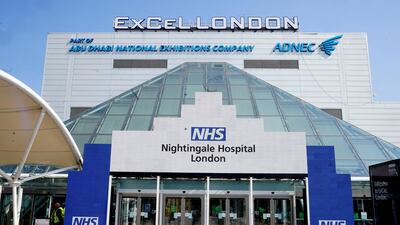
The new NHS Nightingale Hospital, built to fight against the spread of coronavirus, in London. Courtesy: Reuters -
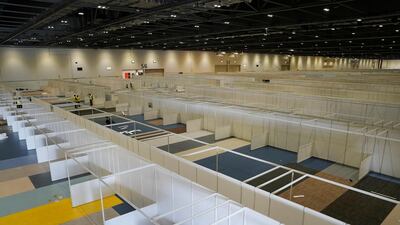
Contractors and members of the armed forces help to build the new NHS Nightingale Hospital. Courtesy: Reuters -
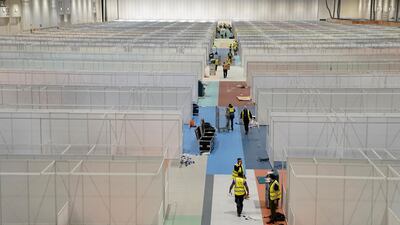
Vital use is being made of the spacious exhibition centre. Courtesy: Reuters -
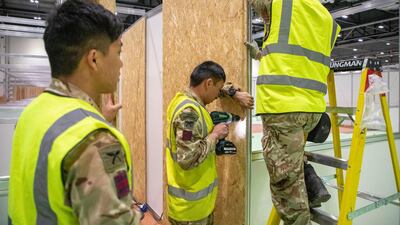
Members of the Queen's Ghurka Engineers Regiment have been enlisted for the task of turning an exhibition space into a medical facility. Courtesy EPA -

A member of the Queen's Ghurka Engineers Regiment helps to build the new NHS Nightingale Hospital. Courtesy Reuters -
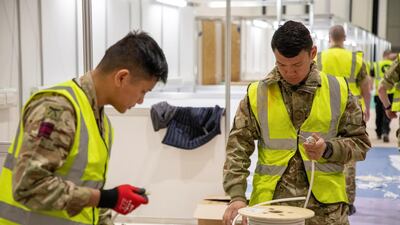
Members of the Queen's Ghurka Engineers Regiment, 36 Engineer Regiment, help to build the new NHS Nightingale Hospital. REUTERS -
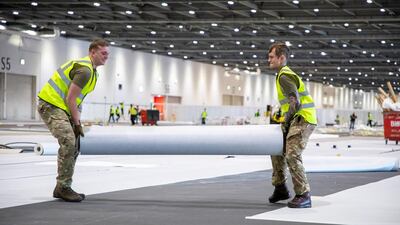
Soldiers from 1 Royal Anglian Regiment gt to work on constructing the emergency hospital. Courtesy EPA -
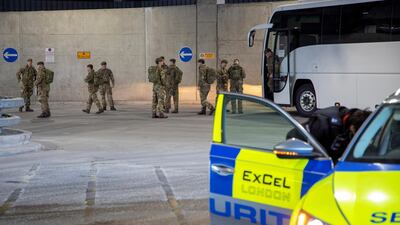
Soldiers from 1 Royal Anglian Regiment arrive at the Excel Centre to build the new NHS Nightingale Hospital. Courtesy Reuters -
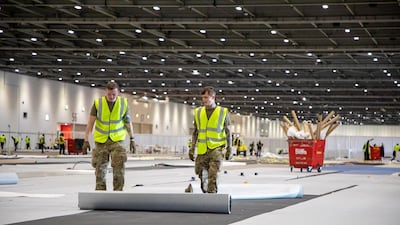
Soldiers from 1 Royal Anglian Regiment assist with the construction of the new NHS Nightingale Hospital. Courtesy Reuters -

Members of the Queen's Ghurka Engineers Regiment lend a vital helping hand to efforts to tackle the coronavirus pandemic. Courtesy Reuters -
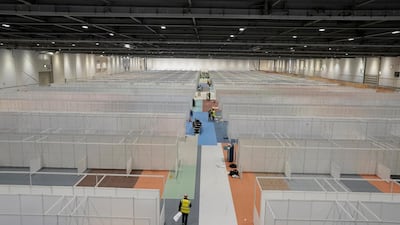
ExCel London is being transformed into a 4,000-bed field hospital. Courtesy: Reuters -

Soldiers from 1 Royal Anglian Regiment arrive at the Excel Centre to build the new NHS Nightingale Hospital. Courtesy Reuters -
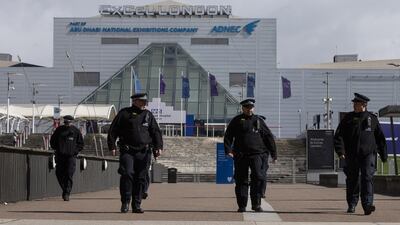
Metropolitan Police officers stand outside the new NHS Nightingale Hospital at ExCeL London. Courtesy Getty Images


The UAE Air Force has also helped the World Health Organisation deliver tonnes of medical supplies to Iran, Lebanon and other nations that require assistance. The cargo includes masks, gloves and testing kits, in a co-ordinated effort with the International Humanitarian City in Dubai.
The UAE has also sent aid to a number of countries, including Greece and Serbia. Similar efforts have been carried out by other nations worldwide.
The world’s biggest economies, which convened at the G20 summit last week, have come together to offset the economic impact of the virus. The global health crisis is already costing millions of people their jobs and, for many, their sole source income. Globally, countries have rolled out stimulus packages totalling $5 trillion, with the US alone dedicating $2 trillion to keep its economy afloat.
On Sunday, an aircraft carrying 80 tonnes of medical supplies from Shanghai arrived in New York to help the US halt the virus’s spread within its borders. It is the first of 22 scheduled flights carrying essential medical goods from China to America.
These vital initiatives should inspire world leaders to keep up the momentum and to offer help, not only to their own people, but also to their neighbours and to those suffering from coronavirus in faraway lands. The only means to defeat a virus that knows no borders is to roll out initiatives that do not stop at our frontiers.

