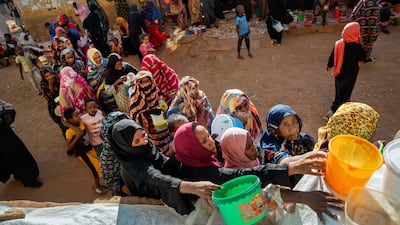

According to the World Food Programme this week, 20 million Sudanese civilians facing acute hunger in their war-torn country. Five million are at emergency levels of hunger and 200,000 are already experiencing what the UN organisation calls “catastrophic” shortages of food. None of this is hyperbole – it is on a scale of suffering that should command the world’s full attention.
Instead, WFP acting chief Carl Skau has said that the agency may be forced to scale back operations within weeks because funding has fallen. In El Fasher, a city that once held a million people, only 20,000 now receive any food assistance at all. In Tawila, Darfur, where nearly one million people are now sheltering, the WFP is providing food to about 950,000 people each month but can afford only half rations.
Right now, the world is too distracted by multiple crises to take note of a humanitarian response in retreat. This is a mistake, and not just a moral one. The cost of neglecting Sudan – a large country that is central to the Red Sea and the Horn of Africa – will have consequences for not only for its long-suffering people but for its neighbours and beyond.
Already, mass displacement caused by Sudan’s three-year war is pushing migration flows towards the Mediterranean, the Gulf and neighbouring countries such as Chad, South Sudan and Ethiopia. Violent instability along the Red Sea coast threatens shipping lanes that are already under strain. Failing harvests – worsened by poor rains, fighting in agricultural areas and the rising price of fuel and fertilisers – will not remain a local food problem. Sudan’s hunger crisis is a test of whether funding fatigue and geopolitical rivalries will determine who gets to eat and who does not.
The UAE has provided $800 million in aid to Sudan since the war began in April 2023, and has pushed, along with the US, at the UN Security Council for a nationwide arms embargo. However, goodwill from some individual countries cannot replace the collective response this crisis demands. The world should not treat the cost of sustaining life-saving operations in Sudan as an optional measure. Responding to save Sudan’s civilians would be an investment in an entire neighbourhood’s stability.
Yet as desirable as stability would be, it should not mean merely rehabilitating Sudan’s warring generals. Three years of fighting have shown the limits of letting armed leaderships dictate the country’s political future. Both sides in the conflict have been accused of committing mass atrocities, with evidence pointing to the Sudanese Armed Forces’ use of chemical weapons. That is why comments made in Dubai on Tuesday by Massad Boulos, a senior adviser to US President Donald Trump, are significant.
Mr Boulos said that neither Gen Abdel Fattah Al Burhan nor Gen Mohamed Dagalo has a future in Sudan’s leadership, and that Washington backs a rapid, civilian-led transition instead. The principle that Sudan’s future belongs to its people and not its armed factions should now guide every diplomatic and humanitarian effort to end this devastating conflict.

