
The World Food Programme could be forced to sharply cut food aid to Sudan within weeks because of a funding shortfall, its acting chief said on Monday, as 20 million people in the war-torn country face acute hunger.
“Our operations are completely underfunded and there is a risk that we will have to scale back quite significantly in the next few weeks unless more funding is being provided,” Carl Skau told reporters in New York after an eight-day visit to the US.
WFP needs just under $300 million to sustain its current operations in Sudan, Mr Skau said. The agency has received about $206 million so far this year, compared with $645 million last year, as humanitarian agencies struggle with a wider decline in donor funding.
Sudan remains the world’s largest hunger and displacement crisis, Mr Skau said, with 14 million people displaced and about five million facing emergency levels of hunger. About 200,000 people are at catastrophic levels of food shortage, he said.

WFP reaches between four million to five million people each month, including up to 2.5 million in some of the hardest-to-reach areas, but funding shortages are limiting how much assistance it can provide.
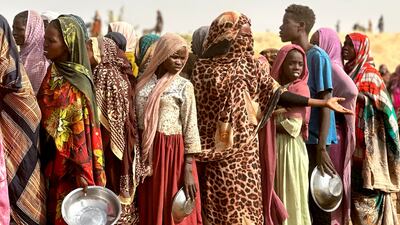
In Tawila, Darfur, where nearly one million people are now sheltering, WFP is providing food to about 950,000 people each month but can afford only half rations.
“We are now delivering to the entire population, to some 950,000 people every month. But we're only providing a half ration. We are only providing them the food that lasts them for two weeks and that is done every month,” Mr Skau said.
The funding shortage comes as drought threatens to further worsen food insecurity in Darfur and hit agricultural production.
“Darfur hasn't been this dry since 1984 and right now is the rainy season. And so, you know, everyone is frightened that this will have a serious hit on agriculture and the agriculture outcome,” Mr Skau said.

Mr Skau also visited El Fasher, where he said only tens of thousands of people remained in a city that was once home to about one million, after an 18-month siege, famine and atrocities.
“We are reaching some 20,000 people now with life-saving food assistance, but that's the only assistance, frankly, that gets into El Fasher. It's the only thing that the people who are still there rely on,” he said.
Fighting is now intensifying in Kordofan and Blue Nile, Mr Skau said, describing the regions as the new centre of the conflict.
“We certainly failed to protect and prevent the atrocities in El Fasher last year and we have not done enough for those IDPs who have ended up in camps,” he said.
“But we need to do more. We need to step up. We cannot keep failing these people.”

