
Amid the pile of smouldering rubble and twisted metal produced by Israel’s brazen attack on Iran’s embassy in Damascus this week was a particularly diverting sight – a portrait of Qassem Suleimani, the commander of the Islamic Revolutionary Guard Corps’ Quds Force who was assassinated in a 2020 US airstrike. Monday’s strike in the heart of the Syrian capital claimed the life of another senior Quds Force figure, Mohammad Reza Zahedi, who commanded units in Syria and Lebanon.
The undeclared war between Israel and Iran took a dangerous turn on Monday, after years of tit-for-tat targeting between the two countries, and often played out in Arab countries. Expectations are that Iran will seek to re-establish its deterrence, whether by responding directly or by using its extensive and destabilising network of regional proxies to hit back against Israeli and US targets in the region.
-
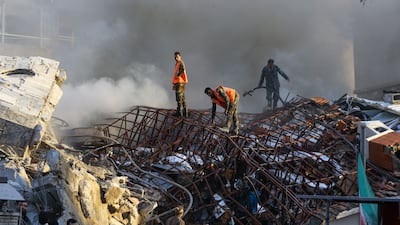
Emergency personnel extinguish a fire at the Iranian embassy compound in Damascus after it was hit by an Israeli air strike. AFP -
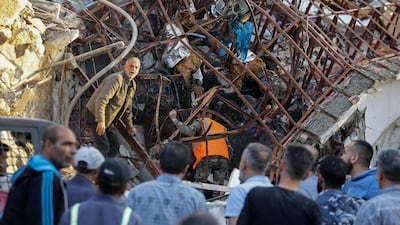
Emergency and security workers comb the rubble following the attack, which killed at least 11 people including senior Islamic Revolutionary Guard Corps commanders, in the Syrian capital. AFP -

Syrian Foreign Minister Faisal Mekdad (centre) visits the embassy compound, in the central Mezzeh area of the city. AFP -
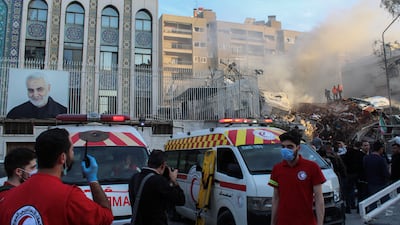
Members of the Syrian Red Crescent work at the scene in Damascus. The head of the Quds Force in Lebanon was among the dead. Reuters -
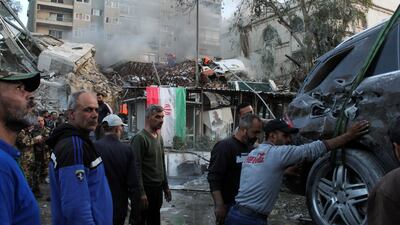
A destroyed vehicle is taken away from the Iranian embassy compound in the Syrian capital. Reuters -

Iranian President Ebrahim Raisi warned that the attack would 'not go unpunished'. AFP -

The strike is the most significant attack against an Iranian target since the Gaza war began. EPA -
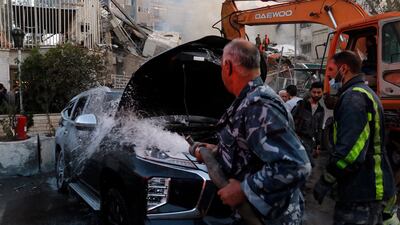
A damaged vehicle is doused following the air strike in Damascus. EPA -
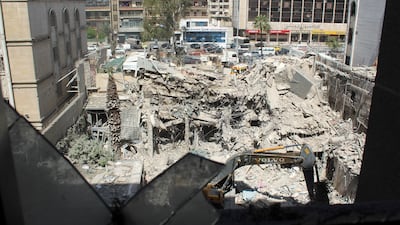
An Israeli army spokesman claimed the embassy compound was a military site 'disguised' as a diplomatic site. Reuters -

Brig Gen Mohammad Reza Zahedi, a senior commander of the Islamic Revolutionary Guard Corps' Quds Force, was killed. AFP


There has been much speculation about what might follow Damascus, but those who claim that this attack and others like it are executed to protect Israel from its main regional enemy should ask themselves the following: is the country really any safer today that it was before Monday? Arguably, no, and it is the decades-long failure to resolve the Palestinian question that endangers Israel’s security more than anything else.
This is not to suggest that the IRGC has been anything but a malign force for instability in the Middle East – its meddling in other countries’ conflicts is something that continues to fuel Iran’s international isolation, and its bellicose rhetoric and action against Israel are almost guaranteed to draw a lethal response. But the Israeli strike in Damascus was so unprecedented and in violation of international norms that, when coupled with its continuing war on Gaza and occupation in the West Bank, the country faces increasing political and diplomatic isolation of its own.
The question facing Israel’s public is this: is anything that the current government is doing making the country safer or moving it closer to recovering its hostages? In the past week alone, the world has seen Israeli forces reduce Gaza’s Al Shifa Hospital to rubble and repeatedly bomb a convoy of international aid workers. Hunger, disease and death stalk the Palestinian enclave, and Israeli actions have led to the suspension of international aid efforts. In fact, what we are seeing are tactics without strategy, authorised by an Israeli leadership that is impervious to persuasion, even from its main US partner.
Far from establishing security for the country, Israel’s actions are making things worse. Strikes on IRGC figures may set back the so-called Axis of Resistance, but from Lebanon to Yemen, Iran-backed proxies will prepare to respond. Without an end to the bloodshed in Gaza and even a tentative attempt to end the occupation,, it seems near impossible to get Israel on a path that isn't set on a trajectory of chronic instability, isolation and insecurity that it cannot bomb itself out of.

