


As symbols for shattered sovereignty and political failure go, few beat the forlorn ruins of Gaza’s international airport. On its opening day on November 24, 1998, planes from Egypt, Morocco, Spain, Austria and the now-defunct Palestinian Airlines could be seen at Yasser Arafat International Airport, close to the border with Egypt. Along with plans for a major seaport, the air link was part of the Oslo agreements reached in 1993 that offered Palestinians even a limited taste of life free from Israeli occupation.
Fast forward to 2024 and the airport is still in ruins, having been bombed in 2001 by Israeli forces, who then went on to rip up its runway with bulldozers the following year. Work on the seaport began in July 2000 but ground to a halt amid a lack of construction materials and the turmoil of the Second Intifada that erupted later that year. Gaza remains without the infrastructure necessary to import goods by sea – an issue that has become painfully apparent amid the recent rush to build a floating pier off its shoreline that would allow emergency aid to be unloaded.
The lack of vital infrastructure is one of the reasons the Palestinian enclave has remained impoverished and dependent on aid for decades. This imposed helplessness has been exacerbated by Israel’s military response to Hamas’s October 7 attacks. At the start of February, the UNRWA – the UN agency for Palestinian refugees – said more than 70 per cent of civilian infrastructure, including homes, hospitals and schools, have been destroyed or severely damaged. While those who have died can never be replaced, and those orphaned or severely injured cannot be made whole, rebuilding infrastructure will take years of funding, planning and work.
-
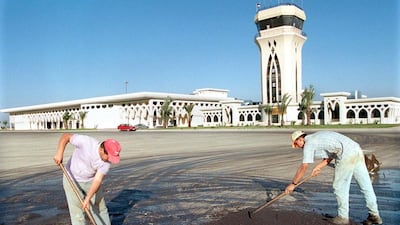
October 27, 1998: Palestinians workers asphalt a road at Gaza international airport on the Gaza Strip. The Wye River memorandum signed in Washington by Palestinian Authority President Yasser Arafat and Israeli Premier Benjamin Netanyahu finally clinched a deal to open the airport early November. AFP Photo -
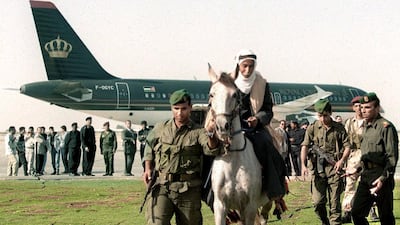
November 24, 1998: A Palestinian policeman leads a horse rider away from a Jordanian plane which landed on the Gaza international airport before its opening day. AFP Photo -
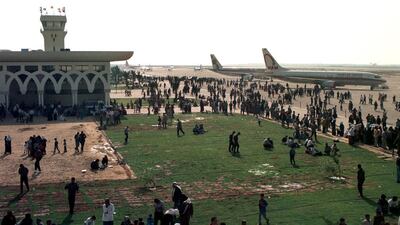
November 24, 1998: A general view of Gaza international airport on its inauguration when planes from Egypt, Morocco, Spain, Austria, the European Community and then Palestinian Airlines landed. The airport cost US$ 250 million to build and its opening was delayed some 20 months. AFP Photo -

December 13, 1998: Two huge US and Palestinian flags hang from the control tower of the Gaza international airport in Rafah City ahead of the historic visit by US president Bill Clinton – the first ever visit by a US president to the Palestinian territories. AFP Photo -
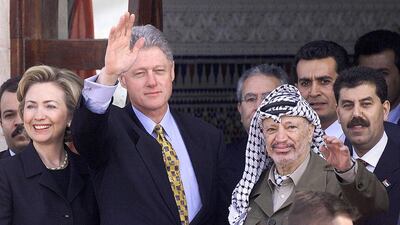
December 14, 1998: Then-US president Bill Clinton, second from left, who was accompanied by his wife Hillary, left, and Palestinian President Yasser Arafat, wave to the crowds upon the Clintons’ arrival at the Gaza international airport in Rafah. Clinton made history when he flew into Gaza airport on a highly symbolic first visit ever by a US leader to the Palestinian territories. AFP Photo -
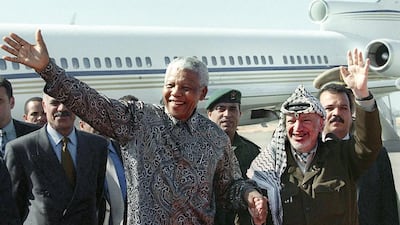
October 19, 1999: Palestinian Authority president Yasser Arafat and the former president of South Africa Nelson Mandela wave to a cheering crowd during their meeting at Gaza international airport. AFP Photo -

September 9, 2001: A lone luggage trolley stands in front of the abandoned check-in counters at the Gaza international airport, outside the southern Gaza town of Rafah. The 70-million-dollar airport which opened in November 1998 was closed forced tp close in February 2001 during a conflict with Israel. AFP Photo -
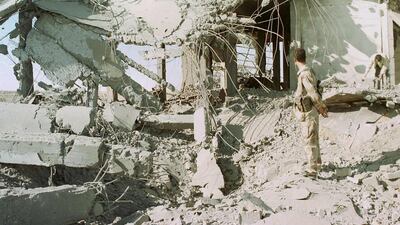
December 13, 2001: A Palestinian police officer inspects the rubble of a building at the Gaza international airport in Rafah after Israeli raids. Israeli warplanes bombarded Palestinian security buildings in the Gaza Strip and West Bank in swift revenge during the second intifida AFP Photo -
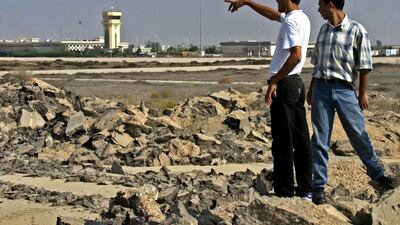
November 8, 2004: Palestinian security personnel walk on the Gaza international airport strip that was destroyed by the Israeli army bulldozers nearly three years before. Said Khatib/AFP Photo -
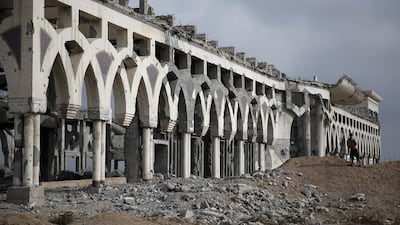
August 18, 2014: A Palestinian boy standing outside the destroyed and deserted Gaza Strip’s former international airport in the southern town of Rafah. Residents of Gaza dream of the day planes will land and take off here again – a key demand of the Islamist Hamas movement and was at the heart of the 50-day Gaza-Israel conflict that ended with a ceasefire last week. Thomas Coex/ AFP Photo


But who will pay for all this? Those looking to the US will not be reassured, having seen its politicians feuding about whether to keep spending taxpayers’ money on supplying Ukraine – an American ally – with much-needed arms. Similarly, the EU has provided an enormous sum – €88 billion ($96.2 billion) and counting – in economic, humanitarian and military support for Ukraine since the 2022 invasion by Russia. Given their many spending commitments, persuading the West to invest heavily in Gazan reconstruction may prove difficult.
What of Israel? Fourteen years ago, the country paid the UNRWA $10.5 million for damage caused by its forces during the 2008-2009 Gaza War. According to a report from Gisha, an Israeli human rights NGO, this sum was barely enough to cover the estimated $10 million cost of the damage done to Gaza’s electricity network alone. Given the rhetoric coming from Israel’s current leadership, and despite the pragmatic sense it would make for Israeli security to have a functional and stable neighbour, it seems unlikely that funding to rebuild will come from this quarter.
Attention has turned to Arab states to potentially step in and pay for rebuilding Gaza. Despite many countries in the Arab world donating often and well to Palestinian relief efforts, these nations are wary of funding reconstruction for damage they did not cause and that could be bombed flat again at a moment’s notice.
More importantly, for Arab countries, funding is the not the key issue – the lack of a political process is. A clear programme that begins with a ceasefire and ends with the political solution that just about all parties recognise is the way out of the conflict is what’s needed. Where there is consensus, funds and action can follow effectively. In a recent interview with The National, GCC Secretary General Jasem Al Budaiwi recalled how, within days of Israel’s strikes on Gaza after Hamas’s attack on October 7, the bloc’s foreign ministers met in an extraordinary session and within 45 minutes had agreed on $100 million in humanitarian aid.
Reconstruction after a war is never easy. As well as funding and stability, much will also depend upon the role of the Palestinian leadership, which will have to be supported as it attempts to reassert itself as capable and representative.
But the rubble of Gaza’s airport tells us one thing: that better times are possible. The optimism of the Oslo years, and the tantalising glimpse of a Palestine that was open to the world should not be forgotten. While Norway’s Foreign Minister Espen Barth Eide concurred that ultimately the Oslo Accords led to “false promises”, he and other officials from around the world are trying to make those promises realities. The resolve of the Palestinian people should be enough inspiration for those with the patience and fortitude to rebuild when this war ends.

