


It is hard to fully articulate the scale of Lebanon's collapse in recent years, but there are vivid anecdotes and examples of failings that can help illustrate the size of the catastrophe. It might be Beirut resident Christian Mischler's tweet last week showing a bill that charged inflated prices for the same cup of coffee ordered just three hours later, or proliferating seagulls next to Beirut International Airport due to mounting rubbish, a serious danger to landing planes.
Still, faced with a spiralling currency and rising poverty, the extent of the problem is hard to fathom and summarise for anyone not living in the country.
But if there was ever a symbol to capture the entirety of Lebanon's disastrous situation it would be the blast at Beirut's port in 2020, which killed 220 people and injured many more. There has still been little closure for the victims' families and for those who lost so much that day. Two and a half years on, no justice has been served.
But this week has seen important progress. On Monday, the investigation into the blast resumed after more than a year of delays due to legal challenges from top politicians. The announcement followed clashes this month between families of victims and the police outside the Palais de Justice over the judicial blockage. No senior official has been held accountable.
The following day, a Lebanese judge investigating the explosion, Tarek Bitar, charged the country's top public prosecutor Ghassan Oweidat and three other judges in connection with the blast, according to judicial sources. Mr Bitar has also charged Hassan Diab, who was prime minister at the time of the explosion, and two former ministers with homicide with probable intent.
Mr Bitar has a very hard job on his hands. Iran-backed Hezbollah has sought to cast his work as politically motivated. Nonetheless, many of the families of the victims support his drive for answers and justice.
And there are hopes that his position, and that of other Lebanese people working for justice, is getting more secure.
The new year has also seen engagement from foreign powers. In a country where bad news stories have sadly become the norm, the dramatic blast at least brought renewed international attention and solidarity for the Lebanese people. This is being continued in 2023. Even more than two years on, footage of the largest non-nuclear explosion in history tearing through Beirut and the terrible aftermath remain hard to forget.
-
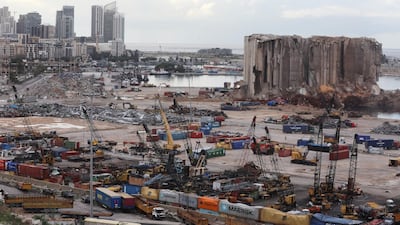
The site of the August 4 explosion at Beirut port in December. Reuters -
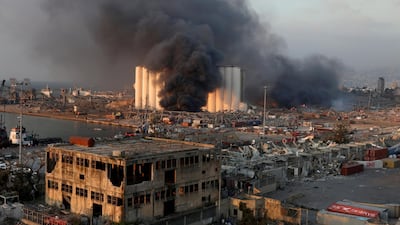
Smoke rises from the site of an explosion in Beirut's port area, Lebanon on August 4, 2020. Reuters -
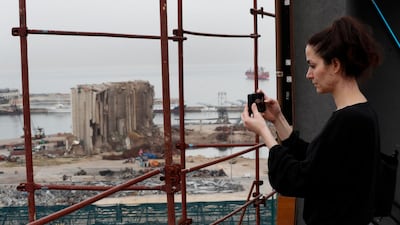
Joana Dagher, 33, who lost her memory for two full months from the trauma she suffered in the massive August explosion at the Beirut port takes pictures of the explosion scene from her damaged apartment rooftop. AP -
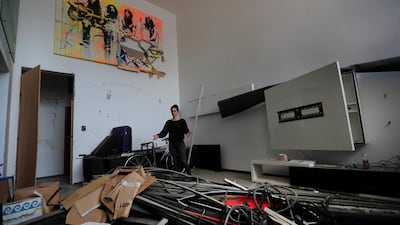
The mental health impact of the Beirut explosion that killed more than 200 and wounded more than 6,000 continues to lay its heavy weight on those who managed to survive the day. AP -
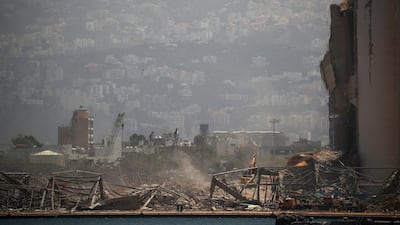
A general view shows damage at the site of the blast in Beirut's port area, Lebanon. Reuters -

A drone picture shows the destruction after the explosion in the seaport of Beirut, Lebanon. AP


Efforts are rightly being made to expose corruption across society, particularly in high-level politics. This week, EU investigators visiting Lebanon as part of a corruption inquiry into Central Bank Governor Riad Salameh have said that the trip was a success.
The visit, the first of its kind, comes as part of a multi-country investigation, including judges from France, Germany, Belgium and Switzerland, looking into the alleged embezzlement of more than $330 million from Lebanon's central bank.
Speaking to The National, a diplomatic source said: “We had some complications at first, but the co-operation turned out to be very smooth; this is a very encouraging sign for the coming steps.” Zena Wakim, a lawyer for the Swiss foundation Accountability Now, said the trip has triggered an “unprecedented awakening” among senior figures.
The probe is not about the blast specifically, but such an awakening would show previously untouchable elites that the powerful are not immune from consequences. That could mean that the failings which led to tragedies such as the blast are prevented in the future.
Today, the still-standing ruined grain silos by the port serve as a reminder of the ongoing inability to move on from the tragedy. One day, they will be torn down. Whether the same can be said of the corrupt networks that led to and covered up responsibility for the blast remains to be seen. But this week has brought a rare indication that they might, and fledgling hope for families of the victims and all Lebanese people who remain traumatised by their country's crises.

