


"We are close to a big victory.” These were the triumphant words of Israel’s most consequential politician and prime minister in recent decades, Benjamin Netanyahu, early on Wednesday morning.
Although results are not yet certain, early polls from his country’s latest elections suggest that Mr Netanyahu, once again, is heading for power.
No one running in the contest is more experienced than him when it comes to the Israeli premiership. That is why, regardless of all the controversy his career represents, partners in the region will work with him, hoping he will pursue responsible policies if he gets into office.
If he does, he has a complex task ahead both at home and abroad. While he is experienced, Mr Netanyahu has also been Israel’s most divisive politician for years. He is still under investigation for alleged corruption while he was last in power.
-
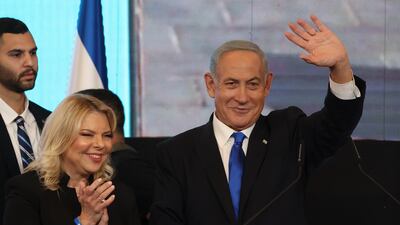
Former Israeli prime minister and leader of the Likud party Benjamin Netanyahu and his wife Sara greet supporters in Jerusalem as Israelis went to the polls on Tuesday. EPA -
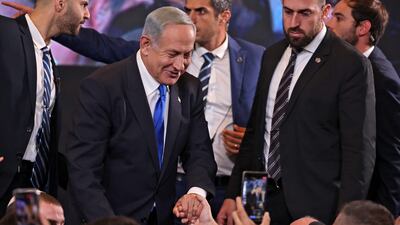
Mr Netanyahu greets supporters after the end of voting for the national elections. AFP -
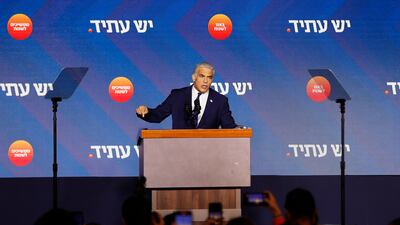
Prime Minister Yair Lapid addresses supporters at his campaign headquarters in Tel Aviv. EPA -
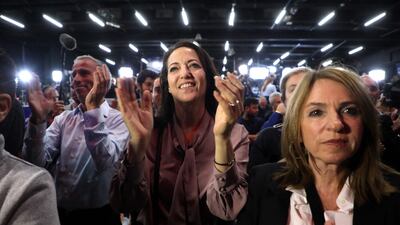
The prime minister's wife Lihi Lapid, centre, cheers her husband. AFP -

The leader of the Otzma Yehudit (Jewish Power) far-right party Itamar Ben Gvir at his party's campaign headquarters in Jerusalem. AFP -
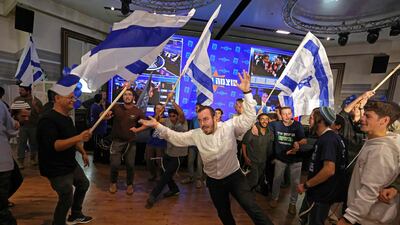
Otzma Yehudit party members in upbeat mood. AFP -
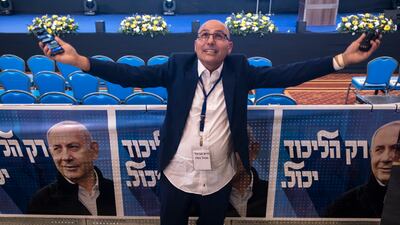
A Likud party supporter responds to favourable exit polls. Getty -
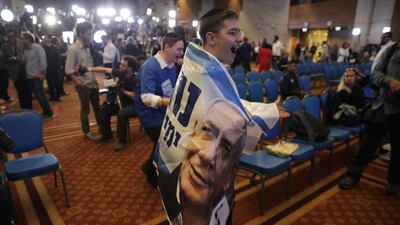
Supporters of Mr Netanyahu react as early exit polls suggest a comeback for the former leader. EPA -

An Ultra-Orthodox Jewish Israeli selects his ballot paper on the day of Israel's general election at a polling station in Jerusalem. Reuters -
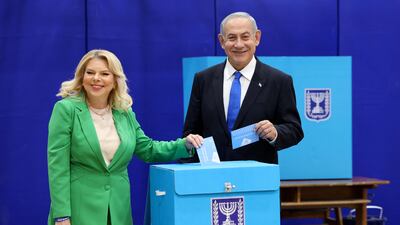
Mr Netanyahu and his wife Sara cast their ballot at a polling station in Jerusalem in the country's fifth election in less than four years. AFP -

A man kisses his dog after casting his ballot in Tel Aviv during the Israeli elections. AP -
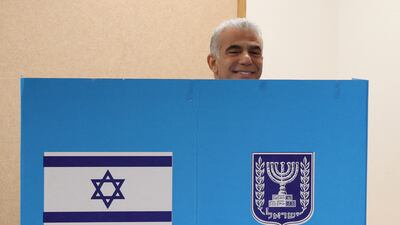
Israeli Prime Minister Yair Lapid smiles as he casts his vote at a polling station in Israel's coastal city of Tel Aviv. Mr Lapid urged the electorate to cast their ballot after voting in an election that might lead to veteran leader Benjamin Netanyahu making a comeback alongside far-right allies. Reuters -
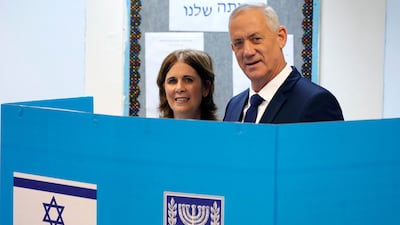
Israeli Defence Minister Benny Gantz, right, head of the new centre-right National Unity Party, and his wife Revital Gantz vote at a polling station in the city of Rosh Haayin in central Israel. AFP -

Ultra-Orthodox Jews watch their Rabbi Israel Hager vote during Israeli elections in Bnei Brak. AP -

An Ultra-Orthodox Jewish man votes in Israel's parliamentary election at a polling station in Bnei Brak. AP -
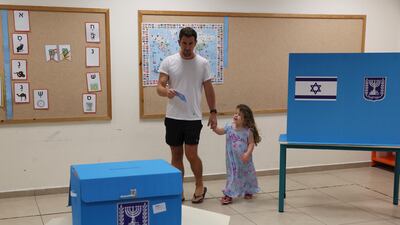
An Israeli man walks with a little girl towards the ballot box to cast his vote. AP -
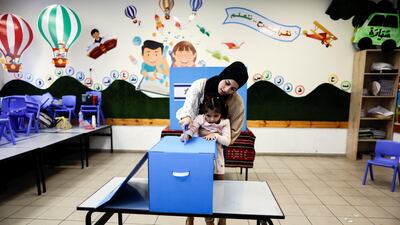
A little girl helps her mother cast her ballot on the day of Israel's general election at a polling station in Taibe, northern Israel. Reuters -

Israelis queue to cast their ballots on the day of Israel's general election at a polling station in Tel Aviv. Reuters -
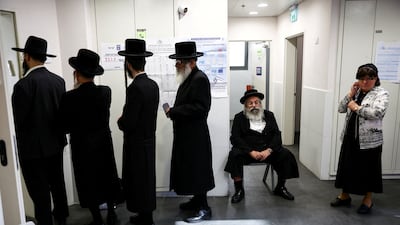
Ultra-Orthodox Jewish Israelis wait to cast their ballots at a polling station in Jerusalem. Reuters -

An Israeli man casts his ballot at a drive-through polling station for people quarantined as a result of Covid-19 in Jerusalem. Reuters


But, many Israelis would say in large part because of Mr Netanyahu, there are now other politicians on the brink of power who are even more controversial. Itamar Ben-Gvir has become the face of a new far-right politics that is likely to become increasingly influential in the years ahead. His policies include annexing the entire Palestinian West Bank and creating a government body to encourage Arab migration from Israel. The far-right list his party is part of, Religious Zionism, could well become a key part of the next coalition.
If this coalition is formed it will represent a stark rebuttal of the previous government, led by current caretaker prime minister Yair Lapid. Last June, eight parties from across Israel’s wide political spectrum came together under his and his colleagues’ stewardship.
It was hard to keep discipline in such an arrangement, but there was a great deal of determination to make it work, and some remarkable things were achieved. At home, Israel got its first independent Arab party to be part of a government. Abroad, a deal to demarcate a disputed maritime border with Lebanon ended a long dispute between two countries still technically at war.
Most of all, it reminded Israelis of the flexibility of their political system, which can bring together right-wing parties with left-wing ones and Arab parties with Jewish ones, if the will is there. It was an affront to those in Israel who think that co-operation between Jews and Arabs is impossible.
But there were major challenges. Israeli society is greatly polarised. This year, deadly violence between Israelis and Palestinians has climbed to the highest levels since 2015.
The conflict between Palestine and Israel is not just about the occupation of Palestinian lands. Its dynamics affect the entire Middle East. Mr Netanyahu was part of the remarkable diplomatic effort that led to the Abraham Accords, one of the most important pushes for peace in the 21st-century.
It is still in place and, in many regards, going from strength to strength. Its message that dialogue and co-operation can be promoted in the most complex and tense situations should be remembered as parties try to form a new government.
Much remains uncertain and Israel will not form a government for some time. It might not even get one at all, forcing the country back into elections. They would be the sixth in four years.
As plans are hashed out, all Israelis have space to think about the country in which they want to live. It is to be hoped that they prioritise unity and peace over division.

