A protest against Iranian President Ebrahim Raisi outside the UN. Getty


What to make of Iran's protests


  • English
  • Arabic

September 23, 2022

It is difficult, at this stage, to anticipate the long-term outcome of protests that have gripped cities throughout Iran this week.

They were sparked by the death in police custody of Mahsa Amini, a young woman who had been detained by the country's morality police for allegedly failing to wear her headscarf correctly. By law, all women must wear one in public.

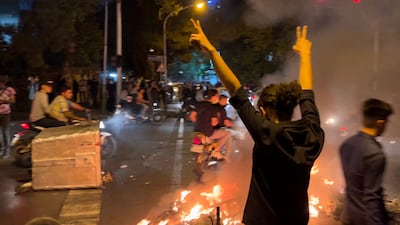
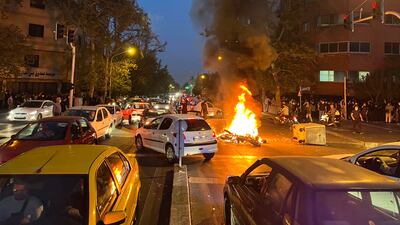
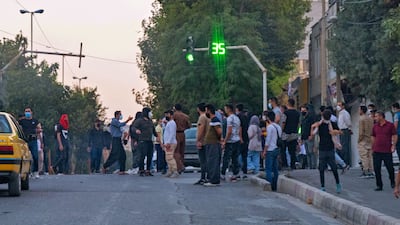
The scale and severity of the protests point to intense, widespread anger. Women are cutting their hair in front of large crowds as an act of protest. Police vehicles are being overturned and their stations torched. Images of religious and government-affiliated officials are being torn down. The working and middle classes are marching together, as are the young and the old.

In response, authorities have stepped up their control of the internet, restricting WhatsApp and Instagram. The move is reminiscent of mass protests in 2009, after which Twitter was permanently blocked, even though the most senior Iranian government officials regularly post on the site, including Supreme Leader Ali Khamenei.

But however dramatic these developments might seem, protests happen fairly frequently in Iran. So far, in the more than four-decade history of the regime, they have led to few government concessions, with at best empty words from the government and brutal oppression at the worst times. This round, nine people have died so far. The sacrifices are significant, the main achievement is reminding the world of the will of the Iranian people.

  • A protest for Mahsa Amini, a woman who died after being arrested by the Islamic republic's 'morality police', in Tehran. AFP
    A protest for Mahsa Amini, a woman who died after being arrested by the Islamic republic's 'morality police', in Tehran. AFP
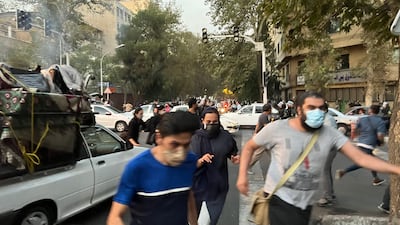
  • Demonstrators disperse during the protest for Amini, who died in a hospital in the capital Tehran on Friday. AFP
    Demonstrators disperse during the protest for Amini, who died in a hospital in the capital Tehran on Friday. AFP
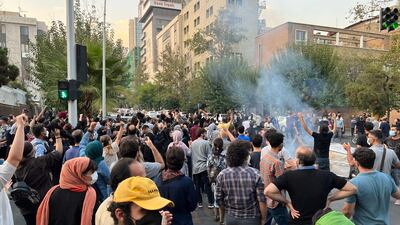
  • The crowd chanted 'Death to the dictator', meaning Supreme Leader Ayatollah Ali Khamenei, while some women took off their headscarves. AFP
    The crowd chanted 'Death to the dictator', meaning Supreme Leader Ayatollah Ali Khamenei, while some women took off their headscarves. AFP
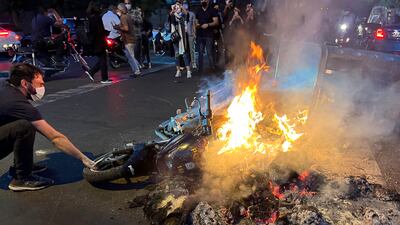
  • A man pulls out a police motorcycle set on fire during the protest. Amini had been detained for violating the country's conservative dress code. AP
    A man pulls out a police motorcycle set on fire during the protest. Amini had been detained for violating the country's conservative dress code. AP
  • In recent months, rights activists have urged women to remove their veils in public, a gesture that would risk their arrest for defying a dress code as the country's rulers crack down on 'immoral behaviour'. AP
    In recent months, rights activists have urged women to remove their veils in public, a gesture that would risk their arrest for defying a dress code as the country's rulers crack down on 'immoral behaviour'. AP
  • Iranians protest in Sanandaj, the capital of Iran's Kurdistan province, following the Amini's death while in custody. AFP
    Iranians protest in Sanandaj, the capital of Iran's Kurdistan province, following the Amini's death while in custody. AFP
  • Iranian police officers clash with demonstrators in Tehran. Police said Amini fell into a coma as she waited with other detained women at a morality police station, rejecting allegations that she was probably beaten. AFP
    Iranian police officers clash with demonstrators in Tehran. Police said Amini fell into a coma as she waited with other detained women at a morality police station, rejecting allegations that she was probably beaten. AFP

The demonstrations are so intense and widespread because women’s rights affect everyone in Iran. This is not fundamentally about clothing. It is about how authorities police women and their affairs, treat them if they resist and then cover up scandals if they are harmed, abused or, in Amini’s case, die. At the moment the trauma is not just about how she died, but the government's inadequate, insulting response. At first, authorities blamed her sudden death on underlying health issues. Her family then came out saying she had none.

A society where deadly civil unrest can happen as a result of how far back a scarf sits on a woman’s head is not a stable one. The protests should in part be viewed as a continuation of a longer chain of demonstrations that have been taking place this year. Whether over water shortages or a cost of living crisis, Iranians have on a number of occasions made their intense anger at the government clear.

The situation is unlikely to improve anytime soon. Negotiations to find a new international deal regarding Iran's nuclear programme are stalling. Getting one would lead to an easing of sanctions and revive an economy that has been curtailed for more than 40 years. Instead, the government sticks belligerently to a regionally destabilising and very expensive foreign policy.

If there is any chance that the protests might bring tangible results, it could be down to the fact that Iran's arch-conservatives are in power, the camp that is most committed to restrictive policies on what women wear and Iran's isolation. The travesty of what happened to Amini that will be firmly laid at their feet and that could make anger at them overwhelming.

After all, they have had the option to do something about these abuses for a long time. They have done little to tackle them. In fact, at least in terms of the morality police, the situation seems to be getting worse. Their activity had been somewhat muted in recent years. Now, these authorities seem emboldened and more women are getting harassed.

Even if nothing changes in the near term, the protests still point to a fundamental problem for the government. After almost half century in which to convince Iranians that Ruhollah Khomeini's radical republic imposed in 1979 is the best way forward, many are still not convinced. They are willing to fight and endanger their lives to make that clear.


Where to donate in the UAE

The Emirates Charity Portal

You can donate to several registered charities through a “donation catalogue”. The use of the donation is quite specific, such as buying a fan for a poor family in Niger for Dh130.

The General Authority of Islamic Affairs & Endowments

The site has an e-donation service accepting debit card, credit card or e-Dirham, an electronic payment tool developed by the Ministry of Finance and First Abu Dhabi Bank.

Al Noor Special Needs Centre

You can donate online or order Smiles n’ Stuff products handcrafted by Al Noor students. The centre publishes a wish list of extras needed, starting at Dh500.

Beit Al Khair Society

Beit Al Khair Society has the motto “From – and to – the UAE,” with donations going towards the neediest in the country. Its website has a list of physical donation sites, but people can also contribute money by SMS, bank transfer and through the hotline 800-22554.

Dar Al Ber Society

Dar Al Ber Society, which has charity projects in 39 countries, accept cash payments, money transfers or SMS donations. Its donation hotline is 800-79.

Dubai Cares

Dubai Cares provides several options for individuals and companies to donate, including online, through banks, at retail outlets, via phone and by purchasing Dubai Cares branded merchandise. It is currently running a campaign called Bookings 2030, which allows people to help change the future of six underprivileged children and young people.

Emirates Airline Foundation

Those who travel on Emirates have undoubtedly seen the little donation envelopes in the seat pockets. But the foundation also accepts donations online and in the form of Skywards Miles. Donated miles are used to sponsor travel for doctors, surgeons, engineers and other professionals volunteering on humanitarian missions around the world.

Emirates Red Crescent

On the Emirates Red Crescent website you can choose between 35 different purposes for your donation, such as providing food for fasters, supporting debtors and contributing to a refugee women fund. It also has a list of bank accounts for each donation type.

Gulf for Good

Gulf for Good raises funds for partner charity projects through challenges, like climbing Kilimanjaro and cycling through Thailand. This year’s projects are in partnership with Street Child Nepal, Larchfield Kids, the Foundation for African Empowerment and SOS Children's Villages. Since 2001, the organisation has raised more than $3.5 million (Dh12.8m) in support of over 50 children’s charities.

Noor Dubai Foundation

Sheikh Mohammed bin Rashid Al Maktoum launched the Noor Dubai Foundation a decade ago with the aim of eliminating all forms of preventable blindness globally. You can donate Dh50 to support mobile eye camps by texting the word “Noor” to 4565 (Etisalat) or 4849 (du).

Indoor cricket in a nutshell

Indoor Cricket World Cup - Sep 16-20, Insportz, Dubai

16 Indoor cricket matches are 16 overs per side

8 There are eight players per team

There have been nine Indoor Cricket World Cups for men. Australia have won every one.

5 Five runs are deducted from the score when a wickets falls

Batsmen bat in pairs, facing four overs per partnership

Scoring In indoor cricket, runs are scored by way of both physical and bonus runs. Physical runs are scored by both batsmen completing a run from one crease to the other. Bonus runs are scored when the ball hits a net in different zones, but only when at least one physical run is score.

Zones

A Front net, behind the striker and wicketkeeper: 0 runs

B Side nets, between the striker and halfway down the pitch: 1 run

Side nets between halfway and the bowlers end: 2 runs

Back net: 4 runs on the bounce, 6 runs on the full

Sri Lanka-India Test series schedule
  • 1st Test India won by 304 runs at Galle
  • 2nd Test Thursday-Monday at Colombo
  • 3rd Test August 12-16 at Pallekele

THE SPECS

Engine: Four-cylinder 2.5-litre

Transmission: Seven-speed auto

Power: 165hp

Torque: 241Nm

Price: Dh99,900 to Dh134,000

On sale: now

The Great Derangement: Climate Change and the Unthinkable
Amitav Ghosh, University of Chicago Press

Company%20profile
%3Cp%3E%3Cstrong%3EName%3A%3C%2Fstrong%3E%20Envi%20Lodges%0D%3Cbr%3E%3Cstrong%3EStarted%3A%20%3C%2Fstrong%3ESeptember%202021%0D%3Cbr%3E%3Cstrong%3ECo-founders%3A%3C%2Fstrong%3E%20Noelle%20Homsy%20and%20Chris%20Nader%0D%3Cbr%3E%3Cstrong%3EBased%3A%3C%2Fstrong%3E%20UAE%0D%3Cbr%3E%3Cstrong%3ESector%3A%3C%2Fstrong%3E%20Hospitality%0D%3Cbr%3E%3Cstrong%3ENumber%20of%20employees%3A%3C%2Fstrong%3E%2012%20to%2015%0D%3Cbr%3E%3Cstrong%3EStage%20of%20investment%3A%20%3C%2Fstrong%3ESeries%20A%3C%2Fp%3E%0A
Updated: September 23, 2022, 3:00 AM