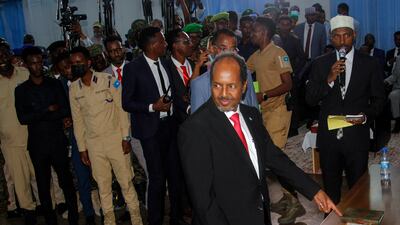
Former president Hassan Sheikh Mohamud after being sworn in as the new president of Somalia after being elected by Somali members of parliament in the presidential elections in the capital Mogadishu, Somalia, 15 May 2022. Voting took place at Mogadishu's fortified airport only involving the country's 329 members of parliament, following long delays. EPA / SAID YUSUF WARSAME
Former president Hassan Sheikh Mohamud after being sworn in as the new president of Somalia after being elected by Somali members of parliament in the presidential elections in the capital Mogadishu,
Insight and opinion from The National’s editorial leadership
May 18, 2022
US President Joe Biden swore to end his country’s “forever wars”. It polled well, as did it for his predecessor, Donald Trump. But in practice, it has been hard, at times hugely controversial to implement – the starkest example being the chaotic and detrimental US withdrawal from Afghanistan last summer.
However it is viewed, it is a promise that may come to define his presidency. But this legacy is not yet set. News that President Biden recently approved a plan to re-deploy hundreds of American troops to Somalia shows how complex America’s position in the world has become.
First, it is a sign that American policy towards the region has been inconsistent. Former president Trump withdrew most US forces from the country during his tenure. Second, it shows quite how bad the situation has become in Somalia.
In better circumstances, this would be a time of optimism for the country. It has just elected a new president after the chaotic and process of removing the former leader, Mohamed Abdullahi Mohamed, from power. Now, President Hassan Sheikh Mohamud has promised to “build a Somalia that is in harmony with itself and is in harmony with the world”.
In actual fact, Mr Mohamud is not that new. He was Somalia’s leader between 2012 and 2017, and clearly did not do enough to stabilise the country. It is imperative he does better this time and builds a strong, fair government not for his legacy only but for the sake of his citizens, because very little is harmonious in today's Somalia. It regularly ranks near the bottom on important development indicators. Only Sierra Leone and the Central African Republic are lower when it comes to infant mortality per 1,000 births, according to the World Bank. The Legatum Institutes' Prosperity Index puts Somalia 161st out of 167, citing poor "economic quality" as the country’s biggest challenge. Somali politics is chaotic, with tensions still high after former president Mohamed did all he could to cling on to power, including extending his term last year. Corruption is also a major issue.
Hassan Sheikh Mohamud (R), marking his election win with incumbent leader Mohamed Abdullahi Mohamed in Mogadishu, Somalia, has returned to the nation's top office. AP Photo
Hassan Sheikh Mohamud voted out of power as president in 2017. AP Photo
Hassan Sheikh Mohamud celebrates his triumph at the Halane military camp in Mogadishu. AP Photo
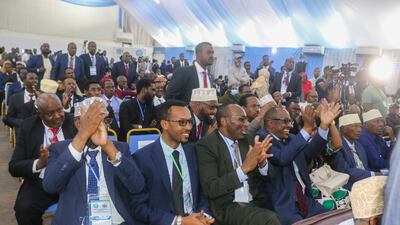
Somali MPs applaud as Hassan Sheikh Mohamud is sworn in as the new president. EPA
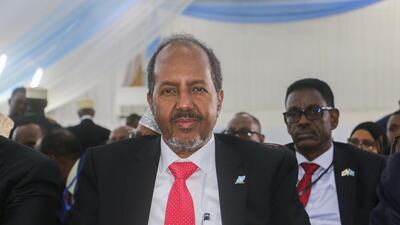
Hassan Sheikh Mohamud after being sworn in as the new president of Somalia. EPA
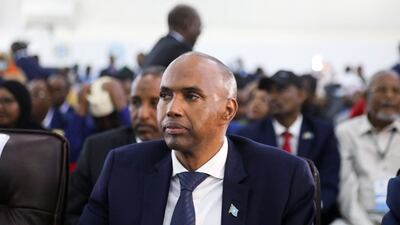
Hassan Ali Khaire, former Somali Prime Minister and candidate for the 2022 presidential elections, during the first round of voting in Mogadishu. Reuters
Mohamed Abdullahi Mohamed, the incumbent President and a candidate for the 2022 elections. Reuters
Said Abdulahi Deni, Puntland region president and another candidate for the 2022 Somali presidential elections. Reuters
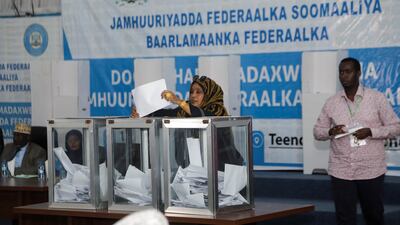
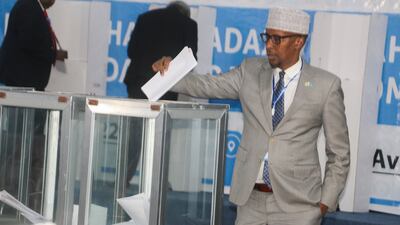
A member of the Somali parliament casts a vote in Mogadishu. Reuters
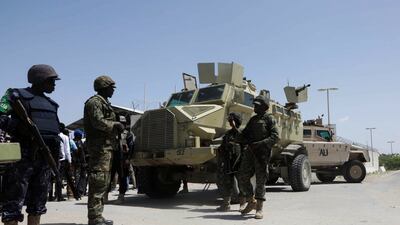
African Union peacekeepers provide security during the Somali presidential elections in Mogadishu. Reuters
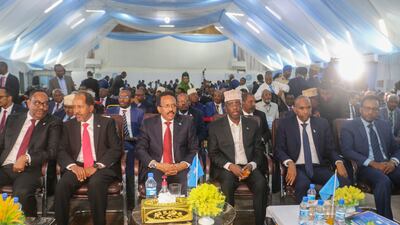
Incumbent President Mohamed Abdullahi Mohamed (C) sits with members of parliament as they attend the presidential elections in Mogadishu, Somalia. EPA
Voting got under way after long delays in the Somalia presidential elections, with 39 registered presidential candidates in the running. EPA
Cleaning up the political landscape would be a start, but it is going to take more to strengthen Somalia and promote the harmony Mr Mohamud wants. Perhaps the main impediment to change is the security situation. Al Shabab is known the world over as one the deadliest terrorist groups in operation. Today, it has inserted itself into daily life in the country, be it acting as judges or the taxman. Worst of all, it is murderous. The Armed Conflict, Location and Event Data Project estimates that between 2010 and 2020 the number of civilians it killed stood at more than 4,000. The majority were in Somalia. The new president must commit to countering extremism in all its facets.
Of course, Mr Mohamud’s government does have valid security concerns, and US troops could help in this regard; a central part of their renewed mission is targeting key leaders in the organisation. But both presidents must learn the lessons of recent failures to stabilise unstable places by relying too much on the military.
Security is imperative, but that can only be built by understanding the true, holistic nature of the challenge the country faces. Al Shabab is deadly, but so are the country’s many environmental crises, including desertification, drought and poor management of land. Almost 90 per cent of districts are affected by continuous, severe water shortages, and the impact that is having on food supplies leaves 1.4 million children malnourished, more than 300,000 severely. In a world already slow to act on the danger of climate change, and now distracted by the war in Ukraine, the sort of multilateral approach and drive needed to address these issues must be emphasised constantly.
Somalia might be isolated, but its instability has global ramifications, whether by piracy affecting international shipping or being a breeding ground for militants. Today, as a new president emerges and a renewed US military presence begins, minds must be focused not yet again on just the results of Somalia's strife, but the causes, too. Only then can the country be in harmony with itself and the world.

Mercer, the investment consulting arm of US services company Marsh & McLennan, expects its wealth division to at least double its assets under management (AUM) in the Middle East as wealth in the region continues to grow despite economic headwinds, a company official said.
Mercer Wealth, which globally has $160 billion in AUM, plans to boost its AUM in the region to $2-$3bn in the next 2-3 years from the present $1bn, said Yasir AbuShaban, a Dubai-based principal with Mercer Wealth.
“Within the next two to three years, we are looking at reaching $2 to $3 billion as a conservative estimate and we do see an opportunity to do so,” said Mr AbuShaban.
Mercer does not directly make investments, but allocates clients’ money they have discretion to, to professional asset managers. They also provide advice to clients.
“We have buying power. We can negotiate on their (client’s) behalf with asset managers to provide them lower fees than they otherwise would have to get on their own,” he added.
Mercer Wealth’s clients include sovereign wealth funds, family offices, and insurance companies among others.
From its office in Dubai, Mercer also looks after Africa, India and Turkey, where they also see opportunity for growth.
Wealth creation in Middle East and Africa (MEA) grew 8.5 per cent to $8.1 trillion last year from $7.5tn in 2015, higher than last year’s global average of 6 per cent and the second-highest growth in a region after Asia-Pacific which grew 9.9 per cent, according to consultancy Boston Consulting Group (BCG). In the region, where wealth grew just 1.9 per cent in 2015 compared with 2014, a pickup in oil prices has helped in wealth generation.
BCG is forecasting MEA wealth will rise to $12tn by 2021, growing at an annual average of 8 per cent.
Drivers of wealth generation in the region will be split evenly between new wealth creation and growth of performance of existing assets, according to BCG.
Another general trend in the region is clients’ looking for a comprehensive approach to investing, according to Mr AbuShaban.
“Institutional investors or some of the families are seeing a slowdown in the available capital they have to invest and in that sense they are looking at optimizing the way they manage their portfolios and making sure they are not investing haphazardly and different parts of their investment are working together,” said Mr AbuShaban.
Some clients also have a higher appetite for risk, given the low interest-rate environment that does not provide enough yield for some institutional investors. These clients are keen to invest in illiquid assets, such as private equity and infrastructure.
“What we have seen is a desire for higher returns in what has been a low-return environment specifically in various fixed income or bonds,” he said.
“In this environment, we have seen a de facto increase in the risk that clients are taking in things like illiquid investments, private equity investments, infrastructure and private debt, those kind of investments were higher illiquidity results in incrementally higher returns.”
The Abu Dhabi Investment Authority, one of the largest sovereign wealth funds, said in its 2016 report that has gradually increased its exposure in direct private equity and private credit transactions, mainly in Asian markets and especially in China and India. The authority’s private equity department focused on structured equities owing to “their defensive characteristics.”
The insured employee may still file an ILOE claim even if a labour dispute is ongoing post termination, but the insurer may suspend or reject payment, until the courts resolve the dispute, especially if the reason for termination is contested. The outcome of the labour court proceedings can directly affect eligibility.
- Abdullah Ishnaneh, Partner, BSA Law
UPI facts
More than 2.2 million Indian tourists arrived in UAE in 2023 More than 3.5 million Indians reside in UAE Indian tourists can make purchases in UAE using rupee accounts in India through QR-code-based UPI real-time payment systems Indian residents in UAE can use their non-resident NRO and NRE accounts held in Indian banks linked to a UAE mobile number for UPI transactions
Cecelia Crocker was on board Northwest Airlines Flight 255 in 1987 when it crashed in Detroit, killing 154 people, including her parents and brother. The plane had hit a light pole on take off
George Lamson Jr, from Minnesota, was on a Galaxy Airlines flight that crashed in Reno in 1985, killing 68 people. His entire seat was launched out of the plane
Bahia Bakari, then 12, survived when a Yemenia Airways flight crashed near the Comoros in 2009, killing 152. She was found clinging to wreckage after floating in the ocean for 13 hours.
Jim Polehinke was the co-pilot and sole survivor of a 2006 Comair flight that crashed in Lexington, Kentucky, killing 49.
ESSENTIALS
The flights
Emirates flies direct from Dubai to Rio de Janeiro from Dh7,000 return including taxes. Avianca fliles from Rio to Cusco via Lima from $399 (Dhxx) return including taxes.
The trip
From US$1,830 per deluxe cabin, twin share, for the one-night Spirit of the Water itinerary and US$4,630 per deluxe cabin for the Peruvian Highlands itinerary, inclusive of meals, and beverages. Surcharges apply for some excursions.
A widely accepted definition was made by the All Party Parliamentary Group on British Muslims in 2019: “Islamophobia is rooted in racism and is a type of racism that targets expressions of Muslimness or perceived Muslimness.” It further defines it as “inciting hatred or violence against Muslims”.
Thursday, December 6
08.00-15.00 Technical scrutineering
15.00-17.00 Extra free practice
Friday, December 7
09.10-09.30 F4 free practice
09.40-10.00 F4 time trials
10.15-11.15 F1 free practice
14.00 F4 race 1
15.30 BRM F1 qualifying
Saturday, December 8
09.10-09.30 F4 free practice
09.40-10.00 F4 time trials
10.15-11.15 F1 free practice
14.00 F4 race 2
15.30 Grand Prix of Abu Dhabi
US households add $601bn of debt in 2019
American households borrowed another $601 billion (Dh2.2bn) in 2019, the largest yearly gain since 2007, just before the global financial crisis, according to February data from the New York Federal Reserve Bank.
Fuelled by rising mortgage debt as homebuyers continued to take advantage of low interest rates, the increase last year brought total household debt to a record high, surpassing the previous peak reached in 2008 just before the market crash, according to the report.
Following the 22nd straight quarter of growth, American household debt swelled to $14.15 trillion by the end of 2019, the New York Fed said in its quarterly report.
In the final three months of the year, new home loans jumped to their highest volume since the fourth quarter of 2005, while credit cards and auto loans also added to the increase.
The bad debt load is taking its toll on some households, and the New York Fed warned that more and more credit card borrowers — particularly young people — were falling behind on their payments.
"Younger borrowers, who are disproportionately likely to have credit cards and student loans as their primary form of debt, struggle more than others with on-time repayment," New York Fed researchers said.