
This weekend, Muslims around the world welcomed Ramadan, with the holy month commencing in the UAE on Saturday. As the first sunset fell, cannons were fired to mark the end of the first day of fasting.
Even more striking than the roar of artillery was the nature of the audiences that surrounded the guns. In Abu Dhabi, outside the Sheikh Zayed Grand Mosque, Cody Combs, a social media journalist for The National, delivered a piece to camera without a mask, now possible after the UAE lifted the mandate on outdoor face coverings in February. In Dubai, shoppers by Burj Khalifa thronged the ceremony in greater numbers than would have been found in the past two years. With Covid-19 travel restrictions now lifted in many countries, the attendees would have been more international than before, too.
All are signs that, at least in terms of social and familial gatherings, this Ramadan is going to mark a much-needed return to normality. Speaking to The National, last-minute shoppers in Dubai were stressing how important this is. Hasnaa Nofal, a pharmacist from Egypt, said: “Ramadan is truly a special time because it brings all of the family together. You make sure you spend that time together that you might not otherwise have throughout the year."
As travel returns to normal, Makkah and Medinah will be welcoming worshippers to the Holy Mosques, particularly to the Kaaba for Umrah.
-
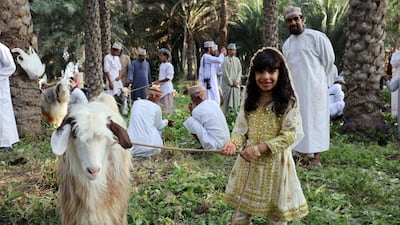
Omanis gather as goats are sold ahead of the Eid Al Fitr holiday, in the Surur area of Samail province, 80 kilometres south-west of the capital Muscat. AFP -
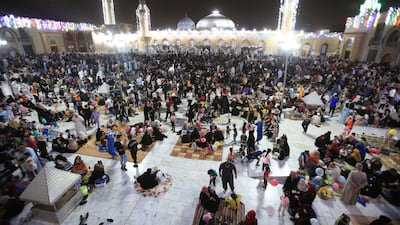
Iraqi Sunni Muslims gather for the Laylat Al Qadr – Night of Power – in the shrine of cleric Sheikh Abdel Kader Al Gilani, in central Baghdad. EPA -
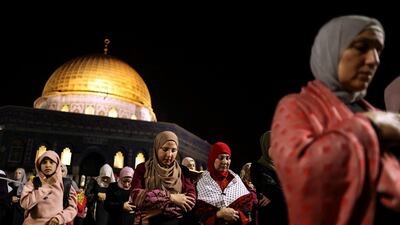
Palestinians pray on Laylat Al Qadr beside the Dome of the Rock shrine, at the Al Aqsa Mosque compound, in Jerusalem's Old City. Reuters -
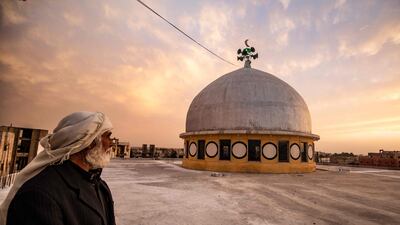
A man stares at the dome of a mosque, in Syria's northern city of Raqa. AFP -
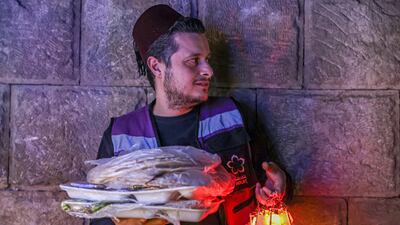
A volunteer from the charity Violet Org hands out food packages for the suhour meal eaten in Syria's rebel-held northwestern city of Idlib. AFP -
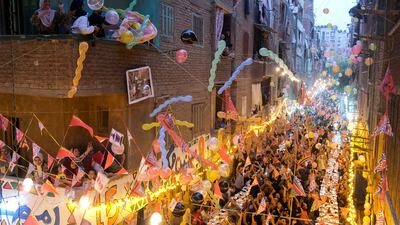
Residents of Ezbet Hamada gather to eat during iftar in Mataria, Cairo. Reuters -
Ramadan decorations at Global Village, Dubai. Chris Whiteoak / The National -
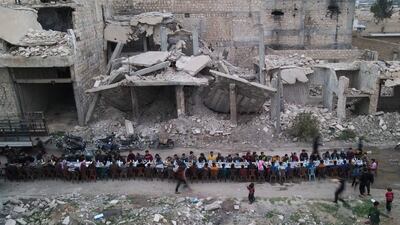
Syrians break their fast during a gathering organised by various groups in Tadef, near the city of Al Bab, in Aleppo province. AFP -
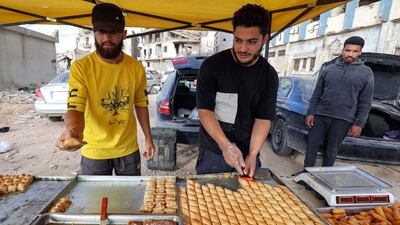
Street traders cut up dessert pastries for sale at a market in Libya's eastern city of Benghazi. AFP -
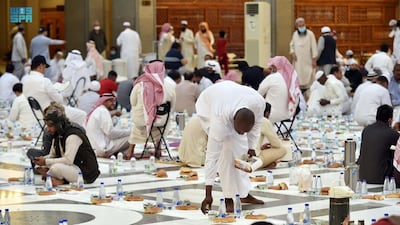
People breaking their fast at Quba Mosque, Madinah, Saudi Arabia. SPA -
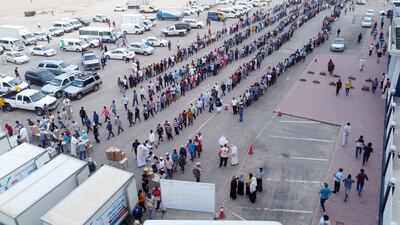
Fasting Muslim worshippers queue to receive iftar meals, donated by a charity, in Mahboula, south of Kuwait City. AFP -

Yemenis read the Quran during Ramadan at a mosque in the old city of Sanaa, Yemen. EPA -
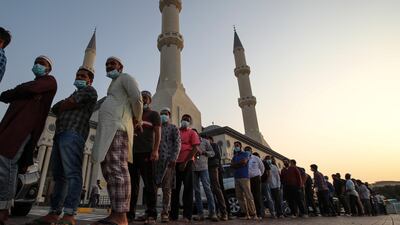
People queue outside Al Farooq Mosque in Dubai before sunset, waiting to break their fast. EPA -
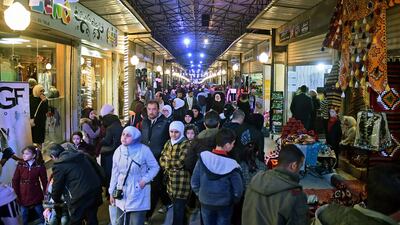
Shoppers at a market after their iftar meal, in the New Aleppo district of the northern Syrian city of Aleppo. AFP -
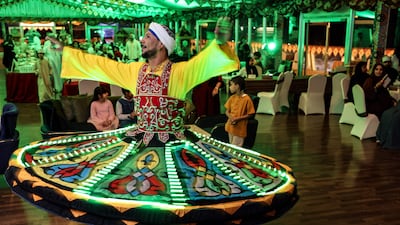
An Egyptian dancer performs the traditional tanoura dance at a restaurant in the Omani capital Muscat. AFP -
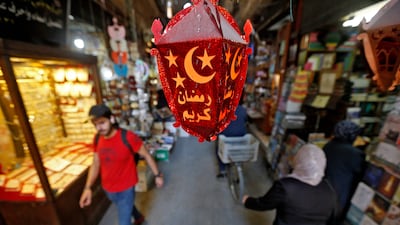
A famous Ramadan lantern inscribed with holy month greetings at Al Hamidiya market in Syria's capital Damascus. AFP -

Volunteers stir a pot of rice for a charity iftar at the eighth century Umayyad Mosque in Syria's capital Damascus. AFP -
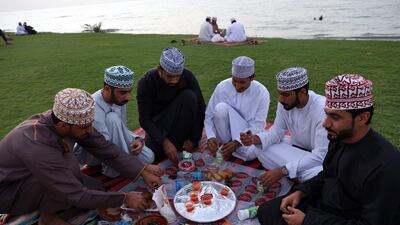
Omanis gather to break their fast on the beach in Muscat. AFP -
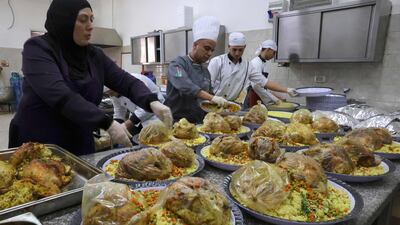
Cooks employed by the Islamic Charitable Society prepare iftar meals for Palestinian orphans and families in need, in the West Bank city of Hebron. AFP -

Iftar is served outside a mosque on the Jazeera State highway in the village of Al Nuba, about 50 kilometres south of Sudan's capital Khartoum. AFP -
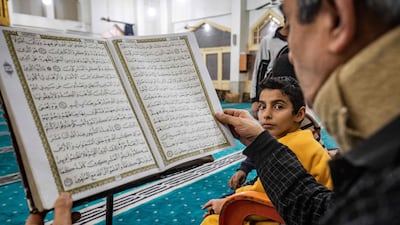
A worshipper reads the Quran inside a mosque in Syria's northern city of Raqqa. AFP -

The first Friday prayers of Ramadan at the shrine of Sheikh Abdul Qadir Al Kilani, the former Sunni Muslim preacher, in central Baghdad. AFP -
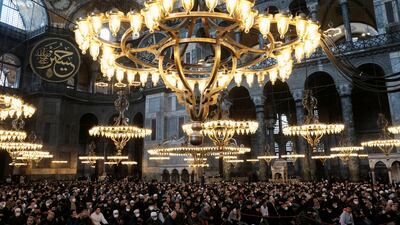
Worshippers attend the first Friday prayer of Ramadan at Hagia Sophia Grand Mosque in Istanbul, Turkey. Reuters -
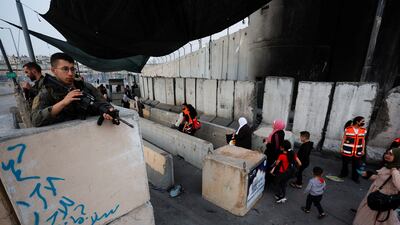
Palestinians cross the Qalandia checkpoint in the occupied West Bank on their way to the first Friday prayers of Ramadan at Jerusalem's Al Aqsa Mosque. Reuters -
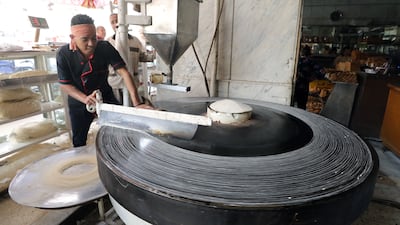
An Egyptian baker prepares kunafa, a Ramadan dessert favourite, at a market in Cairo. EPA -

Dawn awakeners known as musaharatis beat drums to wake Muslims for the suhour meal before the day's Ramadan fast in Damascus, Syria. AFP -
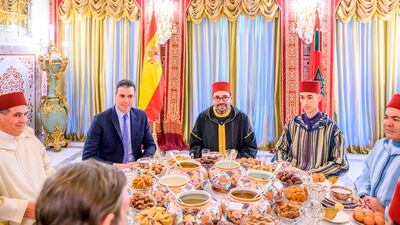
Moroccan King Mohammed VI, centre, and Spanish Prime Minister Pedro Sanchez, second left, share an iftar meal in Sale, Morocco. AP -
Iranian women read the Quran at the shrine of Shah Abdol-Azim in Tehran. Reuters -
A Ramadan catch-up at a cafe in Mosul, Iraq. Reuters -
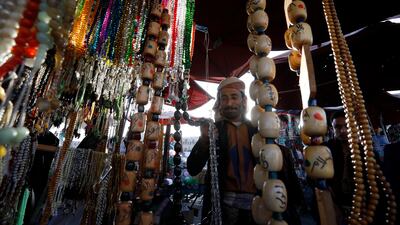
Prayer beads are in great demand during Ramadan in Sanaa, Yemen. EPA -
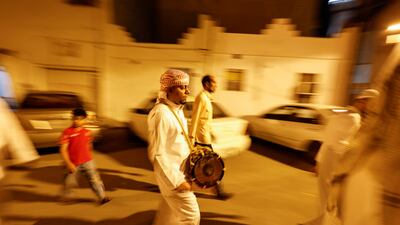
A musaharati drummer wakes people for suhour in Manama, Bahrain. Reuters -
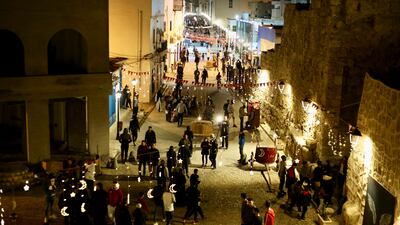
The old city in Tripoli in Libya is decked with Ramadan decorations. Reuters -
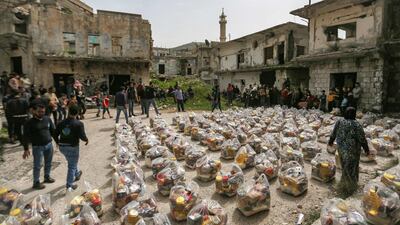
Food packets arranged for distribution in Al Najieh, in Syria's rebel-held Idlib province. AFP -
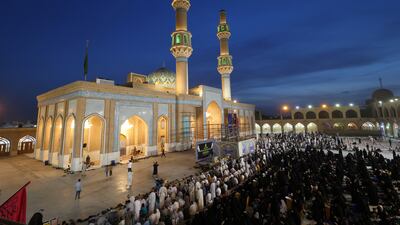
Worshippers gather at Al Sahlah Mosque in Kufa, near the city of Najaf, Iraq. Reuters -
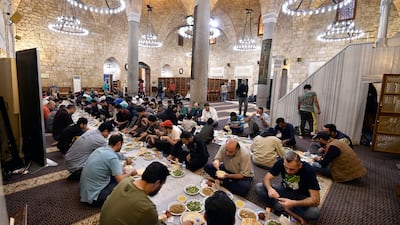
Iftar at the Prince Mansour Assaf Mosque in central Beirut, Lebanon. EPA -
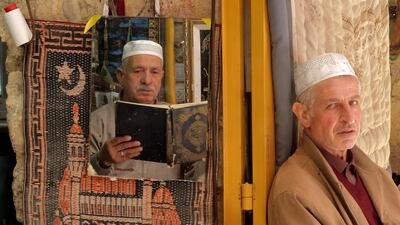
An elderly Palestinian reads the Quran at his shop in the old city of Hebron in the occupied West Bank. AFP -
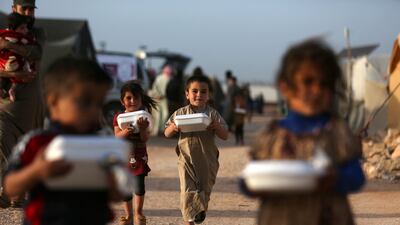
Displaced Syrian children return to their camps with boxes of food on the outskirts of the rebel-held town of Dana, in Idlib province. AFP -

Ramadan lanterns at a shop in Beirut. AP -
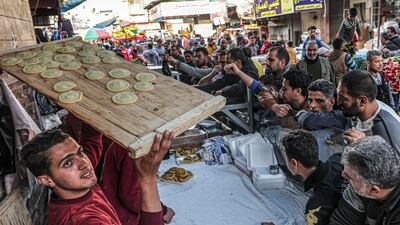
A Palestinian man carries a tray of qatayef, traditional Arabic dumplings, in Rafah, southern Gaza. AFP -
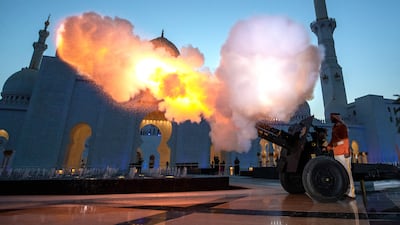
A cannon is fired at Sheikh Zayed Grand Mosque in Abu Dhabi to mark the end of fasting on the first day of Ramadan. Victor Besa / The National
Even modern technology is shaping the holy month, making it easier to observe and celebrate globally. The Islamic Crescents Observation Project at Abu Dhabi's International Astronomical Centre now publishes a map showing the regions where a crescent moon can be seen by the naked eye alone, as well as with a telescope, information that determines when the season begins.
But while progress adorns much of Ramadan 2022, there are also worrying trends emerging. Last year, food prices were rising at unhealthy rates, making iftar, the meal that breaks the daily fast, dangerously expensive for the region's poorer residents. Now, in large part due to the Ukraine conflict and the Middle East's over-reliance on food imports, costs are even higher.
Families might feel safer coming together this year, but all is still not well if the shared meals they were so looking forward to are limited by economic hardship. Many will be forced to rely on charity. An important one is the UAE's global One Billion Meals campaign that was announced to coincide with Ramadan. It will help people in 50 countries, many of which are in the Middle East. It is desperately needed. In Lebanon, for example, more than 20 per cent of households are now food insecure, according to the UN's World Food Programme.
An important aspect of Ramadan is recognising the spiritual benefit of resilience and sacrifice. The tragedy of Covid-19 means these reflections will probably be more intense than usual, as will the relief of being with family and friends once again. But the world's problems are not ending as the pandemic appears to be easing, and, this year, prayers should be offered for an end to new global crises, too.
Volvo ES90 Specs
Engine: Electric single motor (96kW), twin motor (106kW) and twin motor performance (106kW)
Power: 333hp, 449hp, 680hp
Torque: 480Nm, 670Nm, 870Nm
On sale: Later in 2025 or early 2026, depending on region
Price: Exact regional pricing TBA
Company%20profile
All%20The%20Light%20We%20Cannot%20See%20
Russia's Muslim Heartlands
Dominic Rubin, Oxford
'Skin'
Dir: Guy Nattiv
Starring: Jamie Bell, Danielle McDonald, Bill Camp, Vera Farmiga
Rating: 3.5/5 stars
T20 World Cup Qualifier
October 18 – November 2
Opening fixtures
Friday, October 18
ICC Academy: 10am, Scotland v Singapore, 2.10pm, Netherlands v Kenya
Zayed Cricket Stadium: 2.10pm, Hong Kong v Ireland, 7.30pm, Oman v UAE
UAE squad
Ahmed Raza (captain), Rohan Mustafa, Ashfaq Ahmed, Rameez Shahzad, Darius D’Silva, Mohammed Usman, Mohammed Boota, Zawar Farid, Ghulam Shabber, Junaid Siddique, Sultan Ahmed, Imran Haider, Waheed Ahmed, Chirag Suri, Zahoor Khan
Players out: Mohammed Naveed, Shaiman Anwar, Qadeer Ahmed
Players in: Junaid Siddique, Darius D’Silva, Waheed Ahmed
German intelligence warnings
- 2002: "Hezbollah supporters feared becoming a target of security services because of the effects of [9/11] ... discussions on Hezbollah policy moved from mosques into smaller circles in private homes." Supporters in Germany: 800
- 2013: "Financial and logistical support from Germany for Hezbollah in Lebanon supports the armed struggle against Israel ... Hezbollah supporters in Germany hold back from actions that would gain publicity." Supporters in Germany: 950
- 2023: "It must be reckoned with that Hezbollah will continue to plan terrorist actions outside the Middle East against Israel or Israeli interests." Supporters in Germany: 1,250
Source: Federal Office for the Protection of the Constitution
Why it pays to compare
A comparison of sending Dh20,000 from the UAE using two different routes at the same time - the first direct from a UAE bank to a bank in Germany, and the second from the same UAE bank via an online platform to Germany - found key differences in cost and speed. The transfers were both initiated on January 30.
Route 1: bank transfer
The UAE bank charged Dh152.25 for the Dh20,000 transfer. On top of that, their exchange rate margin added a difference of around Dh415, compared with the mid-market rate.
Total cost: Dh567.25 - around 2.9 per cent of the total amount
Total received: €4,670.30
Route 2: online platform
The UAE bank’s charge for sending Dh20,000 to a UK dirham-denominated account was Dh2.10. The exchange rate margin cost was Dh60, plus a Dh12 fee.
Total cost: Dh74.10, around 0.4 per cent of the transaction
Total received: €4,756
The UAE bank transfer was far quicker – around two to three working days, while the online platform took around four to five days, but was considerably cheaper. In the online platform transfer, the funds were also exposed to currency risk during the period it took for them to arrive.
more from Janine di Giovanni
Which honey takes your fancy?
Al Ghaf Honey
The Al Ghaf tree is a local desert tree which bears the harsh summers with drought and high temperatures. From the rich flowers, bees that pollinate this tree can produce delicious red colour honey in June and July each year
Sidr Honey
The Sidr tree is an evergreen tree with long and strong forked branches. The blossom from this tree is called Yabyab, which provides rich food for bees to produce honey in October and November. This honey is the most expensive, but tastiest
Samar Honey
The Samar tree trunk, leaves and blossom contains Barm which is the secret of healing. You can enjoy the best types of honey from this tree every year in May and June. It is an historical witness to the life of the Emirati nation which represents the harsh desert and mountain environments
SQUADS
India
Virat Kohli (captain), Rohit Sharma (vice-captain), Shikhar Dhawan, Ajinkya Rahane, Manish Pandey, Kedar Jadhav, Dinesh Karthik, Mahendra Singh Dhoni (wicketkeeper), Hardik Pandya, Axar Patel, Kuldeep Yadav, Yuzvendra Chahal, Jasprit Bumrah, Bhuvneshwar Kumar, Shardul Thakur
New Zealand
Kane Williamson (captain), Martin Guptill, Colin Munro, Ross Taylor, Tom Latham (wicketkeeper), Henry Nicholls, Ish Sodhi, George Worker, Glenn Phillips, Matt Henry, Colin de Grandhomme, Mitchell Santner, Tim Southee, Adam Milne, Trent Boult
While you're here
Gavin Esler: Before you celebrate Brexit, be clear what it is
HA Hellyer: Brexit is not going to make the far-right disappear
Damien McElroy: Northern Ireland is set for another upheaval
Alice Haine: ‘Bumpy’ period as Britain adapts to new rules
Labour dispute
The insured employee may still file an ILOE claim even if a labour dispute is ongoing post termination, but the insurer may suspend or reject payment, until the courts resolve the dispute, especially if the reason for termination is contested. The outcome of the labour court proceedings can directly affect eligibility.
- Abdullah Ishnaneh, Partner, BSA Law
While you're here
Gavin Esler: Coronavirus offers stinging rebuke to protectionists
Kareem Shaheen: Pandemics can save us from waging wars
Sholto Byrnes: Why the climate change clash will get nastier
Read more about the coronavirus
While you're here
Hussein Ibish: Could it be game over for Donald Trump?
Joyce Karam: Trump's campaign thrown off balance
Trump tests positive: everything we know so far
Yemen's Bahais and the charges they often face
The Baha'i faith was made known in Yemen in the 19th century, first introduced by an Iranian man named Ali Muhammad Al Shirazi, considered the Herald of the Baha'i faith in 1844.
The Baha'i faith has had a growing number of followers in recent years despite persecution in Yemen and Iran.
Today, some 2,000 Baha'is reside in Yemen, according to Insaf.
"The 24 defendants represented by the House of Justice, which has intelligence outfits from the uS and the UK working to carry out an espionage scheme in Yemen under the guise of religion.. aimed to impant and found the Bahai sect on Yemeni soil by bringing foreign Bahais from abroad and homing them in Yemen," the charge sheet said.
Baha'Ullah, the founder of the Bahai faith, was exiled by the Ottoman Empire in 1868 from Iran to what is now Israel. Now, the Bahai faith's highest governing body, known as the Universal House of Justice, is based in the Israeli city of Haifa, which the Bahais turn towards during prayer.
The Houthis cite this as collective "evidence" of Bahai "links" to Israel - which the Houthis consider their enemy.
Director: Laxman Utekar
Cast: Vicky Kaushal, Akshaye Khanna, Diana Penty, Vineet Kumar Singh, Rashmika Mandanna
Rating: 1/5
Army of the Dead
Director: Zack Snyder
Stars: Dave Bautista, Ella Purnell, Omari Hardwick, Ana de la Reguera
Three stars
Electric scooters: some rules to remember
- Riders must be 14-years-old or over
- Wear a protective helmet
- Park the electric scooter in designated parking lots (if any)
- Do not leave electric scooter in locations that obstruct traffic or pedestrians
- Solo riders only, no passengers allowed
- Do not drive outside designated lanes
The specs
Engine: 2.0-litre 4cyl turbo
Power: 261hp at 5,500rpm
Torque: 405Nm at 1,750-3,500rpm
Transmission: 9-speed auto
Fuel consumption: 6.9L/100km
On sale: Now
Price: From Dh117,059
About Karol Nawrocki
• Supports military aid for Ukraine, unlike other eurosceptic leaders, but he will oppose its membership in western alliances.
• A nationalist, his campaign slogan was Poland First. "Let's help others, but let's take care of our own citizens first," he said on social media in April.
• Cultivates tough-guy image, posting videos of himself at shooting ranges and in boxing rings.
• Met Donald Trump at the White House and received his backing.
You might also like
Company%20profile
While you're here
Thomas Harding: Johnson and Biden on collision course over Northern Ireland
Thomas Harding: Biden victory will rejuvenate America's relations with Europe
Gavin Esler: Can the world continue to trust Britain after move to break law?
Key figures in the life of the fort
Sheikh Dhiyab bin Isa (ruled 1761-1793) Built Qasr Al Hosn as a watchtower to guard over the only freshwater well on Abu Dhabi island.
Sheikh Shakhbut bin Dhiyab (ruled 1793-1816) Expanded the tower into a small fort and transferred his ruling place of residence from Liwa Oasis to the fort on the island.
Sheikh Tahnoon bin Shakhbut (ruled 1818-1833) Expanded Qasr Al Hosn further as Abu Dhabi grew from a small village of palm huts to a town of more than 5,000 inhabitants.
Sheikh Khalifa bin Shakhbut (ruled 1833-1845) Repaired and fortified the fort.
Sheikh Saeed bin Tahnoon (ruled 1845-1855) Turned Qasr Al Hosn into a strong two-storied structure.
Sheikh Zayed bin Khalifa (ruled 1855-1909) Expanded Qasr Al Hosn further to reflect the emirate's increasing prominence.
Sheikh Shakhbut bin Sultan (ruled 1928-1966) Renovated and enlarged Qasr Al Hosn, adding a decorative arch and two new villas.
Sheikh Zayed bin Sultan (ruled 1966-2004) Moved the royal residence to Al Manhal palace and kept his diwan at Qasr Al Hosn.
Sources: Jayanti Maitra, www.adach.ae
How to wear a kandura
Dos
- Wear the right fabric for the right season and occasion
- Always ask for the dress code if you don’t know
- Wear a white kandura, white ghutra / shemagh (headwear) and black shoes for work
- Wear 100 per cent cotton under the kandura as most fabrics are polyester
Don’ts
- Wear hamdania for work, always wear a ghutra and agal
- Buy a kandura only based on how it feels; ask questions about the fabric and understand what you are buying
SUCCESSION%20SEASON%204%20EPISODE%201
Mercer, the investment consulting arm of US services company Marsh & McLennan, expects its wealth division to at least double its assets under management (AUM) in the Middle East as wealth in the region continues to grow despite economic headwinds, a company official said.
Mercer Wealth, which globally has $160 billion in AUM, plans to boost its AUM in the region to $2-$3bn in the next 2-3 years from the present $1bn, said Yasir AbuShaban, a Dubai-based principal with Mercer Wealth.
“Within the next two to three years, we are looking at reaching $2 to $3 billion as a conservative estimate and we do see an opportunity to do so,” said Mr AbuShaban.
Mercer does not directly make investments, but allocates clients’ money they have discretion to, to professional asset managers. They also provide advice to clients.
“We have buying power. We can negotiate on their (client’s) behalf with asset managers to provide them lower fees than they otherwise would have to get on their own,” he added.
Mercer Wealth’s clients include sovereign wealth funds, family offices, and insurance companies among others.
From its office in Dubai, Mercer also looks after Africa, India and Turkey, where they also see opportunity for growth.
Wealth creation in Middle East and Africa (MEA) grew 8.5 per cent to $8.1 trillion last year from $7.5tn in 2015, higher than last year’s global average of 6 per cent and the second-highest growth in a region after Asia-Pacific which grew 9.9 per cent, according to consultancy Boston Consulting Group (BCG). In the region, where wealth grew just 1.9 per cent in 2015 compared with 2014, a pickup in oil prices has helped in wealth generation.
BCG is forecasting MEA wealth will rise to $12tn by 2021, growing at an annual average of 8 per cent.
Drivers of wealth generation in the region will be split evenly between new wealth creation and growth of performance of existing assets, according to BCG.
Another general trend in the region is clients’ looking for a comprehensive approach to investing, according to Mr AbuShaban.
“Institutional investors or some of the families are seeing a slowdown in the available capital they have to invest and in that sense they are looking at optimizing the way they manage their portfolios and making sure they are not investing haphazardly and different parts of their investment are working together,” said Mr AbuShaban.
Some clients also have a higher appetite for risk, given the low interest-rate environment that does not provide enough yield for some institutional investors. These clients are keen to invest in illiquid assets, such as private equity and infrastructure.
“What we have seen is a desire for higher returns in what has been a low-return environment specifically in various fixed income or bonds,” he said.
“In this environment, we have seen a de facto increase in the risk that clients are taking in things like illiquid investments, private equity investments, infrastructure and private debt, those kind of investments were higher illiquidity results in incrementally higher returns.”
The Abu Dhabi Investment Authority, one of the largest sovereign wealth funds, said in its 2016 report that has gradually increased its exposure in direct private equity and private credit transactions, mainly in Asian markets and especially in China and India. The authority’s private equity department focused on structured equities owing to “their defensive characteristics.”
RESULTS
Bantamweight title:
Vinicius de Oliveira (BRA) bt Xavier Alaoui (MAR)
(KO round 2)
Catchweight 68kg:
Sean Soriano (USA) bt Noad Lahat (ISR)
(TKO round 1)
Middleweight:
Denis Tiuliulin (RUS) bt Juscelino Ferreira (BRA)
(TKO round 1)
Lightweight:
Anas Siraj Mounir (MAR) bt Joachim Tollefsen (DEN)
(Unanimous decision)
Catchweight 68kg:
Austin Arnett (USA) bt Daniel Vega (MEX)
(TKO round 3)
Lightweight:
Carrington Banks (USA) bt Marcio Andrade (BRA)
(Unanimous decision)
Catchweight 58kg:
Corinne Laframboise (CAN) bt Malin Hermansson (SWE)
(Submission round 2)
Bantamweight:
Jalal Al Daaja (CAN) bt Juares Dea (CMR)
(Split decision)
Middleweight:
Mohamad Osseili (LEB) bt Ivan Slynko (UKR)
(TKO round 1)
Featherweight:
Tarun Grigoryan (ARM) bt Islam Makhamadjanov (UZB)
(Unanimous decision)
Catchweight 54kg:
Mariagiovanna Vai (ITA) bt Daniella Shutov (ISR)
(Submission round 1)
Middleweight:
Joan Arastey (ESP) bt Omran Chaaban (LEB)
(Unanimous decision)
Welterweight:
Bruno Carvalho (POR) bt Souhil Tahiri (ALG)
(TKO)
While you're here
While you're here
Gavin Esler: The Good Friday Agreement teaches us some important lessons
Damien McElroy: Boris must listen to Churchill's comments on Irish divisions
Janine di Giovanni: Track 2 diplomacy key to lasting peace in 21st century



