


In its 24 years of existence, the International Space Station (ISS) has floated above a tumultuous planet Earth. It is a symbol of how the the pursuit of science can unite all powers, and of the promise of a more united world in the post-Cold War era.
Nasa has said it will be decommissioned in 2031. It so nearly got to the end of its life without becoming significantly politicised. But the Ukraine conflict, which has only been under way for less than two weeks, has changed that. Russia has now announced that it will no longer conduct joint scientific experiments with Germany in the station. Moscow's space agency, Roscosmos, has also announced it is suspending its Soyuz rocket launches from the European spaceport in French Guiana, as well as its supply of rocket engines to the US. Rhetoric is coarsening, too. Russia's space chief, Dmitry Rogozin, has said that America can go to orbit "on their brooms".
It is a tragic and dangerous moment. The news is the latest and most severe development in a trend that is seeing space, the most untapped and unspoilt natural environment to which humans currently have access, increasingly threatened and politicised.
Environmentally, world powers are not doing enough to protect it. Scientists have been warning of the increasing danger posed by "space junk", debris from former missions that orbit out of control. In recent months, crew on the ISS have been forced into an emergency capsule a number of times after space junk passed dangerously close. Last week, an unclaimed, decommissioned rocket crashed into the moon for the first time in history, creating a new crater on the surface.
-

From launching the first Arab mission to the Moon to looking into the early universe using the world’s most powerful telescope – the new year is going to be a busy one for space exploration. The National looks at some of the most exciting missions scheduled for 2022. Photo: Nasa -
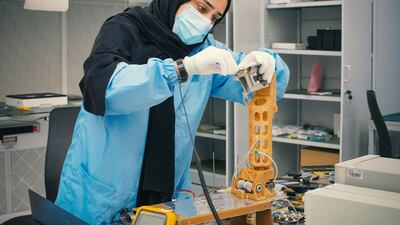
Engineers at the Mohammed bin Rashid Space Centre have been planning a Moon mission since 2017. They have built a 10-kilogram rover called Rashid that will study lunar soil and its properties. It is scheduled for a launch sometime between August to December 2022. Photo: Mohammed bin Rashid Space Centre -
The final prototype of the UAE's Rashid Moon rover. Photo: Mohammed bin Rashid Space Centre -

Two Emirati candidate astronauts are to begin training at Nasa’s Johnson Space Centre in Houston, Texas, in January. Mohammed Al Mulla, a Dubai Police helicopter pilot, and Nora Al Matrooshi, a mechanical engineer, will spend two years in training. Chris Whiteoak / The National -
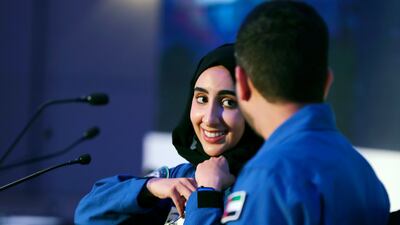
Nora Al Matrooshi and Mohammed Al Mulla will learn the systems of the International Space Station, the Russian language, robotics and how to perform spacewalks. Once they graduate, both astronauts would become eligible for space missions. AP -

Nora Al Matrooshi and Mohammed Al Mulla are the generation of astronauts that could go to the Moon one day. The UAE has its sights set on human missions to the lunar surface. Chris Whiteoak / The National -

US space agency Nasa is preparing the space launch system and Orion spacecraft for the Artemis 1 launch on March 12, which will involve a three-week, uncrewed test flight to the Moon. AFP / Nasa -
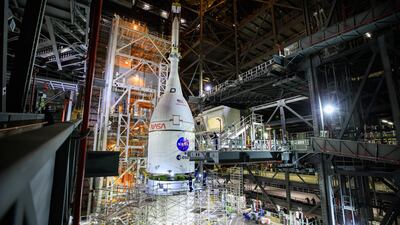
During the mission, the Orion spacecraft will fly 100 kilometres above the Moon’s surface and then use its gravitation force to become captured in an opposite orbit about 70,000 kilometres from the Moon. EPA / Nasa -
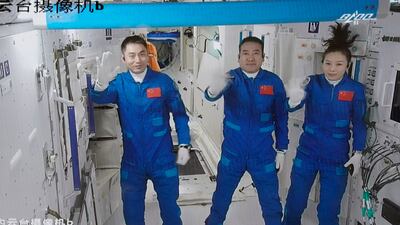
Completion of China’s space station is scheduled for the end of 2022. The Tiangong’s core module Tianhe is already in orbit and has been hosting astronauts, including Wang Yaping, its first female astronaut. Xinhua / AP -
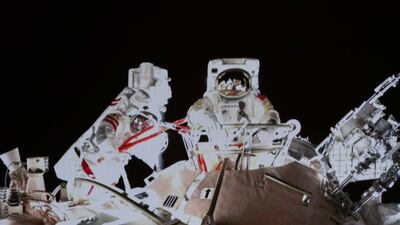
Wang Yaping was sent to the station earlier this year. On November 8, the 41-year-old also became the first Chinese female astronaut to perform a spacewalk. Xinhua / AP -
South Korea plans to launch its first lunar mission in 2022. The Korea Pathfinder orbiter will be launched on a SpaceX Falcon 9 rocket. Photo: Korea Aerospace Research Agency -
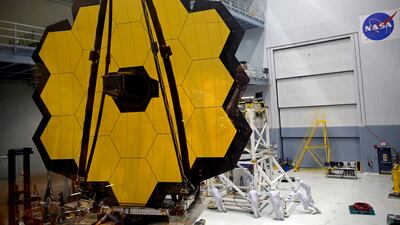
The James Webb Space Telescope will be capable of 'looking back' 13.5 billion years to see the first stars and galaxies of the universe and search for signs of life. It was launched on Saturday, December 25, 2021, and it is expected to make several discoveries when it becomes operational in 2022. Reuters


Intentional actions are also a risk. In January, Nato said in a report that space satellites, key to fighting modern wars, are "high-priority targets" for enemy attacks. As tensions between the bloc and Russia reach historic levels, this warning must be taken seriously, because more and more strategic assets use them, illustrated by Mr Musk's recent attempt to get his satellite-based internet capability into Ukraine to secure its connection from the destruction.
All of these developments are indicative of an emerging free-for-all, in which private companies and governments are on course for possible collision, deliberate or not. On Earth, international law is used to, at least in theory, bring order to these complex situations. It is time space gets the same. Creating a new legal framework will not be easy, but it will be crucial if the cosmos is to be protected. In an optimistic move last year, the UAE unveiled the Dubai Courts of Space, which it hopes will play a "leading role in advancing judicial systems to direct capacity and capability to commercial space-related disputes". There are early frameworks already in place. In 2020, for example, the UAE's space agency joined the Artemis Accords, an international treaty drawn up by Nasa that sets out standards on space exploration, encouraging transparency and safety. More such agreements will be needed, however, if the complex environment is to be properly regulated.
The need for more such bodies does not mean space has to become a vast, legalistic natural reserve. There is much it can offer to improve life at home beyond just scientific research, be it precious metals on asteroids for a world that has never relied on them more, or satellite technology. All countries have a right to pursue these opportunities responsibly.
More laws will protect such ventures, not hamper them. Without them, any geopolitical rivalry, particularly a conflict as significant as Ukraine's, has the potential to deprive the world of access to a region upon which it is increasingly reliant. As environmental crises spiral out of control on Earth, the world has a chance to show lessons have been learned for the sake of space, and revive the early spirit of the ISS at a time when it has rarely been needed more.

