


It is becoming increasingly obvious that repeated attempts at diplomacy are failing to solve the crisis in Ukraine. In recent weeks, a frenzied series of ministerial talks, presidential summits and rejected proposals has resulted in little more than cautionary tales for future historians to mention while they reflect on how the world, particularly the people of Ukraine, waited desperately for concrete action and got none.
In his efforts to convince Russia to remove its forces from the Ukrainian border region, French President Emmanuel Macron has been rebuffed four times by his Russian counterpart, Vladimir Putin, who in turn has spoken at length of how his country has been rebuffed by the West for years. Mr Macron’s failed efforts are now summed up in an image of the two sitting at either ends of a vast table during talks in Moscow. The gulf between the two symbolises the gulf between Nato and Russia.
Britain has been treated with even more antipathy. Foreign Secretary Liz Truss was told by her Russian counterpart that talking to her was like talking to a "deaf person". Trips to Russia have been matched in number by ones between the capitals of Nato members, as the bloc struggles to form a common approach.
This debacle need not signal the death of diplomacy in Europe. There are no conflicts that cannot be at least mitigated, if not prevented, by effective diplomacy and negotiation. What the situation reiterates is the need for skill and empathy in statecraft, rather than rushed, shortsighted brinkmanship.
-
Firefighters arrive at a military building in Kiev that was damaged in an explosion. EPA -

A man looks at the debris of an unidentified object in the aftermath of an explosion in Kiev. EPA -
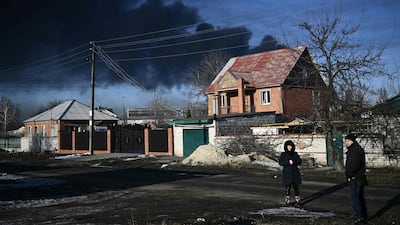
Black smoke rises from a military airport in Chuguyev near Kharkiv. AFP -

People take shelter in a Kiev subway station, after Russian President Vladimir Putin authorised a military operation in eastern Ukraine. Reuters -
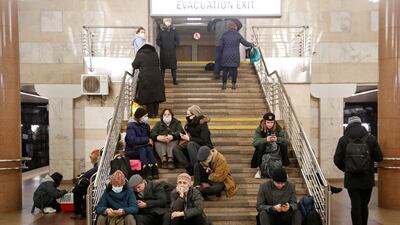
A Kiev underground train station provides some shelter. Reuters -

Clear airspace over Ukraine, shortly after the attack began, as shown on the Flightradar24 website. AP -

Kiev residents leave the city following pre-offensive missile strikes by the Russian armed forces and Belarus. Getty -
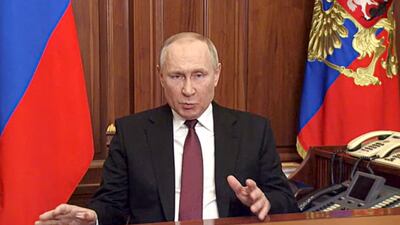
Russian President Vladimir Putin justified the attack in a televised address, saying it was to protect civilians in eastern Ukraine. AP -
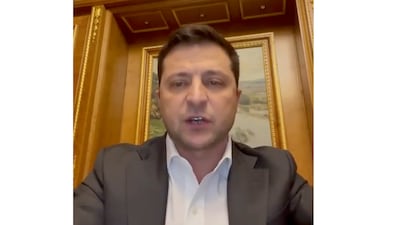
Ukrainian President Volodymyr Zelenskyy addresses the nation in Kiev. He has declared martial law, saying Russia has targeted Ukraine's military infrastructure. AP -
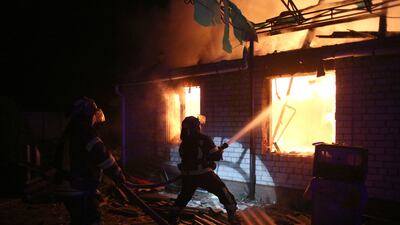
Firefighters extinguish a blaze at a house in Muratovo, in Ukraine's Luhansk enclave. AFP -

The house is said to have been hit during shelling by Russian-backed separatists. AFP -

The coffin of Capt Anton Sidorov is carried by members of the honour guard during a ceremony held at the Ministry of Defence in Kiev, Ukraine. Getty -
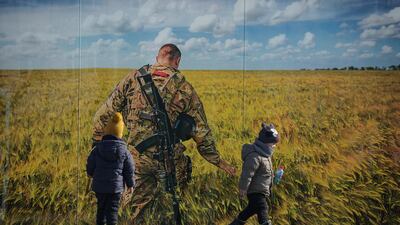
A picture memorial for those killed in the confrontation between Ukraine's military and pro-Russia separatist forces, in the Luhansk region in eastern Ukraine. AP -

UN Secretary General Antonio Guterres and Russia's Ambassador to the UN, Vassily Nebenzia, attend a Security Council meeting in New York to discuss the crisis in Ukraine. Reuters -
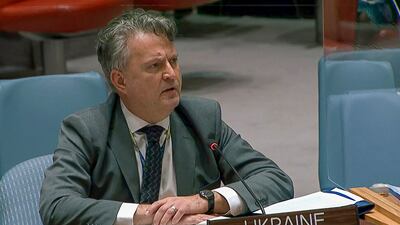
Ukraine's UN ambassador Sergey Kyslytsya speaks during an emergency meeting of the Security Council. AP -
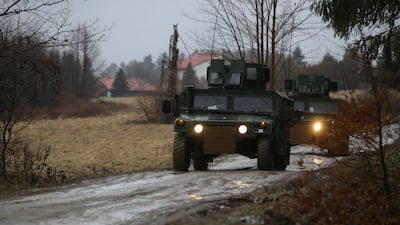
US Army soldiers from the 82nd Airborne Division head towards an air base near Arlamow, Poland. Reuters -

An employee works at the gun counter of a tactical equipment shop in Kiev, Ukraine. Getty -
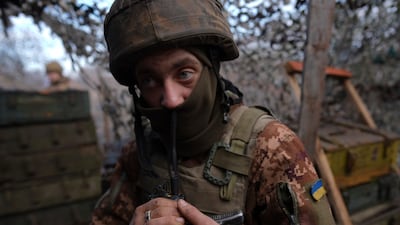
A Ukrainian soldier speaks on a walkie-talkie at his position at the line of separation between Ukraine-held territory and rebel-held territory near Svitlodarsk, eastern Ukraine. AP -
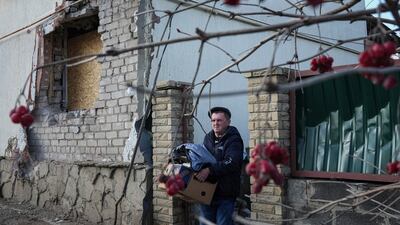
A man removes his belongings from his house after it was struck by artillery shells in Novoluhanske, eastern Ukraine. AP -
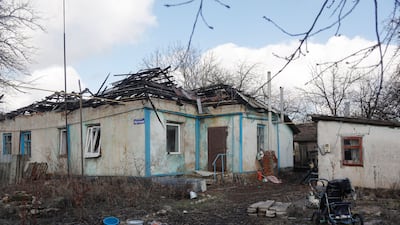
A damaged house in Vibrovka village. EPA -
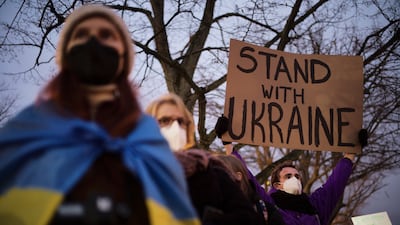
A man shows a poster in support of Ukraine as he protests against the escalation of the tension between Russia and Ukraine, in Berlin. AP -

Soldiers carry the coffin of Capt Anton Sydorov, 35, after he was killed in eastern Ukraine. AP -
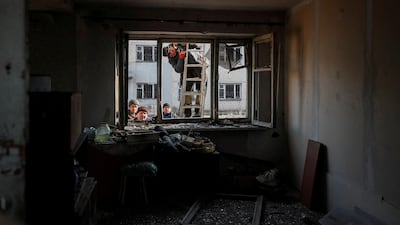
Workers look into a destroyed house after shelling near the city of Novoluhanske in Donetsk. Reuters -

Destroyed buildings in Krasnogorivka, Ukraine. AFP -
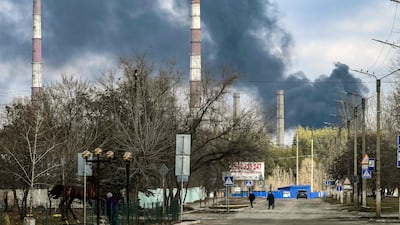
Smoke rises from a power plant after shelling outside the town of Schastia, a day after Moscow recognised two Ukrainian separatist republics and ordered the Russian Army to send in troops as ‘peacekeepers’. AFP -
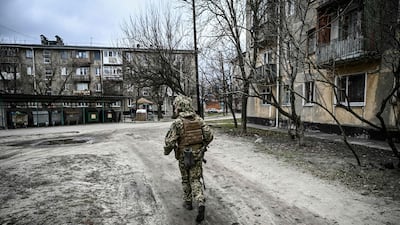
A Ukrainian Army soldier trudges through the wintry streets of Schastia on patrol. AFP -
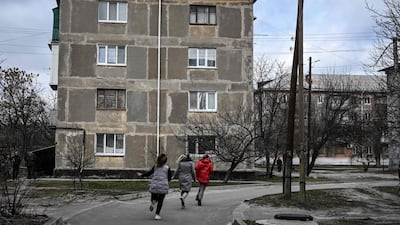
Three women run for cover during shelling in Schastia, eastern Ukraine. AFP -
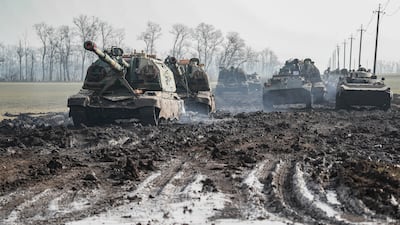
Russian tanks and armoured vehicles on the road in Rostov. EPA -
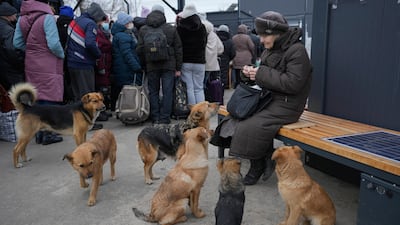
A woman shares food with dogs in Stanytsia Luhanska, a crossing point between Ukrainian government-controlled areas and pro-Russian separatists' territory. AP -
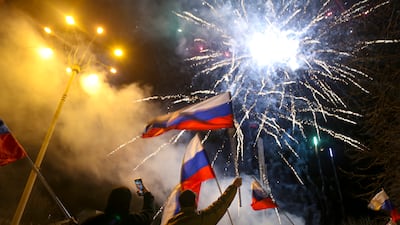
People wave Russian flags in Donetsk, the territory controlled by pro-Russian militants, in eastern Ukraine. AP -
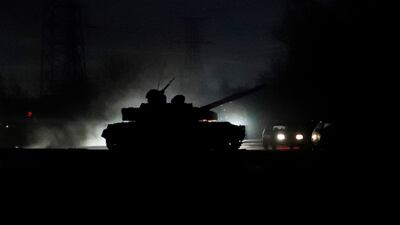
A tank drives along a street in the city of Donetsk. Reuters -
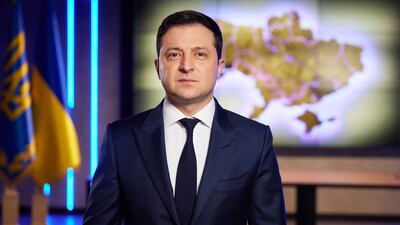
Ukrainian President Volodymyr Zelenskyy addresses the nation on TV and says 'we are not afraid' after Russian President Vladimir Putin ordered troops into Donetsk and Luhansk, two Moscow-backed rebel regions of Ukraine. AFP -
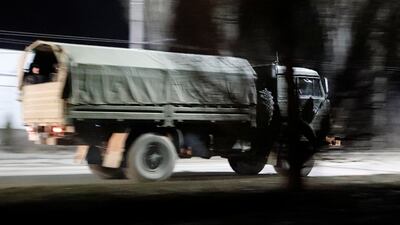
A military truck in Donetsk after Mr Putin ordered the deployment of Russian troops to the city. Reuters -
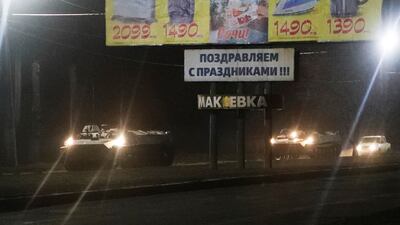
Russian state television showed Mr Putin signing a decree recognising the independence of the two Ukrainian breakaway regions. Reuters -
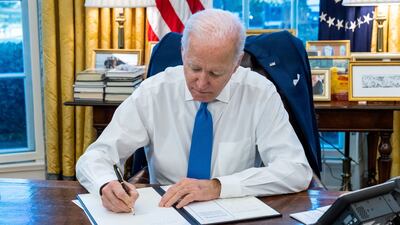
US President Joe Biden signs an executive order at the White House to prohibit trade and investment between US individuals and the two breakaway regions of eastern Ukraine. Reuters -
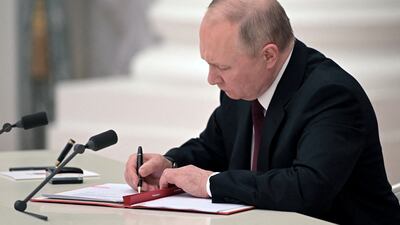
Mr Putin signs documents, including the decree recognising two Russian-backed breakaway regions in eastern Ukraine. Reuters -
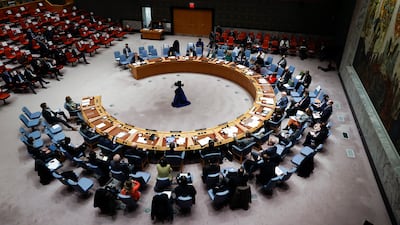
Ukraine ambassador to the United Nations, Sergiy Kyslytsya, addresses an emergency meeting of the UN Security Council on the situation between Ukraine and Russia in New York. EPA


What makes the potential for conflict in Ukraine particularly tragic is that there has been an intricate, multilateralist diplomatic solution on the table for years. Struck in 2015, the "Minsk-2" agreements saw all sides come up with a detailed pathway to peace, with backing from the UN Security Council. If realised, it would have brought about the demilitarisation of rebel-held areas of Ukraine, supported by Russia, a restoration of Kiev's sovereign control of the regions but under new measures to ensure the autonomy of Russian-speaking minority citizens and, therefore, quell fears over the future survival of their culture in Ukraine.
These plans have not been realised because neither Russia nor Ukraine have shown adequate desire to work at their implementation. But it is also because of the failure of the international community to keep both sides accountable, while also giving them the necessary attention and concern that their perspectives deserved. The result is the apparent death of a thorough agreement, brought about through negotiations by skilled diplomats. It has instead been replaced by a mania of ineffective meetings, proposals and subjective speeches on history, while innocent citizens from both sides are forced to consider fleeing or taking up arms against their centuries-old neighbours.
There is still time to de-escalate, despite the worrying developments of the past 48 hours, and all sides should work to do so. Globally, its effects are already being felt. Oil prices have risen and are edging close to $100 a barrel. Numerous airlines have cancelled flights to Ukraine. And the Beijing Winter Olympics, which should have ended on a note of global unity, has instead concluded with calls for peace as a vast war looms.
The case for avoiding war is blatantly obvious – far more so than the rationales for starting one, as evidenced by the murkiness of the disinformation both sides are accused by each other of promoting. But making the case might never have been necessary, if the diplomatic efforts that led to the Minsk agreements had had sufficient follow-through. That is the first tragedy of this crisis. It is only to be hoped desperately that there will be no more in the coming days.

