Insight and opinion from The National’s editorial leadership
January 24, 2022
The UAE’s roads will be busier on Monday, as schoolchildren start returning to classrooms, following the decision to bring them back after three weeks of distance learning for pupils in Abu Dhabi and at government schools in the Emirates. But in a sign of the difficult times in which we live thanks to the Covid-19 pandemic, getting back to school resulted in more delays than simply traffic. In Abu Dhabi, long queues were reported throughout the emirate’s PCR testing facilities, because pupils required a negative result within 96 hours of going back. They will need to test every fortnight according to the guidance.
While these measures remain necessary, they are a reminder of the significant disruption pupils have experienced during the past two years. With no warning, they traded the classroom for a computer screen; the playground for the limits of their own homes.
The scale of this global transition was vast. In a 2020 report by Unicef, the UN’s agency for children, 90 per cent of the 188 countries surveyed adopted some form of digital or remote learning policy.
This was not just a trauma for pupils, but the entire network of adults that support them through education. If learning via a screen seems hard, teaching and managing a class of thirty requires adapting to also. For millions of teachers the world over, there was no choice in the matter. Suddenly their vocation, which involves not just educating children but also safeguarding them, was carried out at a distance. On the opposite end, parents were on call for extra periods of child care, disrupting employment and generally adding more stress at a time of uncertainty. This took a particular toll on women, who carried a disproportionate burden of care the world over.
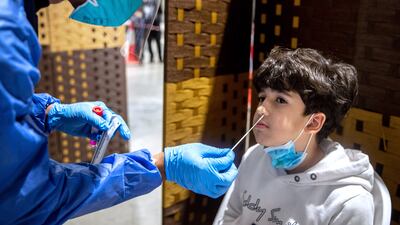
Back-to-school PCR testing gets under way at Biogenix Labs by G42 Healthcare, Masdar City, Abu Dhabi. All Photos: Victor Besa / The National
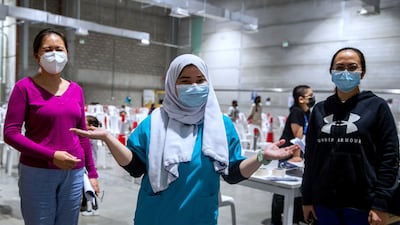
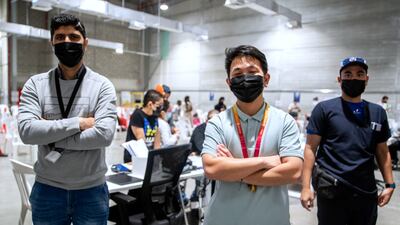
Biogenix Labs staff are ready and waiting for the mass testing as schools reopen in the capital.
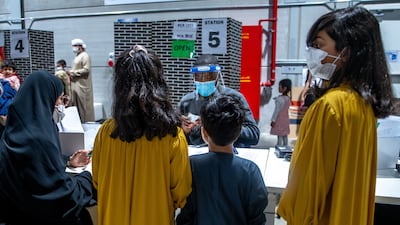
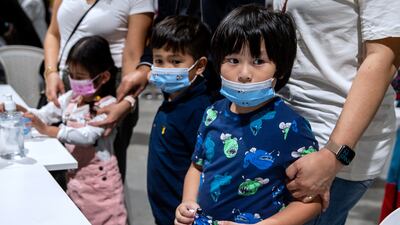
Children queue to be tested.
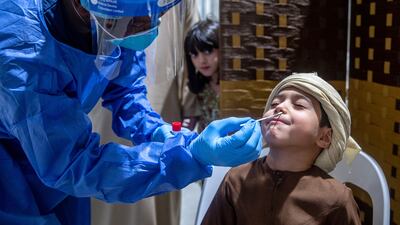
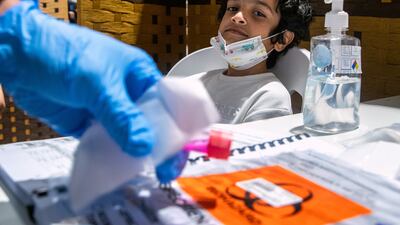
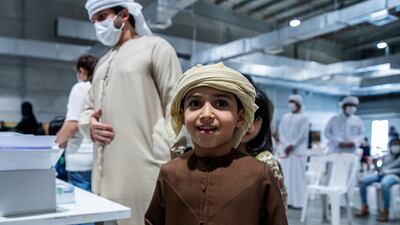
Sultan Al Marzooqi, five, gets his back to school PCR test.
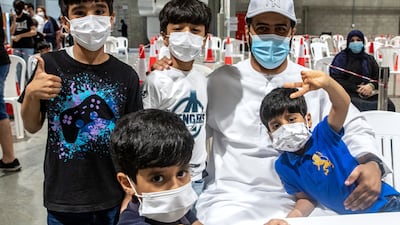
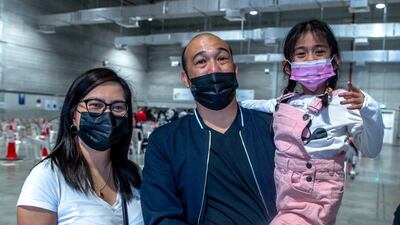
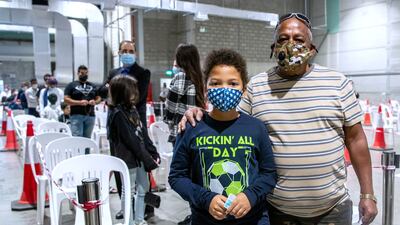
The Solitario family get their PCR tests.
Biogenix Labs staff are ready to help in the fight against Covid-19.
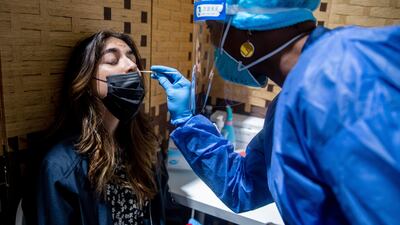
Sarah Ahmad, 17, is tested before heading back to school.
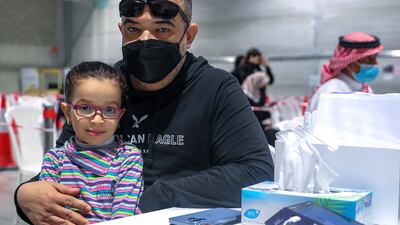
A father takes his daughter for testing.
The Aragon family get their PCR tests.
Khamis Al Balooshi, 10, waits for his turn.
The Williams family get their PCR tests.
The youngest Al Marzooqi family member is all smiles after his test.
Mohamed Al Zahri, eight, is swabbed.
Nonetheless, today will still be a welcome return for most children in Abu Dhabi, specifically those in kindergarten/foundation stage, years 2-6 and year 13, university students and anyone preparing for international exams. The rest will return on January 31.
Today’s resumption of in-person teaching also falls on a symbolic date. January 24 is the UN’s International Day of Education. It is a moment to reflect on the work of those in the education sector, as well as the many people who are unfairly excluded from it. According to the organisation, almost 260 million children around the world do not attend school, 4 million of whom are refugees.
This year’s theme is “Changing Course, Transforming Education”. The past few years have seen the biggest change of course to schooling in generations, and the UN stresses that “the pandemic is a stark reminder of our fragilities and interconnectedness”. In the face of this major change, the organisation has called for a worldwide transformation, built on “solidarity and co-operation”.
Highlighting the need for global action is the right thing to do. While the pandemic has disrupted almost every classroom on the planet, the nature of the disruption differs starkly from country to country. For those in wealthier ones, mask-wearing and regular testing remain somewhat inconvenient, but pale in comparison to challenges elsewhere. For example, more than 460 million schoolchildren are unable to access remote learning programmes offered by their governments, typically due to poverty and bad internet connection.
As the UAE returns to its secure, flexible and high-quality schools, pupils and parents should remember all those in education who are less fortunate. And as an unequal global recovery gathers pace, particular help should be given to those whose ticket to a better life has been disrupted most during the past two years.

Tips for job-seekers
Do not submit your application through the Easy Apply button on LinkedIn. Employers receive between 600 and 800 replies for each job advert on the platform. If you are the right fit for a job, connect to a relevant person in the company on LinkedIn and send them a direct message.
Make sure you are an exact fit for the job advertised. If you are an HR manager with five years’ experience in retail and the job requires a similar candidate with five years’ experience in consumer, you should apply. But if you have no experience in HR, do not apply for the job.
David Mackenzie, founder of recruitment agency Mackenzie Jones Middle East
Founders:Alhaan Ahmed, Alyina Ahmed and Maximo Tettamanzi
Sector:Sustainability
Total funding: Self funded
Number of employees:4
What vitamins do we know are beneficial for living in the UAE
Vitamin D: Highly relevant in the UAE due to limited sun exposure; supports bone health, immunity and mood. Vitamin B12: Important for nerve health and energy production, especially for vegetarians, vegans and individuals with absorption issues. Iron: Useful only when deficiency or anaemia is confirmed; helps reduce fatigue and support immunity. Omega-3 (EPA/DHA): Supports heart health and reduces inflammation, especially for those who consume little fish.
'Ghostbusters: From Beyond'
Director: Jason Reitman
Starring: Paul Rudd, Carrie Coon, Finn Wolfhard, Mckenna Grace
Rating: 2/5
Who's who in Yemen conflict
Houthis: Iran-backed rebels who occupy Sanaa and run unrecognised government
Yemeni government: Exiled government in Aden led by eight-member Presidential Leadership Council
Southern Transitional Council: Faction in Yemeni government that seeks autonomy for the south
Habrish 'rebels': Tribal-backed forces feuding with STC over control of oil in government territory
Will the pound fall to parity with the dollar?
The idea of pound parity now seems less far-fetched as the risk grows that Britain may split away from the European Union without a deal.
Rupert Harrison, a fund manager at BlackRock, sees the risk of it falling to trade level with the dollar on a no-deal Brexit. The view echoes Morgan Stanley’s recent forecast that the currency can plunge toward $1 (Dh3.67) on such an outcome. That isn’t the majority view yet – a Bloomberg survey this month estimated the pound will slide to $1.10 should the UK exit the bloc without an agreement.
New Prime Minister Boris Johnson has repeatedly said that Britain will leave the EU on the October 31 deadline with or without an agreement, fuelling concern the nation is headed for a disorderly departure and fanning pessimism toward the pound. Sterling has fallen more than 7 per cent in the past three months, the worst performance among major developed-market currencies.
“The pound is at a much lower level now but I still think a no-deal exit would lead to significant volatility and we could be testing parity on a really bad outcome,” said Mr Harrison, who manages more than $10 billion in assets at BlackRock. “We will see this game of chicken continue through August and that’s likely negative for sterling,” he said about the deadlocked Brexit talks.
The pound fell 0.8 per cent to $1.2033 on Friday, its weakest closing level since the 1980s, after a report on the second quarter showed the UK economy shrank for the first time in six years. The data means it is likely the Bank of England will cut interest rates, according to Mizuho Bank.
The BOE said in November that the currency could fall even below $1 in an analysis on possible worst-case Brexit scenarios. Options-based calculations showed around a 6.4 per cent chance of pound-dollar parity in the next one year, markedly higher than 0.2 per cent in early March when prospects of a no-deal outcome were seemingly off the table.
4.35pm: Tilal Al Khalediah 5.10pm: Continous 5.45pm: Raging Torrent 6.20pm: West Acre 7pm: Flood Zone 7.40pm: Straight No Chaser 8.15pm: Romantic Warrior 8.50pm: Calandogan 9.30pm: Forever Young
Some of Darwish's last words
"They see their tomorrows slipping out of their reach. And though it seems to them that everything outside this reality is heaven, yet they do not want to go to that heaven. They stay, because they are afflicted with hope." - Mahmoud Darwish, to attendees of the Palestine Festival of Literature, 2008
His life in brief: Born in a village near Galilee, he lived in exile for most of his life and started writing poetry after high school. He was arrested several times by Israel for what were deemed to be inciteful poems. Most of his work focused on the love and yearning for his homeland, and he was regarded the Palestinian poet of resistance. Over the course of his life, he published more than 30 poetry collections and books of prose, with his work translated into more than 20 languages. Many of his poems were set to music by Arab composers, most significantly Marcel Khalife. Darwish died on August 9, 2008 after undergoing heart surgery in the United States. He was later buried in Ramallah where a shrine was erected in his honour.
Indoor cricket World Cup:
Insportz, Dubai, September 16-23
UAE fixtures:
Men
Saturday, September 16 – 1.45pm, v New Zealand
Sunday, September 17 – 10.30am, v Australia; 3.45pm, v South Africa
Monday, September 18 – 2pm, v England; 7.15pm, v India
Tuesday, September 19 – 12.15pm, v Singapore; 5.30pm, v Sri Lanka
Thursday, September 21 – 2pm v Malaysia
Friday, September 22 – 3.30pm, semi-final
Saturday, September 23 – 3pm, grand final
Women
Saturday, September 16 – 5.15pm, v Australia
Sunday, September 17 – 2pm, v South Africa; 7.15pm, v New Zealand
Monday, September 18 – 5.30pm, v England
Tuesday, September 19 – 10.30am, v New Zealand; 3.45pm, v South Africa
Thursday, September 21 – 12.15pm, v Australia
Friday, September 22 – 1.30pm, semi-final
Saturday, September 23 – 1pm, grand final
• There are six libraries in Abu Dhabi emirate run by the Department of Culture and Tourism, including one in Al Ain and Al Dhafra.
• Libraries are free to visit and visitors can consult books, use online resources and study there. Most are open from 8am to 8pm on weekdays, closed on Fridays and have variable hours on Saturdays, except for Qasr Al Watan which is open from 10am to 8pm every day.
• In order to borrow books, visitors must join the service by providing a passport photograph, Emirates ID and a refundable deposit of Dh400. Members can borrow five books for three weeks, all of which are renewable up to two times online.
• If users do not wish to pay the fee, they can still use the library’s electronic resources for free by simply registering on the website. Once registered, a username and password is provided, allowing remote access.