


In good times as well as bad, few diplomatic events have as much geopolitical significance as state visits. But for countries with royal families, even ones that have limited political power, coverage and popular appeal of their official trips can easily rival the presence of a nation's most senior politician.
We saw this special kind of diplomacy throughout the recent visit by Britain's Prince Charles and his wife Camilla to the Middle East. It was not an occasion to discuss geopolitics, rather one to re-emphasise the longstanding friendship between the UK and the region. And while it was not technically a state visit, it was significant. Prince Charles has deep ties with the Middle East and is seen as one of Europe’s most respected royals.
The trip is a sign that Britain values its friends. Politicians change, reflecting the modern, political phases of a country; royal families have a deeper, symbolic association with tradition and identity. The British royals are particularly illustrative of this fact. Constitutionally, they are largely ceremonial. Culturally, however, they are one of the most influential brands around, and a major part of the UK's soft power.
-
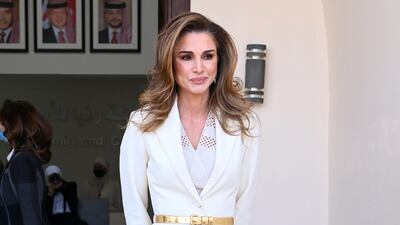
Queen Rania, wearing a white V-neck Dior midi coat with a patterned white blouse, gold Dior belt and a matching Louis Vuitton handbag, poses for a photograph as she visits Queen Rania Family and Child Centre with Britain's Camilla, Duchess of Cornwall, in Amman, Jordan, on November 16, 2021. Reuters -

Queen Rania wears a gold and cream abaya to attend a private dinner at the Al Husseiniya Palace in Amman. Reuters -
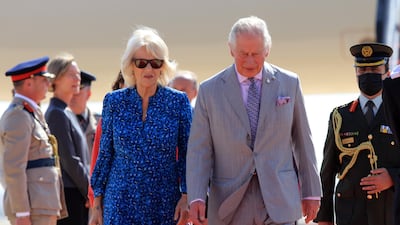
Prince Charles and Camilla, Duchess of Cornwall, wearing a blue flowery dress by Fiona Clare, arrive at Queen Alia International Airport in Amman, Jordan. EPA -

Camilla, Duchess of Cornwall, in a pale green Anna Valentine gown, arrives at a private dinner at Al Husseiniya Palace. Reuters -
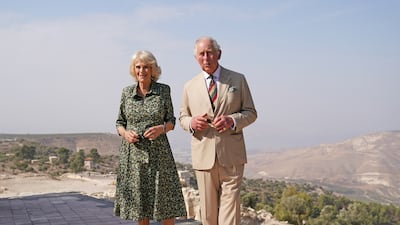
Prince Charles and Camilla, Duchess of Cornwall, wearing a black and khaki Fiona Clare dress, take a walking tour of Umm Qais in Jordan. Getty Images -

Prince Charles and Camilla, Duchess of Cornwall, wearing a white Anna Valentine tunic and trousers, arrive for a centenary celebration of the founding of the Jordanian state, at the Jordan Museum in Amman. AFP -
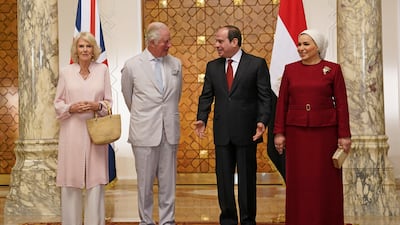
Prince Charles and Camilla, Duchess of Cornwall, wearing a pale pink Anna Valentine tunic and trousers, meet Egypt's President Abdel Fattah El Sisi and the first lady Entissar Amer, at Al-Ittihadiya Palace in Cairo on November 18, 2021. Reuters -

The Egyptian first lady, Entissar Amer, in a red skirt and top, at Al-Ittihadiya Palace in Cairo, 2021. Reuters -

To visit the Al-Azhar Mosque in Cairo, Camilla, Duchess of Sussex, added a white head scarf to her Anna Valentine look. EPA -

Camilla, Duchess of Cornwall, wore the same Anna Valentine tunic to tour the Great Sphinx of Giza, on the outskirts of Cairo, with Prince Charles. Reuters -

Camilla, Duchess of Cornwall, wearing blue Anna Valentine, talks with Magdi Yacoub, retired heart surgeon, during a UK-Egypt reception in Cairo on November 18. Reuters -
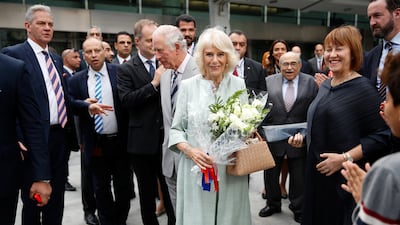
Camilla, Duchess of Cornwall wears a pale green Anna Valentine dress, to visit the Bibliotheca Alexandrina, in Alexandria, Egypt. Reuters


The current British monarch, Queen Elizabeth, has been a friend to the Middle East all her reign. Her first visit to the region was to Libya in 1954. Her first to the UAE was in 1979, when the country was just eight years old. She returned in 2010.
On the advice of doctors, she is now gradually pulling back from her full schedule of state occasions at the age of 95, paving the way for Prince Charles, the monarch-in-waiting, to take on the most important international royal visits. Like his mother, he, too, is a friend of the Middle East, although he has been away for some time; his last trip to the region was in 2006.
He was happy to be back, this time visiting Jordan and Egypt. On the last leg of his trip, the Grand Imam of Al Azhar in Cairo called him a "wise and responsible leader”, and the pair discussed issues such as the environment and interfaith dialogue. Charles, like many of the region's governments, has a longstanding interest in both. Charles's passion for the environment is so great – he is a leading global advocate of organic farming – that it has sometimes got him in trouble at home for overstepping the tight controls on the Royals' political neutrality.
But away from home, the mood this week has been one of friendship and optimism. Naturally, it is also one of responsibility. Camilla was clear that this visit was not a "holiday", but an important moment to affirm Britain's strong and enduring ties with the region. Nonetheless, after so many years away, the pair have said at the end of their tour that it was "absolutely brilliant", but also "too short".

