


When US President Joe Biden gave a detailed address on the withdrawal of American forces from Afghanistan earlier this month, his opening remarks focused on speed. Speed in the drawdown, he said, was safety.
That might have been true for American troops, but it was not so for Afghan ones, who claim they were not given notice the day the US left Bagram air base. And from that moment on, the only speed in Afghanistan has been the rate at which it has descended into chaos, mere weeks after Nato announced its withdrawal.
This is a domestic tragedy. In the past two months, the Taliban has captured more territory than at any time since 2001, the year the US-led coalition invaded. A rapid takeover by the group threatens a return to the barbarity of its rule seen in the 1990s. The Biden administration, which continues to negotiate with the Taliban in Doha, is hoping the organisation has since then become a moderate version of its former self. Many Afghans, most of whom endured the horrible reality of the Taliban's last stint in power, are far less trusting. They are preparing, often by arming themselves, for civil war.
This week has also shown the speed at which a regional disaster is unfolding. Instability in Afghanistan first poured over into neighbouring Tajikistan at the beginning of July, when more than 1,000 Afghan troops had to retreat across the border after heavy clashes with the Taliban. Now, Dushanbe, along with Moscow, is preparing for a new threat. On Wednesday, Russia announced it was reinforcing its military base in Tajikistan, as well as its training of Tajik troops. This is not primarily in response to threats posed by the Taliban, which historically takes less of an interest in carrying out foreign terrorism even if its hosts terrorists, but ISIS, a group that could now find a home in chaotic Afghanistan.
-
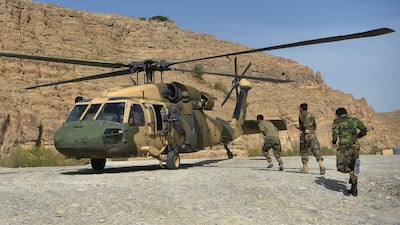
Afghan soldiers unload supplies from an Afghan Air Force Black Hawk helicopter at the Kajaki Dam in Kajaki, Helmand Province. Afghan legislators have voiced concerns about the ability of the military to withstand a Taliban offensive. -
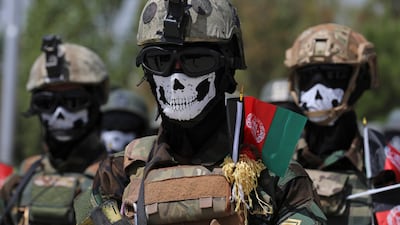
Afghan Army special forces personnel graduate after a three-month training programme at the Kabul Military Training Centre. The Afghan military is under increased pressure as US forces are withdrawing after almost 20 years. -

A graduation ceremony for Afghan Army special forces commandos at the Kabul Military Training Centre. The Afghan military is consolidating forces around cities, border crossings and vital infrastructure. -
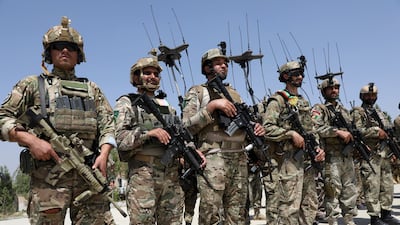
This strategy reflects an attempt to hold provincial capitals in the face of a resurgent Taliban. -
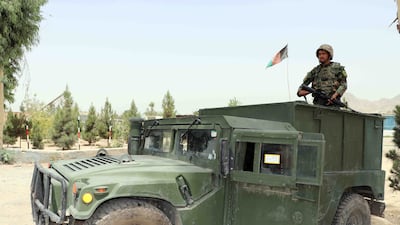
A member of Afghan security forces at a checkpoint in Kandahar. All US forces are due to have left Afghanistan by August 31.


China, which shares a small border with the country, is another major power being drawn into the crisis. Also on Wednesday, a Taliban delegation was in Beijing to give assurances that the group would not allow Uighur separatists to shelter in its territories. The Taliban will use such meetings to claim international legitimacy, although US Secretary of State Antony Blinken has since said that China's increased engagement on Afghanistan could be "positive".
And to the west, the unfolding disaster is aggravating older problems. Turkey, which already hosts millions of refugees in line with a fragile deal signed with the EU in 2016, has seen an influx of Afghan migrants recently, which is being attributed largely to the renewed violence. About 1,200 people are are thought to be crossing each day.
There is speculation that US air support in Afghanistan could be extended, a move that would scrap a current deadline to withdraw it at the end of August. This could help stem Taliban advances; US bombs have proven crucial in keeping the organisation at bay. Drones and planes, however, do not provide economic and political support, or training, all of which are vital to keeping Kabul's government going, as well as the promise of a stable future for Afghans that Nato made when it rolled in two decades ago.
America is physically leaving Afghanistan, but a resurgent Taliban domestically and an unfolding geopolitical crisis regionally means Washington cannot claim mission accomplished. Mr Biden is trying to break a pattern of American forever wars, but the Afghanistan campaign is not yet over if tactical blunders drag its forces back.

