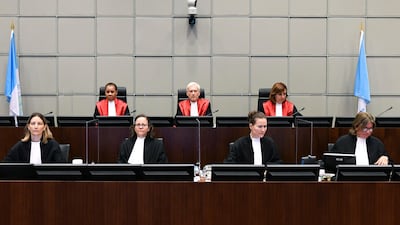
The idea of forming a Special Tribunal for Lebanon first emerged on October 1, 2004, when news came of a car bomb severely injuring Marwan Hamadeh, a Lebanese politician and journalist, in Beirut. Terje Rod-Larsen, at the time the UN special co-ordinator for the Middle East Peace Process, and I discussed the idea at a meeting that took place later that day in New York.
As a lawyer and activist, I had sought out Mr Rod-Larsen, who was effectively the man in charge of Lebanon issues at the UN, to ask how he intended to implement the recently passed UN Security Council Resolution 1559, which called for free and fair presidential elections in Lebanon, the surrender of weapons by the Iranian-backed Lebanese militia group Hezbollah and the withdrawal of Syrian troops stationed in the country.

It is important to remember at this point that the Lebanese state, its institutions and many of its politicians were being coerced by Syrian President Bashar Al Assad into toeing the line he was imposing on Lebanon.
It was obvious to me that the attack on Mr Hamadeh was meant to serve as a warning to his two primary allies – the Progressive Socialist Party leader Walid Joumblatt and the prime minister Rafik Hariri – because of their stand against Lebanon’s President, Emile Lahoud, and his Syrian backers.
I pointed out to Mr Rod-Larsen the likely emergence of a pattern of assassination attempts with the purpose of punishing the rising anti-Syrian coalition in Lebanon, and the need to anticipate and respond to it.
Sure enough, matters got worse in Lebanon.
Hariri was forced out of office in the second week of October, despite the fact that, under pressure from the Syrian regime, he had voted for Mr Lahoud’s extension. According to a later UN investigative report, President Bashar Al Assad had told Hariri: “I will bring down the whole of Lebanon over your head if you don’t support the extension of Lahoud’s presidency.”
Meanwhile, no arrests were made following the attack on Mr Hamadeh.
After the assassination of Hariri in another car bomb in February, 2005, I suggested to Nick Rostow, the legal adviser to the US delegation to the UN, that an international tribunal be set up immediately.
It is still my view that the assassination should have been treated not as terrorism, but rather as a crime against humanity, which would have qualified it for referral to the International Criminal Court. This would have negated the need to build a tribunal from scratch. At the time, moreover, the ICC had shown more competence in dealing with crimes of this nature and magnitude. Amnesty International also agreed with that categorisation because the attack had claimed 22 lives (including Hariri’s). It did not help matters that the word “terrorism” was – and, in fact, remains – undefined in international law.
It was a missed opportunity.
Instead, an international probe was instituted by the UN a few weeks later, which in turn recommended the establishment of a tribunal. Two excellent investigators were appointed in 2005: Irish deputy police commissioner Peter Fitzgerald and German federal prosecutor Detlev Mehlis. Both proved remarkable in their efforts to push back against the Lebanese-Syrian security complex and force the arrest of four Lebanese generals suspected of covering up the assassination and deflecting the course of justice. Two prominent journalists, Samir Kassir and Gebrane Tueni, were murdered that year – I believe, by this security complex – yet there was progress being made in the investigation.

In January 2006, however, the probe screeched to a halt, with the dynamism of the Cedar Revolution – a chain of nationwide demonstrations seeking truth and justice following Hariri’s assassination – undermined by a new appointee, former Belgian prosecutor Serge Brammertz.
After his appointment in January, little serious work was done for about two years, during which time he worked as an investigator and then as a prosecutor, botching the enquiry process as well as the legal work.
The four generals arrested on the request of Mr Mehlis were imprisoned without any set court date. Meanwhile, assassinations of those who stood up to the pro-Syrian and pro-Hezbollah forces continued unabated. Mr Lahoud and his allies were adversarial towards the STL and, as corpses piled up, the tribunal became little more than a paper tiger.
The prosecution would only issue the first indictments five years later, after a courageous Lebanese investigator named Wissam Eid conducted a detailed analysis of mobile phone signals on the day of the killing to isolate certain individuals he suspected of being involved. One of the suspicious phone calls was made by Salim Ayyash, a seemingly low-level Hezbollah operative. Ayyash and four others were indicted by the STL. One of the four, Mustafa Badreddine, later died in Syria, and proceedings against him were ended. Eid, though, was assassinated in 2008. It is worth noting that the STL did not mention his name in the public statement.
Nor, since January 2006, has there been a single word mentioned about the openly brutal obstruction of justice by Mr Al Assad, Mr Lahoud and Hassan Nasrallah, the head of Hezbollah. Journalists, instead, were cited for various insignificant leaks.
Apart from being toothless, the STL was also leaderless for a long time. For a while Antonio Cassese, a distinguished international criminal scholar and judge, presided over the tribunal. From my correspondence with him, I knew he wanted to take the case forward. He was of a different calibre. But luck deserted Lebanon again, as Cassese died of cancer shortly after his resignation in 2011.
I was, therefore, hardly surprised by how timid this week’s judgment turned out to be.
The only person found guilty was Ayyash, who led the assassination cell, but was the smallest fish in the conspiracy. And the STL found no grounds to condemn Nasrallah for his steadfast refusal to surrender Ayyash either, since his indictment in 2010.
The enquiry was botched in so many ways, with manifest errors in law. The most shocking among them was the tribunal’s refusal to investigate those whom it said had the strongest motives in Hariri’s killing. The legal expert in me wonders how will any teacher of criminal law explain to his or her students that motive is not a component of a crime – as it was bewildering to hear the STL president say this week. The streets of a Beirut, recently battered by explosions in its port area, seethed with disappointment and anger.
The line heard on the street aptly summarised the judgment: “The STL found that Salim Ayyash, alone, made a telephone call.”
Chibli Mallat is an emeritus law professor, international criminal lawyer and, until September, co-ordinator of the Lebanese activist coalition TMT

