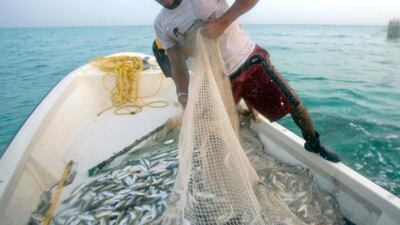
Many years ago, while researching into the archaeology of Abu Dhabi, I encountered a local fisherman who lived a spartan life with his wife on the island of Marawah, in western Abu Dhabi. They felt very much at home there, coming only rarely to their house in the city.
Though we struggled with language – his English was non-existent and my Arabic very poor – Darwish and I became friends.
Born well before the Second World War, he had tales in profusion of the pre-oil past. He remembered the days when fresh water used to be brought from Kuwait in wooden casks towed behind dhows. A resident of the island of Balghelam, in north-east Abu Dhabi, before moving to Marawah, he knew almost every island well. He knew where the old settlements had been and how they were used, something of enormous value to archaeologists as we struggled to understand the sketchy remains that were still visible. He could explain how people moved from the islands onshore and inland at various times of the year.
Darwish knew the sea too. It was his life. He knew the tides and the pearl banks. He knew the crevices in coral reefs where the big hamour would hide and told tales of how he could go wading at low tide, put a hand into the crevices and pull out a big fish. Such knowledge, I suspect, is now largely forgotten.
More than 20 years ago, I wrote a profile of Darwish in Emirates News talking about his knowledge of a passing era. I remember the headline clearly, one of his favourite phrases: "Al Bahr Kulu Kharrab", a pidgin Arabic of the phrase "The Sea is All Ruined".
Darwish lamented the over-fishing that was already depleting our marine resources. The large hamour of the past, he told me, were increasingly difficult to find. Other species were also rapidly declining. Metal gargour fishing traps, lost on the seabed, were catching fish that would never be brought to market, a phenomenon known as "ghost fishing".
Unless something drastic was done, he predicted, our fish stocks would collapse irreversibly and a way of life that had lasted for thousands of years would be gone.
He was an early harbinger of doom. Although the use of the gargour is now tightly controlled and regulations have been introduced to the fishing industry, a study by the Environment Agency Abu Dhabi published last year showed that stocks of popular species such as hamour and sheri have declined by over 85 per cent.
Sellers weigh leftover hamour before sticking them in the freezer at the Sharjah Fish Market. Jeff Topping for The National
I thought of Darwish this week as I read of the success of a fish-breeding project in Umm Al Quwain, run by the Ministry of Climate Change and the Environment in association with the local Department of Economic Development and the UAQ fishermen's co-operative. This project, along with another one on the island of Abu Al Abyad, now produce around 35 million young fish a year, of hamour, sheri and other species, to be released into the waters of the Gulf.
At last, dedicated efforts are being made to reverse the decline in stocks that Darwish saw so clearly nearly a quarter of a century ago. I hope that it is not too late.
Over-exploitation of our natural resources is not confined to the sea, of course. Onshore, in the deserts, the numbers of camels have grown to such an extent that the natural vegetation is being eliminated. According to the Food and Agriculture Organisation, the numbers of UAE camels increased from 39,500 in 1976 to 436,800 in 2016. Numbers in Abu Dhabi, according to Statistics Centre – Abu Dhabi, rose by 42 per cent between 2005 and 2018 alone, to 405,160. Grazing areas in Abu Dhabi have 85 per cent less vegetation than the areas that are fenced and ungrazed.
Camels have decimated green areas of the desert, according to a new documentary from Environment Agency Abu Dhabi. Anushka Eranga / Caters News
The establishment of protected areas, whether on land or at sea, is a positive and much welcome step, as are the breeding programmes for hamour and other fish. That, though, can only ever be part of the solution
While similar studies haven’t been undertaken in the mountains, the rapid expansion of herds of sheep and goats mean that plants and shrubs have less chance to regenerate. Barren hillsides predominate where once sturdy trees could be found. A study a few years ago of wild olive trees – found only in a restricted area south of Fujairah – showed that virtually no young trees were present. They had been grazed before they could become established.
As the vegetation disappears, so too do the various forms of wildlife that depend on it.
The establishment of protected areas, whether on land or at sea, is a positive and much welcome step, as are the breeding programmes for hamour and other fish. That, though, can only ever be part of the solution if we are to halt the damage that has already been done and to reverse the downward trend.
The numbers of camels, sheep and goats need to be drastically reduced. More of our demand for fresh fish needs to be met from fish farms, so that both inshore and deep sea fishing can be dramatically curtailed.
My friend Darwish, and many others like him, sounded the alarm long ago. It is good to see decisive action taken to act on the warnings they so passionately gave.
Peter Hellyer is a UAE cultural historian and columnist for The National

Flying to Guyana requires first reaching New York with either Emirates or Etihad, then connecting with JetBlue or Caribbean Air at JFK airport. Prices start from around Dh7,000.
Getting around:
Wildlife Worldwide offers a range of Guyana itineraries, such as its small group tour, the 15-day ‘Ultimate Guyana Nature Experience’ which features Georgetown, the Iwokrama Rainforest (one of the world’s four remaining pristine tropical rainforests left in the world), the Amerindian village of Surama and the Rupununi Savannah, known for its giant anteaters and river otters; wildlifeworldwide.com
As a UAE-based travel agent who processes tourist visas from the Philippines, Jennifer Pacia Gado is fielding a lot of calls from concerned travellers just now. And they are all asking the same question.
“My clients are mostly Filipinos, and they [all want to know] about good conduct certificates,” says the 34-year-old Filipina, who has lived in the UAE for five years.
Ms Gado contacted the Philippines Embassy to get more information on the certificate so she can share it with her clients. She says many are worried about the process and associated costs – which could be as high as Dh500 to obtain and attest a good conduct certificate from the Philippines for jobseekers already living in the UAE.
“They are worried about this because when they arrive here without the NBI [National Bureau of Investigation] clearance, it is a hassle because it takes time,” she says.
“They need to go first to the embassy to apply for the application of the NBI clearance. After that they have go to the police station [in the UAE] for the fingerprints. And then they will apply for the special power of attorney so that someone can finish the process in the Philippines. So it is a long process and more expensive if you are doing it from here.”
ENGLAND SQUAD
Team: 15 Mike Brown, 14 Anthony Watson, 13 Ben Te'o, 12 Owen Farrell, 11 Jonny May, 10 George Ford, 9 Ben Youngs, 1 Mako Vunipola, 2 Dylan Hartley, 3 Dan Cole, 4 Joe Launchbury, 5 Maro Itoje, 6 Courtney Lawes, 7 Chris Robshaw, 8 Sam Simmonds
Replacements 16 Jamie George, 17 Alec Hepburn, 18 Harry Williams, 19 George Kruis, 20 Sam Underhill, 21 Danny Care, 22 Jonathan Joseph, 23 Jack Nowell
Get a service history for cars less than five years old
Don’t go cheap on the inspection
Check for oil leaks
Do a Google search on the standard problems for your car model
Do your due diligence. Get a transfer of ownership done at an official RTA centre
Check the vehicle’s condition. You don’t want to buy a car that’s a good deal but ends up costing you Dh10,000 in repairs every month
Validate warranty and service contracts with the relevant agency and and make sure they are valid when ownership is transferred
If you are planning to sell the car soon, buy one with a good resale value. The two most popular cars in the UAE are black or white in colour and other colours are harder to sell
Tarek Kabrit, chief executive of Seez, and Imad Hammad, chief executive and co-founder of CarSwitch.com
Winner Man Of Promise, William Buick, Charlie Appleby
Tips from the expert
Dobromir Radichkov, chief data officer at dubizzle and Bayut, offers a few tips for UAE residents looking to earn some cash from pre-loved items.
Sellers should focus on providing high-quality used goods at attractive prices to buyers.
It’s important to use clear and appealing photos, with catchy titles and detailed descriptions to capture the attention of prospective buyers.
Try to advertise a realistic price to attract buyers looking for good deals, especially in the current environment where consumers are significantly more price-sensitive.
Be creative and look around your home for valuable items that you no longer need but might be useful to others.
Director: Paul Weitz
Stars: Kevin Hart
3/5 stars
Manchester City transfers:
OUTS
Pablo Zabaleta, Bacary Sagna, Gael Clichy, Willy Caballero and Jesus Navas (all released)
INS
Ederson (Benfica) £34.7m, Bernardo Silva (Monaco) £43m
ON THEIR WAY OUT?
Joe Hart, Eliaquim Mangala, Samir Nasri, Wilfried Bony, Fabian Delph, Nolito and Kelechi Iheanacho
ON THEIR WAY IN?
Dani Alves (Juventus), Alexis Sanchez (Arsenal)
The specs
BMW M8 Competition Coupe
Engine 4.4-litre twin-turbo V8
Power 625hp at 6,000rpm
Torque 750Nm from 1,800-5,800rpm
Gearbox Eight-speed paddleshift auto
Acceleration 0-100kph in 3.2 sec
Top speed 305kph
Fuel economy, combined 10.6L / 100km
Price from Dh700,000 (estimate)
On sale Jan/Feb 2020
UAE Falcons
Carly Lewis (captain), Emily Fensome, Kelly Loy, Isabel Affley, Jessica Cronin, Jemma Eley, Jenna Guy, Kate Lewis, Megan Polley, Charlie Preston, Becki Quigley and Sophie Siffre. Deb Jones and Lucia Sdao – coach and assistant coach.
23-man shortlist for next six Hall of Fame inductees
Tony Adams, David Beckham, Dennis Bergkamp, Sol Campbell, Eric Cantona, Andrew Cole, Ashley Cole, Didier Drogba, Les Ferdinand, Rio Ferdinand, Robbie Fowler, Steven Gerrard, Roy Keane, Frank Lampard, Matt Le Tissier, Michael Owen, Peter Schmeichel, Paul Scholes, John Terry, Robin van Persie, Nemanja Vidic, Patrick Viera, Ian Wright.
