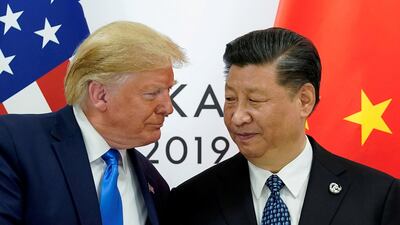
A while ago I asked in these pages why China’s authorities were not better at setting out a positive case for the contributions they had helped make to other countries around the world – because they are in fact legion, but detractors who want to accuse Beijing of practicing debt-trap diplomacy, for instance, will never mention them.
It may seem counter-intuitive, or even perverse, in the age of US President Donald Trump, but why is America not better at promoting itself abroad? This is something that needs to be raised in an era which is characterised not just by actual contestation with China, but by a culture on the hawkish right that borders on encouraging conflict or that suggests, in a possibly dangerously self-fulfilling way, that it is inevitable.
Everything is seen through the lens of competition. Take a report by Australia’s Lowy Institute last November which stated that China now had more missions, consulates and other representative offices around the world than the US. That prompted the headline in one publication: “The US is losing its crown to China as the world’s biggest diplomatic power”. Given that foreign service heft is measured not solely by the numbers of diplomats or embassies, that conclusion is debatable. What is not, however, is that China is getting a much better return on the money it spends abroad than the US.
Until Mr Trump announced he would stop funding for the World Health Organisation (WHO), the US had been the largest annual contributor, in the hundreds of millions per year. China contributes around a tenth of the American total. But when President Xi Jinping pledged an additional $30 million to the WHO a week after Mr Trump’s intervention he garnered plenty of favourable media coverage, for what was a minuscule amount by comparison.
As the Atlantic magazine put it recently: for years, US officials have been "worried that China kept somehow buying more influence, with less money, around the world." In the UN system in general, writes the French academic and analyst Francois Godement, while the US provides far more financial support than China, it appears that "the US talks loudly but carries a small stick" whereas "China now speaks softly but carries a big stick."
The UN has its own special dynamics; China’s ability to cast itself still as a fellow developing country and to “say no” at the Security Council as Mr Godement rightly points out, constitutes a power unquantifiable in monetary terms. But the broader point remains.
The lack of wider knowledge about what America's presence means struck me forcefully when looking at the US State Department's document on "A Free and Open Indo-Pacific" that I mentioned last week. Let some of the figures sink in: "In 2018, we conducted over $1.9 trillion in two-way trade with the region, supporting more than three million jobs in the US and 5.1 million jobs in the Indo-Pacific. All five of our non-Nato bilateral defence alliances are in the Indo-Pacific. We are also the largest donor of foreign assistance in the region, contributing $2tn in constant dollars since the end of the Second World War."
There is much, much more. But rarely are these sums spelt out so specifically. As one Malaysian analyst put it to me: “The Americans, including the private sector, have been here in Asia for ages. But they seem unable to harness that narrative and sell it like China does.”
Could Mr Trump perhaps have a point when he berates the rest of the world for being ungrateful to America? Have we all got used to taking US largesse for granted?
Now of course there are all sorts of reasons why some people or countries are not so fond of Uncle Sam. An overly interventionist foreign policy backed by a self-awarded exceptionalism that has allowed president after president to act extra-judicially or order disastrous invasions. There is a reflex anti-Americanism on much of the left; not just among those who granted too much benefit of the doubt to Communist regimes during the Cold War, but also those who dislike the inequalities resulting from the unbridled capitalism Washington champions.
Many would argue that lots of US spending overseas is not altruistic but is about upholding its “leader of the world” status. That is at least partly true; USAID, the agency which administers around half of American assistance abroad, is explicit that it is an instrument of US foreign policy.
But the figures speak for themselves – that is, when they are actually mentioned. Where would Nato have been without the US’s overwhelming defence spending? How would Europe have coped without the multibillion US Marshall Plan that helped the continent recover after the devastation of the Second World War?
What would happen to the security of Southeast Asian countries in the South China Sea if the US didn't conduct freedom of navigation operations? It is virtually risk-free for regional politicians to use anti-colonial rhetoric to win votes, but they would be terrified if US forces departed for good. And that $2tn in foreign assistance to the Indo-Pacific bears repeating.
Yes, US funds and support often come with a price tag. American officials have a long and tiresome habit of wagging their fingers at developing countries that dare to have different cultural, legal and political systems. But fears or resentments about US imperial overreach should not obscure all the good America has done in the real business of nation-building: in education, training, skills transference, infrastructure and investment.
This is no paean to America. Nor do many countries want to be placed in the invidious position of having to choose between the US and China. But perhaps when measuring up the assistance Beijing and Washington are offering, it is worth remembering that the answer to the question “just what did the Americans do for us?” is “actually, rather a lot.”
Sholto Byrnes is a commentator and consultant in Kuala Lumpur and a corresponding fellow of the Erasmus Forum

Brahmastra%3A%20Part%20One%20-%20Shiva
%3Cp%3E%3Cstrong%3EDirector%3A%20%3C%2Fstrong%3EAyan%20Mukerji%3C%2Fp%3E%0A%3Cp%3E%3Cstrong%3EStars%3A%20%3C%2Fstrong%3ERanbir%20Kapoor%2C%20Alia%20Bhatt%20and%20Amitabh%20Bachchan%3C%2Fp%3E%0A%3Cp%3E%3Cstrong%3ERating%3A%3C%2Fstrong%3E%202%2F5%3C%2Fp%3E%0A
Milestones on the road to union
1970
October 26: Bahrain withdraws from a proposal to create a federation of nine with the seven Trucial States and Qatar.
December: Ahmed Al Suwaidi visits New York to discuss potential UN membership.
1971
March 1: Alex Douglas Hume, Conservative foreign secretary confirms that Britain will leave the Gulf and “strongly supports” the creation of a Union of Arab Emirates.
July 12: Historic meeting at which Sheikh Zayed and Sheikh Rashid make a binding agreement to create what will become the UAE.
July 18: It is announced that the UAE will be formed from six emirates, with a proposed constitution signed. RAK is not yet part of the agreement.
August 6: The fifth anniversary of Sheikh Zayed becoming Ruler of Abu Dhabi, with official celebrations deferred until later in the year.
August 15: Bahrain becomes independent.
September 3: Qatar becomes independent.
November 23-25: Meeting with Sheikh Zayed and Sheikh Rashid and senior British officials to fix December 2 as date of creation of the UAE.
November 29: At 5.30pm Iranian forces seize the Greater and Lesser Tunbs by force.
November 30: Despite a power sharing agreement, Tehran takes full control of Abu Musa.
November 31: UK officials visit all six participating Emirates to formally end the Trucial States treaties
December 2: 11am, Dubai. New Supreme Council formally elects Sheikh Zayed as President. Treaty of Friendship signed with the UK. 11.30am. Flag raising ceremony at Union House and Al Manhal Palace in Abu Dhabi witnessed by Sheikh Khalifa, then Crown Prince of Abu Dhabi.
December 6: Arab League formally admits the UAE. The first British Ambassador presents his credentials to Sheikh Zayed.
December 9: UAE joins the United Nations.
Company%20Profile
%3Cp%3E%3Cstrong%3EName%3A%3C%2Fstrong%3E%20Takestep%0D%3Cbr%3E%3Cstrong%3EStarted%3A%3C%2Fstrong%3E%20March%202018%0D%3Cbr%3E%3Cstrong%3EFounders%3A%3C%2Fstrong%3E%20Mohamed%20Khashaba%2C%20Mohamed%20Abdallah%2C%20Mohamed%20Adel%20Wafiq%20and%20Ayman%20Taha%0D%3Cbr%3E%3Cstrong%3EBased%3A%3C%2Fstrong%3E%20Cairo%2C%20Egypt%0D%3Cbr%3E%3Cstrong%3ESector%3A%3C%2Fstrong%3E%20health%20technology%0D%3Cbr%3E%3Cstrong%3EEmployees%3A%3C%2Fstrong%3E%20%2011%20full%20time%20and%2022%20part%20time%0D%3Cbr%3E%3Cstrong%3EInvestment%20stage%3A%3C%2Fstrong%3E%20pre-Series%20A%3C%2Fp%3E%0A
Padmaavat
Director: Sanjay Leela Bhansali
Starring: Ranveer Singh, Deepika Padukone, Shahid Kapoor, Jim Sarbh
3.5/5
The%20Roundup%20%3A%20No%20Way%20Out
%3Cp%3E%3Cstrong%3EDirector%3A%3C%2Fstrong%3E%20Lee%20Sang-yong%3Cbr%3E%3Cstrong%3EStars%3A%3C%2Fstrong%3E%20Don%20Lee%2C%20Lee%20Jun-hyuk%2C%20Munetaka%20Aoki%3Cbr%3E%3Cstrong%3ERating%3A%20%3C%2Fstrong%3E3%2F5%3Cbr%3E%3Cbr%3E%3C%2Fp%3E%0A
'The Ice Road'
Director: Jonathan Hensleigh
Stars: Liam Neeson, Amber Midthunder, Laurence Fishburne
2/5
UAE currency: the story behind the money in your pockets
Specs%20
%3Cp%3E%3Cstrong%3EPower%20train%3A%20%3C%2Fstrong%3E4.0-litre%20twin-turbo%20V8%20and%20synchronous%20electric%20motor%3Cbr%3E%3Cstrong%3EMax%20power%3A%20%3C%2Fstrong%3E800hp%3Cbr%3E%3Cstrong%3EMax%20torque%3A%20%3C%2Fstrong%3E950Nm%3Cbr%3E%3Cstrong%3ETransmission%3A%20%3C%2Fstrong%3EEight-speed%20auto%3Cbr%3E%3Cstrong%3EBattery%3A%20%3C%2Fstrong%3E25.7kWh%20lithium-ion%3Cbr%3E0-100km%2Fh%3A%203.4sec%3Cbr%3E0-200km%2Fh%3A%2011.4sec%3Cbr%3E%3Cstrong%3ETop%20speed%3A%20%3C%2Fstrong%3E312km%2Fh%3Cbr%3E%3Cstrong%3EMax%20electric-only%20range%3A%3C%2Fstrong%3E%2060km%20(claimed)%3Cbr%3E%3Cstrong%3EOn%20sale%3A%3C%2Fstrong%3E%20Q3%3Cbr%3E%3Cstrong%3EPrice%3A%20%3C%2Fstrong%3EFrom%20Dh1.2m%20(estimate)%3Cbr%3E%3Cbr%3E%3C%2Fp%3E%0A
Company%20Profile
%3Cp%3E%3Cstrong%3EName%3A%3C%2Fstrong%3E%20Ovasave%3Cbr%3E%3Cstrong%3EStarted%3A%3C%2Fstrong%3E%20November%202022%3Cbr%3E%3Cstrong%3EFounders%3A%3C%2Fstrong%3E%20Majd%20Abu%20Zant%20and%20Torkia%20Mahloul%3Cbr%3E%3Cstrong%3EBased%3A%3C%2Fstrong%3E%20Abu%20Dhabi%3Cbr%3E%3Cstrong%3ESector%3A%3C%2Fstrong%3E%20Healthtech%3Cbr%3E%3Cstrong%3ENumber%20of%20staff%3A%3C%2Fstrong%3E%20Three%20employees%3Cbr%3E%3Cstrong%3EInvestment%20stage%3A%3C%2Fstrong%3E%20Pre-seed%3Cbr%3E%3Cstrong%3EInvestment%3A%3C%2Fstrong%3E%20%24400%2C000%3C%2Fp%3E%0A
COMPANY PROFILE
Name: HyperSpace
Started: 2020
Founders: Alexander Heller, Rama Allen and Desi Gonzalez
Based: Dubai, UAE
Sector: Entertainment
Number of staff: 210
Investment raised: $75 million from investors including Galaxy Interactive, Riyadh Season, Sega Ventures and Apis Venture Partners
What the law says
Micro-retirement is not a recognised concept or employment status under Federal Decree Law No. 33 of 2021 on the Regulation of Labour Relations (as amended) (UAE Labour Law). As such, it reflects a voluntary work-life balance practice, rather than a recognised legal employment category, according to Dilini Loku, senior associate for law firm Gateley Middle East.
“Some companies may offer formal sabbatical policies or career break programmes; however, beyond such arrangements, there is no automatic right or statutory entitlement to extended breaks,” she explains.
“Any leave taken beyond statutory entitlements, such as annual leave, is typically regarded as unpaid leave in accordance with Article 33 of the UAE Labour Law. While employees may legally take unpaid leave, such requests are subject to the employer’s discretion and require approval.”
If an employee resigns to pursue micro-retirement, the employment contract is terminated, and the employer is under no legal obligation to rehire the employee in the future unless specific contractual agreements are in place (such as return-to-work arrangements), which are generally uncommon, Ms Loku adds.
MATCH INFO
Barcelona v Real Madrid, 11pm UAE
Match is on BeIN Sports
How it works
Booklava works on a subscription model. On signing up you receive a free book as part of a 30-day-trial period, after which you pay US$9.99 (Dh36.70) per month to gain access to a library of books and discounts of up to 30 per cent on selected titles. You can cancel your subscription at any time. For more details go to www.booklava.com
Our family matters legal consultant
Name: Dr Hassan Mohsen Elhais
Position: legal consultant with Al Rowaad Advocates and Legal Consultants.
Match statistics
Dubai Sports City Eagles 8 Dubai Exiles 85
Eagles
Try: Bailey
Pen: Carey
Exiles
Tries: Botes 3, Sackmann 2, Fourie 2, Penalty, Walsh, Gairn, Crossley, Stubbs
Cons: Gerber 7
Pens: Gerber 3
Man of the match: Tomas Sackmann (Exiles)
The years Ramadan fell in May
RESULTS
Bantamweight:
Zia Mashwani (PAK) bt Chris Corton (PHI)
Super lightweight:
Flavio Serafin (BRA) bt Mohammad Al Khatib (JOR)
Super lightweight:
Dwight Brooks (USA) bt Alex Nacfur (BRA)
Bantamweight:
Tariq Ismail (CAN) bt Jalal Al Daaja (JOR)
Featherweight:
Abdullatip Magomedov (RUS) bt Sulaiman Al Modhyan (KUW)
Middleweight:
Mohammad Fakhreddine (LEB) bt Christofer Silva (BRA)
Middleweight:
Rustam Chsiev (RUS) bt Tarek Suleiman (SYR)
Welterweight:
Khamzat Chimaev (SWE) bt Mzwandile Hlongwa (RSA)
Lightweight:
Alex Martinez (CAN) bt Anas Siraj Mounir (MAR)
Welterweight:
Jarrah Al Selawi (JOR) bt Abdoul Abdouraguimov (FRA)
Quick%20facts
%3Cul%3E%0A%3Cli%3EStorstockholms%20Lokaltrafik%20(SL)%20offers%20free%20guided%20tours%20of%20art%20in%20the%20metro%20and%20at%20the%20stations%3C%2Fli%3E%0A%3Cli%3EThe%20tours%20are%20free%20of%20charge%3B%20all%20you%20need%20is%20a%20valid%20SL%20ticket%2C%20for%20which%20a%20single%20journey%20(valid%20for%2075%20minutes)%20costs%2039%20Swedish%20krone%20(%243.75)%3C%2Fli%3E%0A%3Cli%3ETravel%20cards%20for%20unlimited%20journeys%20are%20priced%20at%20165%20Swedish%20krone%20for%2024%20hours%3C%2Fli%3E%0A%3Cli%3EAvoid%20rush%20hour%20%E2%80%93%20between%209.30%20am%20and%204.30%20pm%20%E2%80%93%20to%20explore%20the%20artwork%20at%20leisure%3C%2Fli%3E%0A%3C%2Ful%3E%0A
Mercer, the investment consulting arm of US services company Marsh & McLennan, expects its wealth division to at least double its assets under management (AUM) in the Middle East as wealth in the region continues to grow despite economic headwinds, a company official said.
Mercer Wealth, which globally has $160 billion in AUM, plans to boost its AUM in the region to $2-$3bn in the next 2-3 years from the present $1bn, said Yasir AbuShaban, a Dubai-based principal with Mercer Wealth.
“Within the next two to three years, we are looking at reaching $2 to $3 billion as a conservative estimate and we do see an opportunity to do so,” said Mr AbuShaban.
Mercer does not directly make investments, but allocates clients’ money they have discretion to, to professional asset managers. They also provide advice to clients.
“We have buying power. We can negotiate on their (client’s) behalf with asset managers to provide them lower fees than they otherwise would have to get on their own,” he added.
Mercer Wealth’s clients include sovereign wealth funds, family offices, and insurance companies among others.
From its office in Dubai, Mercer also looks after Africa, India and Turkey, where they also see opportunity for growth.
Wealth creation in Middle East and Africa (MEA) grew 8.5 per cent to $8.1 trillion last year from $7.5tn in 2015, higher than last year’s global average of 6 per cent and the second-highest growth in a region after Asia-Pacific which grew 9.9 per cent, according to consultancy Boston Consulting Group (BCG). In the region, where wealth grew just 1.9 per cent in 2015 compared with 2014, a pickup in oil prices has helped in wealth generation.
BCG is forecasting MEA wealth will rise to $12tn by 2021, growing at an annual average of 8 per cent.
Drivers of wealth generation in the region will be split evenly between new wealth creation and growth of performance of existing assets, according to BCG.
Another general trend in the region is clients’ looking for a comprehensive approach to investing, according to Mr AbuShaban.
“Institutional investors or some of the families are seeing a slowdown in the available capital they have to invest and in that sense they are looking at optimizing the way they manage their portfolios and making sure they are not investing haphazardly and different parts of their investment are working together,” said Mr AbuShaban.
Some clients also have a higher appetite for risk, given the low interest-rate environment that does not provide enough yield for some institutional investors. These clients are keen to invest in illiquid assets, such as private equity and infrastructure.
“What we have seen is a desire for higher returns in what has been a low-return environment specifically in various fixed income or bonds,” he said.
“In this environment, we have seen a de facto increase in the risk that clients are taking in things like illiquid investments, private equity investments, infrastructure and private debt, those kind of investments were higher illiquidity results in incrementally higher returns.”
The Abu Dhabi Investment Authority, one of the largest sovereign wealth funds, said in its 2016 report that has gradually increased its exposure in direct private equity and private credit transactions, mainly in Asian markets and especially in China and India. The authority’s private equity department focused on structured equities owing to “their defensive characteristics.”
Killing of Qassem Suleimani
STAY%2C%20DAUGHTER
%3Cp%3E%3Cstrong%3EAuthor%3A%20%3C%2Fstrong%3EYasmin%20Azad%3C%2Fp%3E%0A%3Cp%3E%3Cstrong%3EPublisher%3A%20%3C%2Fstrong%3ESwift%20Press%3C%2Fp%3E%0A%3Cp%3E%3Cstrong%3EAvailable%3A%20%3C%2Fstrong%3ENow%3C%2Fp%3E%0A
The%20pillars%20of%20the%20Dubai%20Metaverse%20Strategy
%3Cp%3EEncourage%20innovation%20in%20the%20metaverse%20field%20and%20boost%20economic%20contribution%3C%2Fp%3E%0A%3Cp%3EDevelop%20outstanding%20talents%20through%20education%20and%20training%3C%2Fp%3E%0A%3Cp%3EDevelop%20applications%20and%20the%20way%20they%20are%20used%20in%20Dubai's%20government%20institutions%3C%2Fp%3E%0A%3Cp%3EAdopt%2C%20expand%20and%20promote%20secure%20platforms%20globally%3C%2Fp%3E%0A%3Cp%3EDevelop%20the%20infrastructure%20and%20regulations%3C%2Fp%3E%0A
If you go
Flight connections to Ulaanbaatar are available through a variety of hubs, including Seoul and Beijing, with airlines including Mongolian Airlines and Korean Air. While some nationalities, such as Americans, don’t need a tourist visa for Mongolia, others, including UAE citizens, can obtain a visa on arrival, while others including UK citizens, need to obtain a visa in advance. Contact the Mongolian Embassy in the UAE for more information.
Nomadic Road offers expedition-style trips to Mongolia in January and August, and other destinations during most other months. Its nine-day August 2020 Mongolia trip will cost from $5,250 per person based on two sharing, including airport transfers, two nights’ hotel accommodation in Ulaanbaatar, vehicle rental, fuel, third party vehicle liability insurance, the services of a guide and support team, accommodation, food and entrance fees; nomadicroad.com
A fully guided three-day, two-night itinerary at Three Camel Lodge costs from $2,420 per person based on two sharing, including airport transfers, accommodation, meals and excursions including the Yol Valley and Flaming Cliffs. A return internal flight from Ulaanbaatar to Dalanzadgad costs $300 per person and the flight takes 90 minutes each way; threecamellodge.com
Teaching in coronavirus times
PULITZER PRIZE 2020 WINNERS
JOURNALISM
Public Service
Anchorage Daily News in collaboration with ProPublica
Breaking News Reporting
Staff of The Courier-Journal, Louisville, Ky.
Investigative Reporting
Brian M. Rosenthal of The New York Times
Explanatory Reporting
Staff of The Washington Post
Local Reporting
Staff of The Baltimore Sun
National Reporting
T. Christian Miller, Megan Rose and Robert Faturechi of ProPublica
and
Dominic Gates, Steve Miletich, Mike Baker and Lewis Kamb of The Seattle Times
International Reporting
Staff of The New York Times
Feature Writing
Ben Taub of The New Yorker
Commentary
Nikole Hannah-Jones of The New York Times
Criticism
Christopher Knight of the Los Angeles Times
Editorial Writing
Jeffery Gerritt of the Palestine (Tx.) Herald-Press
Editorial Cartooning
Barry Blitt, contributor, The New Yorker
Breaking News Photography
Photography Staff of Reuters
Feature Photography
Channi Anand, Mukhtar Khan and Dar Yasin of the Associated Press
Audio Reporting
Staff of This American Life with Molly O’Toole of the Los Angeles Times and Emily Green, freelancer, Vice News for “The Out Crowd”
LETTERS AND DRAMA
Fiction
"The Nickel Boys" by Colson Whitehead (Doubleday)
Drama
"A Strange Loop" by Michael R. Jackson
History
"Sweet Taste of Liberty: A True Story of Slavery and Restitution in America" by W. Caleb McDaniel (Oxford University Press)
Biography
"Sontag: Her Life and Work" by Benjamin Moser (Ecco/HarperCollins)
Poetry
"The Tradition" by Jericho Brown (Copper Canyon Press)
General Nonfiction
"The Undying: Pain, Vulnerability, Mortality, Medicine, Art, Time, Dreams, Data, Exhaustion, Cancer, and Care" by Anne Boyer (Farrar, Straus and Giroux)
and
"The End of the Myth: From the Frontier to the Border Wall in the Mind of America" by Greg Grandin (Metropolitan Books)
Music
"The Central Park Five" by Anthony Davis, premiered by Long Beach Opera on June 15, 2019
Special Citation
Ida B. Wells
More from Neighbourhood Watch:
