


The latest allegations that senior representatives of Lebanon's Hezbollah militia met with members of a breakaway Irish terrorist group have highlighted the growing extent of the Iranian-backed organisation's operations in Europe.
For decades, Hezbollah's primary focus has been the Middle East, where the terrorist organisation – working in conjunction with Iran’s Islamic Revolutionary Guard Corps (IRGC) – has been responsible for conducting attacks designed to create political instability and discord. In recent years, however, it has gradually expanded its operations farther afield, with its terror cells operating from locations in Latin America, Africa and Asia.
Now there is fresh evidence that it is investing in its terrorist network in Europe by establishing arms caches in several countries and building links with terrorist and criminal organisations on the continent. The most recent proof of this has emerged after members of an Irish dissident group were arrested on terrorism charges last month following claims they met with Hezbollah officials at Iran’s embassy in Dublin.
-
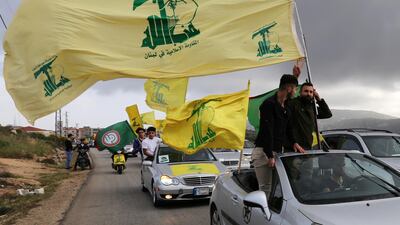
A supporter of Lebanon's Hezbollah gestures as he holds a Hezbollah flag in Marjayoun, Lebanon May 7, 2018. Reuters -
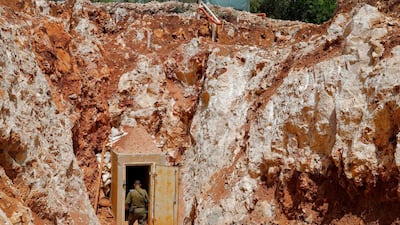
In 2019, Israel said this was a Hezbollah-dug tunnel under the "blue line", a demarcation line drawn by the UN to mark Israel's withdrawal from southern Lebanon in 2000. AFP -
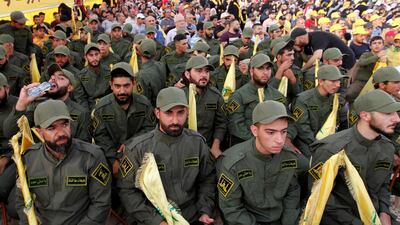
Lebanon's Hezbollah members hold party flags as they listen to their leader Sayyed Hassan Nasrallah. Reuters -

A banner depicting Hezbollah leader Sayyed Hassan Nasrallah and an United Nation's post in Lebanon. Reuters -
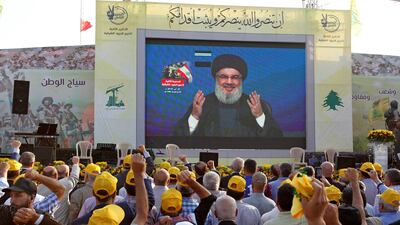
Hezbollah leader Hassan Nasrallah has direct ties with Iran's supreme leader Ayatollah Ali Khamenei. Reuters -
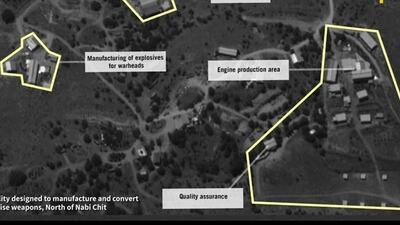
The Israeli military claimed that Hezbollah, with Iranian assistance, had been bringing specialised equipment to a weapons factory in southern Lebanon. Screengrab/YouTube -
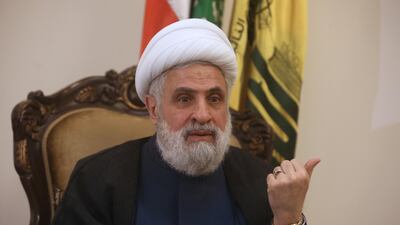
Lebanon's Hezbollah deputy leader Sheikh Naim Qassem gestures as he speaks during an interview with Reuters in Beirut, Lebanon March 15, 2018. Reuters -
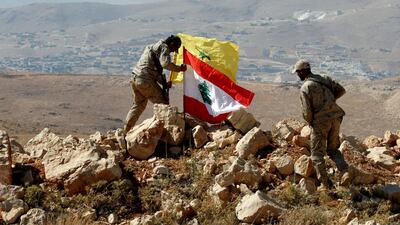
Hezbollah fighters put Lebanese and Hezbollah flags at Juroud Arsal, Syria-Lebanon border, July 25, 2017. Reuters -
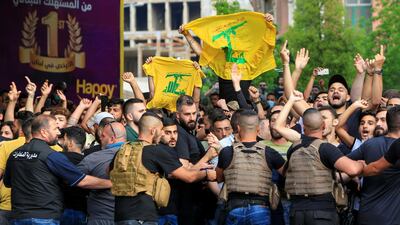
Lebanese soldiers try to block Hezbollah supporters as they gesture and chant slogans against anti-government demonstrators, in Beirut. Reuters -
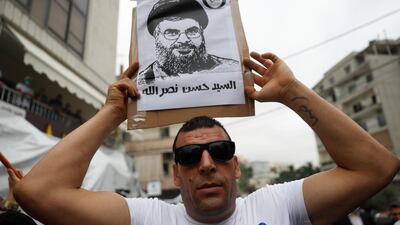
A Hezbollah supporter holds a placard of its leader Hassan Nasrallah, during a protest against the US in Beirut. AP Photo -
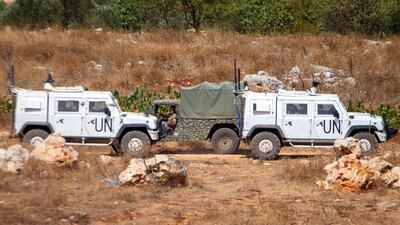
Lebanese soldiers on patrol drive by UN vehicles on the border with Israel on July 28, 2020. AP -
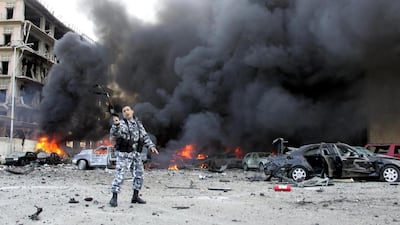
A Lebanese police officer gesturing on the site of an explosion in Beirut that killed ex-premier Rafik Hariri in 2005. AFP -
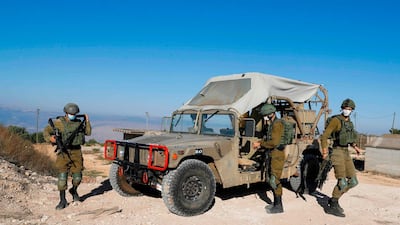
Israeli soldiers monitor the country's border with Lebanon near the northern town of Metula, in July 14, 2020. AFP -
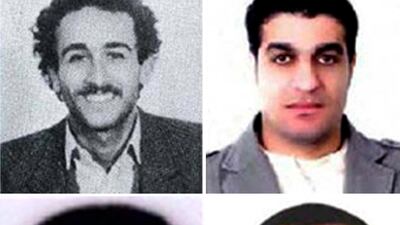
In this file photo obtained on July 29, 2011 from the Special Tribunal for Lebanon shows a combo of pictures showing four Hezbollah suspects indicted in the assassination case of former Lebanese prime minister Rafiq Hariri. AFP -
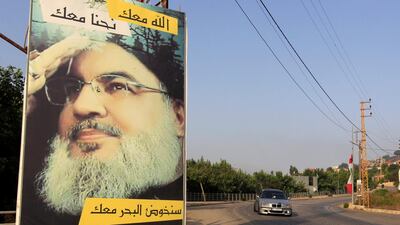
A car drives past a poster depicting Lebanon's Hezbollah leader Sayyed Hassan Nasrallah in Adaisseh village, near the Lebanese-Israeli border, Lebanon July 28, 2020. REUTERS/Aziz Taher


As The National reported this month, Irish and British security officials believe that former members of the Provisional Irish Republican Army (IRA) sought to revive long-standing contacts with Hezbollah in an attempt to obtain finance and weapons for the New IRA (NIRA), a fanatical offshoot of the Irish republican movement that is bitterly opposed to the Good Friday Agreement between Northern Ireland and the Irish Republic.
Dissident Irish republicans have been waging a militant campaign against the police and security forces in Northern Ireland since 2009, and were held responsible for the killing of Irish journalist Lyra McKee in April last year.
According to officials investigating the Hezbollah plot, Irish dissidents were seeking advanced bomb-making technology previously used by Hezbollah in Lebanon and Iraq. They were in advanced talks with Hezbollah to strike a deal that would have greatly enhanced NIRA’s ability to attack British security forces, including the use of sophisticated improvised explosive devices.
Nine NIRA members have now been arrested following a long-running operation by MI5, the British security service.
Among those detained was Dr Issam Hijjawi Bassalat, a Palestinian, who has been charged with terrorism offences. At least two of those detained are said to have attended a commemoration ceremony at the Iranian embassy in Dublin following the assassination of Iranian general Qassem Suleimani by a US drone strike in January.
From the IRA's perspective, the claims that NIRA members are attempting to link up with terrorist organisations such as Hezbollah should not come as a big surprise. Irish republicans have a long history of associating with global terror groups and rogue regimes. In the past, the IRA received weapons and other forms of support from the Palestine Liberation Organisation, the Libyan regime of Muammar Qaddafi, Colombian insurgents Farc and Basque terrorist group ETA.

The suggestion, however, that senior Irish republicans have been attempting to form a terror pact with Hezbollah is an illustration of the organisation’s growing influence among Europe’s criminal and terrorist networks.
This month, the US State Department accused Hezbollah of storing caches of weapons and ammonium nitrate, the same material responsible for the devastating explosion at Beirut's port last month, at bases throughout Europe. According to Nathan Sales, the State Department's counterterrorism co-ordinator, Hezbollah has been steadily building up its weapons stockpiles on the continent with the aim of preparing for terrorist acts that may be ordered by Tehran.
Describing it as a “clear and present danger to the US” and its allies, Mr Sales said that intelligence reports showed Hezbollah had weapons in Belgium, France, Greece, Italy, Spain and Switzerland, while “significant” ammonium nitrate cashes had either been discovered or destroyed in France, Greece and Italy.
“We have reason to believe that this activity is still under way,” Mr Sales said in a recent video briefing in Washington. “Why would Hezbollah stockpile ammonium nitrate on European soil? The answer is clear. It can conduct major terror attacks whenever its masters in Tehran deem it necessary.”
The threat to European security posed by the growth of Hezbollah's terrorist network was highlighted this week following the conviction of two suspected terrorists for the murder of five Israeli tourists in Bulgaria in 2012.
Meliad Farah, a Lebanese-Australian, and Hassan El Hajj Hassan, a Lebanese-Canadian, were found guilty of helping plan the bombing of an Israeli tourist bus in an operation prosecutors claim was carried out on the orders of Hezbollah. The organisation has denied any involvement in the attack, and the whereabouts of the two convicted men are not known. But European Union officials accepted that there was sufficient evidence to point to its involvement in the attack, and responded by placing its military wing on its terrorism blacklist.
The latest revelations come against a deepening background of tensions between the US and Iran over its controversial nuclear programme. This week, the Trump administration announced it was re-imposing sanctions against Tehran, a move that prompted fierce opposition from other members of the UN Security Council committed to maintaining the nuclear deal struck with Iran in 2015.
But while the European signatories to the deal – Britain, France and Germany – have opposed Washington’s decision, the introduction of fresh sanctions against Iran by the US could provoke Tehran to launch a fresh wave of terror attacks, including against targets in Europe.
Con Coughlin is a defence and foreign affairs columnist for The National

