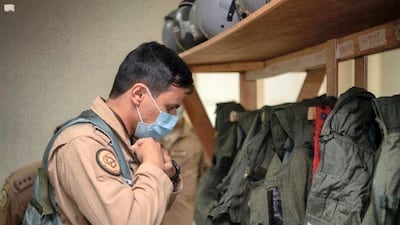
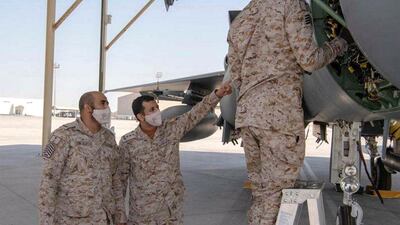
Nothing better illustrates the dangerous game of brinkmanship that Iran has embarked upon than the latest round of attacks carried out against Saudi Arabia’s oil facilities.
At a time when the new administration of US President Joe Biden has made clear its desire to re-engage with Tehran on the nuclear issue, thereby seeking to end the hostility that developed between Iran and the US during Donald Trump’s tenure at the White House, the reasonable course of action for the Iranian regime to adopt would be to demonstrate that it is genuinely interested in establishing a more constructive relationship with the outside world.
Instead, as last weekend’s attack on Saudi Arabia’s petroleum plant at Ras Tanura demonstrated, Tehran is indicating that rather than adopting a conciliatory tone, it remains committed to pursuing an aggressive overseas agenda.
The attack on Ras Tanura was one of more than 20 that have been carried out with drones and missiles against predominantly civilian targets in Saudi Arabia in recent days, with the Iranian-backed Houthi rebels claiming responsibility for them.
Relying on proxies to undertake hostile operations in the Middle East has become a standard practice for Iran’s Islamic Revolutionary Guard Corps, as it allows Iran the benefit of deniability while at the same time maintaining its policy of armed aggression throughout the region.
Apart from relying on Yemen’s Houthi rebels to maintain Tehran’s aggression against Saudi Arabia, Iranian-backed militias remain active in Iraq, where they have been held responsible for attacks against US and coalition personnel. They are also a force in Lebanon and Syria, where Iran’s military build-up along the Israeli border has led to a significant increase in tensions.
Moreover, the recent upsurge in Iranian-sponsored violence not only has implications for the Middle East but the wider world. After last Sunday’s drone strikes on Ras Tunara and a nearby Aramco facility, oil prices rose above $70 a barrel, the highest in more than a year.
Nor is this the first time recently that Iran has deliberately targeted Saudi oil facilities. In September 2019, Tehran came close to provoking a military confrontation with US forces in the Gulf after launching an attack on Aramco’s facility in the eastern city of Abqaiq, causing another sharp spike in oil prices.
Certainly, following the recent upsurge in Iranian-sponsored aggression in the Middle East, the prospects of Mr Biden succeeding in reopening negotiations on Iran’s nuclear programme look more remote.
For, at every turn, rather than showing a willingness to engage in compromise and conciliation, the regime continues to maintain a defiant and antagonistic attitude towards the outside world.
A good example of Iran’s inability to make even the smallest gesture of goodwill to its Western adversaries can be seen in the case of Nazanin Zaghari-Ratcliffe, the British-Iranian woman who has just completed a five-year jail term in Tehran on what are generally recognised as trumped-up spying charges.
After officially completing her sentence last weekend, her family in Britain had been hoping that she would be granted her freedom and allowed to return home to be reunited with her husband Richard, who has campaigned tirelessly for her release, and six-year-old daughter Gabriella.
Instead, the only concession made by the Iranian authorities was to remove the electronic tag Ms Zaghari-Ratcliffe had been forced to wear as she finished the rest of her sentence under house arrest at her parent’s home in Tehran.
After last Sunday's drone strikes on Ras Tunara and a nearby Aramco facility, oil prices rose above $70 a barrel
The Iranian authorities announced that she faces a fresh trial on Sunday in a closed court on charges relating to spreading propaganda against the regime. And so she now faces the appalling prospect of being returned to prison.
The prospect of a new trial has already prompted an angry response from the British government, with Prime Minister Boris Johnson demanding that she be released “permanently” so that she can be reunited with her British family.
Certainly, as far as Iran’s handling of the case is concerned, this was an opportunity for the regime to demonstrate a modicum of goodwill with the West.
Tehran’s shabby treatment of Ms Zaghari-Ratcliffe, moreover, could prove to be counter-productive for the regime if, as it claims, it is genuinely interested in reviving talks on saving the nuclear deal former US president Barack Obama helped to negotiate in 2015.
Britain, together with Germany and France, the other European signatories to the deal, is leading diplomatic efforts to persuade Tehran to engage in exploratory talks to restart negotiations.
But if the regime persists with its heartless treatment of Ms Zaghari-Ratcliffe, London’s ability to reopen talks with Tehran will become a great deal more challenging, especially in terms of persuading the British public that this is the right course of action.
That said, to judge by Iran’s reluctance to engage with even this modest diplomatic initiative on the part of the Europeans, it appears that the hard-line supporters of Iran’s Supreme Leader, Ayatollah Ali Khamenei, are in no mood for compromise. This is despite Iran’s official position being that it wants to revive the nuclear deal.
Earlier this month, Iran rejected an EU invitation to attend an informal summit to discuss the deal – what are known as “talks about talks” in diplomatic parlance.
Consequently, rather than indulging in what Winston Churchill called “jaw-jaw” – that is to say, negotiations – the Iranian regime appears intent on pursuing the other, less attractive proposition, namely “war, war”.
Con Coughlin is a defence and foreign affairs columnist for The National

WHAT IS A BLACK HOLE?
1. Black holes are objects whose gravity is so strong not even light can escape their pull
2. They can be created when massive stars collapse under their own weight
3. Large black holes can also be formed when smaller ones collide and merge
4. The biggest black holes lurk at the centre of many galaxies, including our own
5. Astronomers believe that when the universe was very young, black holes affected how galaxies formed
Where to donate in the UAE
The Emirates Charity Portal
You can donate to several registered charities through a “donation catalogue”. The use of the donation is quite specific, such as buying a fan for a poor family in Niger for Dh130.
The General Authority of Islamic Affairs & Endowments
The site has an e-donation service accepting debit card, credit card or e-Dirham, an electronic payment tool developed by the Ministry of Finance and First Abu Dhabi Bank.
Al Noor Special Needs Centre
You can donate online or order Smiles n’ Stuff products handcrafted by Al Noor students. The centre publishes a wish list of extras needed, starting at Dh500.
Beit Al Khair Society
Beit Al Khair Society has the motto “From – and to – the UAE,” with donations going towards the neediest in the country. Its website has a list of physical donation sites, but people can also contribute money by SMS, bank transfer and through the hotline 800-22554.
Dar Al Ber Society
Dar Al Ber Society, which has charity projects in 39 countries, accept cash payments, money transfers or SMS donations. Its donation hotline is 800-79.
Dubai Cares
Dubai Cares provides several options for individuals and companies to donate, including online, through banks, at retail outlets, via phone and by purchasing Dubai Cares branded merchandise. It is currently running a campaign called Bookings 2030, which allows people to help change the future of six underprivileged children and young people.
Emirates Airline Foundation
Those who travel on Emirates have undoubtedly seen the little donation envelopes in the seat pockets. But the foundation also accepts donations online and in the form of Skywards Miles. Donated miles are used to sponsor travel for doctors, surgeons, engineers and other professionals volunteering on humanitarian missions around the world.
Emirates Red Crescent
On the Emirates Red Crescent website you can choose between 35 different purposes for your donation, such as providing food for fasters, supporting debtors and contributing to a refugee women fund. It also has a list of bank accounts for each donation type.
Gulf for Good
Gulf for Good raises funds for partner charity projects through challenges, like climbing Kilimanjaro and cycling through Thailand. This year’s projects are in partnership with Street Child Nepal, Larchfield Kids, the Foundation for African Empowerment and SOS Children's Villages. Since 2001, the organisation has raised more than $3.5 million (Dh12.8m) in support of over 50 children’s charities.
Noor Dubai Foundation
Sheikh Mohammed bin Rashid Al Maktoum launched the Noor Dubai Foundation a decade ago with the aim of eliminating all forms of preventable blindness globally. You can donate Dh50 to support mobile eye camps by texting the word “Noor” to 4565 (Etisalat) or 4849 (du).
Biog
Mr Kandhari is legally authorised to conduct marriages in the gurdwara
He has officiated weddings of Sikhs and people of different faiths from Malaysia, Sri Lanka, Russia, the US and Canada
Father of two sons, grandfather of six
Plays golf once a week
Enjoys trying new holiday destinations with his wife and family
Walks for an hour every morning
Completed a Bachelor of Commerce degree in Loyola College, Chennai, India
2019 is a milestone because he completes 50 years in business
Mercer, the investment consulting arm of US services company Marsh & McLennan, expects its wealth division to at least double its assets under management (AUM) in the Middle East as wealth in the region continues to grow despite economic headwinds, a company official said.
Mercer Wealth, which globally has $160 billion in AUM, plans to boost its AUM in the region to $2-$3bn in the next 2-3 years from the present $1bn, said Yasir AbuShaban, a Dubai-based principal with Mercer Wealth.
“Within the next two to three years, we are looking at reaching $2 to $3 billion as a conservative estimate and we do see an opportunity to do so,” said Mr AbuShaban.
Mercer does not directly make investments, but allocates clients’ money they have discretion to, to professional asset managers. They also provide advice to clients.
“We have buying power. We can negotiate on their (client’s) behalf with asset managers to provide them lower fees than they otherwise would have to get on their own,” he added.
Mercer Wealth’s clients include sovereign wealth funds, family offices, and insurance companies among others.
From its office in Dubai, Mercer also looks after Africa, India and Turkey, where they also see opportunity for growth.
Wealth creation in Middle East and Africa (MEA) grew 8.5 per cent to $8.1 trillion last year from $7.5tn in 2015, higher than last year’s global average of 6 per cent and the second-highest growth in a region after Asia-Pacific which grew 9.9 per cent, according to consultancy Boston Consulting Group (BCG). In the region, where wealth grew just 1.9 per cent in 2015 compared with 2014, a pickup in oil prices has helped in wealth generation.
BCG is forecasting MEA wealth will rise to $12tn by 2021, growing at an annual average of 8 per cent.
Drivers of wealth generation in the region will be split evenly between new wealth creation and growth of performance of existing assets, according to BCG.
Another general trend in the region is clients’ looking for a comprehensive approach to investing, according to Mr AbuShaban.
“Institutional investors or some of the families are seeing a slowdown in the available capital they have to invest and in that sense they are looking at optimizing the way they manage their portfolios and making sure they are not investing haphazardly and different parts of their investment are working together,” said Mr AbuShaban.
Some clients also have a higher appetite for risk, given the low interest-rate environment that does not provide enough yield for some institutional investors. These clients are keen to invest in illiquid assets, such as private equity and infrastructure.
“What we have seen is a desire for higher returns in what has been a low-return environment specifically in various fixed income or bonds,” he said.
“In this environment, we have seen a de facto increase in the risk that clients are taking in things like illiquid investments, private equity investments, infrastructure and private debt, those kind of investments were higher illiquidity results in incrementally higher returns.”
The Abu Dhabi Investment Authority, one of the largest sovereign wealth funds, said in its 2016 report that has gradually increased its exposure in direct private equity and private credit transactions, mainly in Asian markets and especially in China and India. The authority’s private equity department focused on structured equities owing to “their defensive characteristics.”
Tamkeen's offering
- Option 1: 70% in year 1, 50% in year 2, 30% in year 3
- Option 2: 50% across three years
- Option 3: 30% across five years
COMPANY%20PROFILE
%3Cp%3E%3Cstrong%3ECompany%20name%3A%3C%2Fstrong%3E%20OneOrder%3Cbr%3E%3Cstrong%3EStarted%3A%3C%2Fstrong%3E%20March%202022%3Cbr%3E%3Cstrong%3EFounders%3A%3C%2Fstrong%3E%20Tamer%20Amer%20and%20Karim%20Maurice%3Cbr%3E%3Cstrong%3EBased%3A%3C%2Fstrong%3E%20Cairo%3Cbr%3E%3Cstrong%3ENumber%20of%20staff%3A%20%3C%2Fstrong%3E82%3Cbr%3E%3Cstrong%3EInvestment%20stage%3A%3C%2Fstrong%3E%20Series%20A%3C%2Fp%3E%0A
UAE currency: the story behind the money in your pockets
Avatar: Fire and Ash
Director: James Cameron
Starring: Sam Worthington, Sigourney Weaver, Zoe Saldana
Rating: 4.5/5
Results
6.30pm: Al Maktoum Challenge Round-2 Group 1 (PA) US$75,000 (Dirt) 1,900m
Winner: Ziyadd, Richard Mullen (jockey), Jean de Roualle (trainer).
7.05pm: Al Rashidiya Group 2 (TB) $250,000 (Turf) 1,800m
Winner: Barney Roy, William Buick, Charlie Appleby.
7.40pm: Meydan Cup Listed Handicap (TB) $175,000 (T) 2,810m
Winner: Secret Advisor, Tadhg O’Shea, Charlie Appleby.
8.15pm: Handicap (TB) $175,000 (D) 1,600m
Winner: Plata O Plomo, Carlos Lopez, Susanne Berneklint.
8.50pm: Handicap (TB) $135,000 (T) 1,600m
Winner: Salute The Soldier, Adrie de Vries, Fawzi Nass.
9.25pm: Al Shindagha Sprint Group 3 (TB) $200,000 (D) 1,200m
Winner: Gladiator King, Mickael Barzalona, Satish Seemar.
360Vuz PROFILE
Date started: January 2017
Founder: Khaled Zaatarah
Based: Dubai and Los Angeles
Sector: Technology
Size: 21 employees
Funding: $7 million
Investors: Shorooq Partners, KBW Ventures, Vision Ventures, Hala Ventures, 500Startups, Plug and Play, Magnus Olsson, Samih Toukan, Jonathan Labin
WHAT%20MACRO%20FACTORS%20ARE%20IMPACTING%20META%20TECH%20MARKETS%3F
%3Cp%3E%E2%80%A2%20Looming%20global%20slowdown%20and%20recession%20in%20key%20economies%3C%2Fp%3E%0A%3Cp%3E%E2%80%A2%20Russia-Ukraine%20war%3C%2Fp%3E%0A%3Cp%3E%E2%80%A2%20Interest%20rate%20hikes%20and%20the%20rising%20cost%20of%20debt%20servicing%3C%2Fp%3E%0A%3Cp%3E%E2%80%A2%20Oil%20price%20volatility%3C%2Fp%3E%0A%3Cp%3E%E2%80%A2%20Persisting%20inflationary%20pressures%3C%2Fp%3E%0A%3Cp%3E%E2%80%A2%20Exchange%20rate%20fluctuations%3C%2Fp%3E%0A%3Cp%3E%E2%80%A2%20Shortage%20of%20labour%2Fskills%3C%2Fp%3E%0A%3Cp%3E%E2%80%A2%20A%20resurgence%20of%20Covid%3F%3C%2Fp%3E%0A