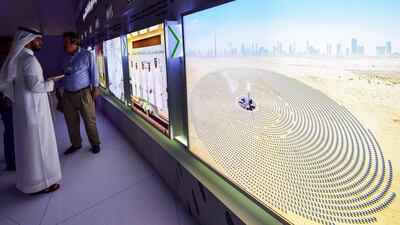
Visitors look at screens displaying images of the Mohammed bin Rashid Al Maktoum Solar Park on March 20, 2017, at the solar plant in Dubai. AFP

If we don't develop sustainably now, we risk our whole future


  • English
  • Arabic

The world this year has witnessed an unprecedented upheaval, the effect of which will continue to be felt for years. In addition to creating the biggest health crisis in modern times, it has brought about chaos in society, environment and individual lives. As the global economy continues to decelerate, millions have lost jobs and millions more face the prospect of their livelihoods being snatched.

The headwinds created by the coronavirus pandemic also seem to have disrupted the Sustainable Development Goals, launched with great hope at the United Nations General Assembly in September 2015 to achieve a better future for all.

As we become collectively more aware of the consequences of our actions that have magnified the effects of the pandemic, such gloomy pictures of tomorrow tend to eclipse the emerging signs of transformation.

The pandemic has made us realise that sustainability is the key to guaranteeing our future well-being. There is little doubt that Covid-19 has also altered the views of those who previously dismissed the notion that human action, nature and economies are all interconnected.

There is a wider acknowledgment today that crises fuelled by climate change are no less grave than those caused by Covid-19. Such a shift in perspective could push not just governments to take urgent action, but it could also prompt industries to switch from manufacturing practices that are polluting and wasteful to more sustainable ones, where there is a symbiosis between cycles of consumption and production.

This is an idea that corresponds to responsible consumption and production patterns under the Sustainable Development Goals, number 12 ('Ensure sustainable consumption and production patterns'), in particular which Abu Dhabi Fund for Development (ADFD) helps partner countries to achieve through funding of sustainable projects.

For nearly five decades, the Fund has been promoting sustainable development around the world, while catering to the UAE’s economic diversification efforts through financing environmentally and economically sustainable projects across key sectors.

It is crucial for organisations and entities funding development initiatives to help developing countries

Consider some of the recent ones that could serve as models, such as an innovative sustainable project in the Maldives that addresses simultaneously the country’s waste-management and energy challenges in an eco-friendly manner; the Al Dahra Holding project, which supports food-security initiatives; and the waste-to-energy facility in Sharjah (a joint venture between Masdar and Bee’ah that bolstered the UAE’s leading position in the development of sustainable projects). All these initiatives are aligned with the Development Goals.

In 2013 we committed $350 million over seven funding cycles to finance renewable energy projects in developing countries that are members of The International Renewable Energy Agency, to increase clean energy access for their people, improve livelihoods and advance sustainable development.

A driverless vehicle at Masdar City, a planned sustainable city powered by renewable energy on the eastern outskirts of Abu Dhabi, on September 4, 2018. Mahmoud Khaled / AFP

So far we have financed 78 renewable energy projects, whose total value stands at $1.2 billion (Dh4.4 bn). Spanning across 62 countries, these initiatives have not just transformed millions of lives, but they have also reduced environmental degeneration.

Let us not forget that many countries do not have the means to implement their sustainable development agenda despite having the will to do so. This is where collaborative partnership comes into play. Take Cuba, which has set a goal to produce 24 per cent of electricity from renewable sources by 2030.

Sometimes objectives like these can only be fulfilled through partnerships such as the one it has with ADFD, which has financed one of its major solar projects. The result is remarkable: the 15megawatt project has helped the country save 5.9 million litres of fossil fuels annually and reduce total annual carbon dioxide emissions by 19,000 tonnes.

Employees walk past solar panels at the Mohammed bin Rashid Al-Maktoum Solar Park on March 20, 2017, in Dubai. AFP

Thanks to rapid advancement of technology, unlocking the untapped natural energy in a sustainable manner has never been easier. These initiatives only have upsides – they hasten socioeconomic development, help nations achieve energy security more easily, keep the environment clean, support industry and create jobs. Yet another similar project that we have decided to implement in Cuba will hasten its transition to renewable energy.

It is crucial for organisations and entities funding development initiatives to help developing countries, as well as businesses and companies all over the world focus on responsible manufacturing practices.

It is equally critical for development financers to maintain their focus on sustainable and innovative projects, as these funding entities play a vital role in the process of transition to sustainable practices through international co-operation and partnerships that are catalysts for spurring creativity and ingenuity across sectors. These actions can help us achieve the 17 Sustainable Development Goals, thus ensuring that everyone in the world enjoys the fruits of prosperity and peace.

We already hear that the world will be different after Covid-19. It is a realisation that can take us to the next world, of which we have only dreamt of until now.

Mohammed Saif Al Suwaidi is the director general of Abu Dhabi Fund for Development

25%20Days%20to%20Aden
%3Cp%3EAuthor%3A%20Michael%20Knights%3C%2Fp%3E%0A%3Cp%3EPages%3A%20256%3C%2Fp%3E%0A%3Cp%3EAvailable%3A%20January%2026%3C%2Fp%3E%0A
Ten tax points to be aware of in 2026

1. Domestic VAT refund amendments: request your refund within five years

If a business does not apply for the refund on time, they lose their credit.

2. E-invoicing in the UAE

Businesses should continue preparing for the implementation of e-invoicing in the UAE, with 2026 a preparation and transition period ahead of phased mandatory adoption. 

3. More tax audits

Tax authorities are increasingly using data already available across multiple filings to identify audit risks. 

4. More beneficial VAT and excise tax penalty regime

Tax disputes are expected to become more frequent and more structured, with clearer administrative objection and appeal processes. The UAE has adopted a new penalty regime for VAT and excise disputes, which now mirrors the penalty regime for corporate tax.

5. Greater emphasis on statutory audit

There is a greater need for the accuracy of financial statements. The International Financial Reporting Standards standards need to be strictly adhered to and, as a result, the quality of the audits will need to increase.

6. Further transfer pricing enforcement

Transfer pricing enforcement, which refers to the practice of establishing prices for internal transactions between related entities, is expected to broaden in scope. The UAE will shortly open the possibility to negotiate advance pricing agreements, or essentially rulings for transfer pricing purposes. 

7. Limited time periods for audits

Recent amendments also introduce a default five-year limitation period for tax audits and assessments, subject to specific statutory exceptions. While the standard audit and assessment period is five years, this may be extended to up to 15 years in cases involving fraud or tax evasion. 

8. Pillar 2 implementation 

Many multinational groups will begin to feel the practical effect of the Domestic Minimum Top-Up Tax (DMTT), the UAE's implementation of the OECD’s global minimum tax under Pillar 2. While the rules apply for financial years starting on or after January 1, 2025, it is 2026 that marks the transition to an operational phase.

9. Reduced compliance obligations for imported goods and services

Businesses that apply the reverse-charge mechanism for VAT purposes in the UAE may benefit from reduced compliance obligations. 

10. Substance and CbC reporting focus

Tax authorities are expected to continue strengthening the enforcement of economic substance and Country-by-Country (CbC) reporting frameworks. In the UAE, these regimes are increasingly being used as risk-assessment tools, providing tax authorities with a comprehensive view of multinational groups’ global footprints and enabling them to assess whether profits are aligned with real economic activity. 

Contributed by Thomas Vanhee and Hend Rashwan, Aurifer

Company%20profile
%3Cp%3EName%3A%20Tabby%3Cbr%3EFounded%3A%20August%202019%3B%20platform%20went%20live%20in%20February%202020%3Cbr%3EFounder%2FCEO%3A%20Hosam%20Arab%2C%20co-founder%3A%20Daniil%20Barkalov%3Cbr%3EBased%3A%20Dubai%2C%20UAE%3Cbr%3ESector%3A%20Payments%3Cbr%3ESize%3A%2040-50%20employees%3Cbr%3EStage%3A%20Series%20A%3Cbr%3EInvestors%3A%20Arbor%20Ventures%2C%20Mubadala%20Capital%2C%20Wamda%20Capital%2C%20STV%2C%20Raed%20Ventures%2C%20Global%20Founders%20Capital%2C%20JIMCO%2C%20Global%20Ventures%2C%20Venture%20Souq%2C%20Outliers%20VC%2C%20MSA%20Capital%2C%20HOF%20and%20AB%20Accelerator.%3Cbr%3E%3C%2Fp%3E%0A
Bert van Marwijk factfile

Born: May 19 1952
Place of birth: Deventer, Netherlands
Playing position: Midfielder

Teams managed:
1998-2000 Fortuna Sittard
2000-2004 Feyenoord
2004-2006 Borussia Dortmund
2007-2008 Feyenoord
2008-2012 Netherlands
2013-2014 Hamburg
2015-2017 Saudi Arabia
2018 Australia

Major honours (manager):
2001/02 Uefa Cup, Feyenoord
2007/08 KNVB Cup, Feyenoord
World Cup runner-up, Netherlands

Company%20profile
%3Cp%3EName%3A%20Cashew%0D%3Cbr%3EStarted%3A%202020%0D%3Cbr%3EFounders%3A%20Ibtissam%20Ouassif%20and%20Ammar%20Afif%0D%3Cbr%3EBased%3A%20Dubai%2C%20UAE%0D%3Cbr%3EIndustry%3A%20FinTech%0D%3Cbr%3EFunding%20size%3A%20%2410m%0D%3Cbr%3EInvestors%3A%20Mashreq%2C%20others%0D%3C%2Fp%3E%0A
Greatest Royal Rumble results

John Cena pinned Triple H in a singles match

Cedric Alexander retained the WWE Cruiserweight title against Kalisto

Matt Hardy and Bray Wyatt win the Raw Tag Team titles against Cesaro and Sheamus

Jeff Hardy retained the United States title against Jinder Mahal

Bludgeon Brothers retain the SmackDown Tag Team titles against the Usos

Seth Rollins retains the Intercontinental title against The Miz, Finn Balor and Samoa Joe

AJ Styles remains WWE World Heavyweight champion after he and Shinsuke Nakamura are both counted out

The Undertaker beats Rusev in a casket match

Brock Lesnar retains the WWE Universal title against Roman Reigns in a steel cage match

Braun Strowman won the 50-man Royal Rumble by eliminating Big Cass last

Farage on Muslim Brotherhood

Nigel Farage told Reform's annual conference that the party will proscribe the Muslim Brotherhood if he becomes Prime Minister.
"We will stop dangerous organisations with links to terrorism operating in our country," he said. "Quite why we've been so gutless about this – both Labour and Conservative – I don't know.
“All across the Middle East, countries have banned and proscribed the Muslim Brotherhood as a dangerous organisation. We will do the very same.”
It is 10 years since a ground-breaking report into the Muslim Brotherhood by Sir John Jenkins.
Among the former diplomat's findings was an assessment that “the use of extreme violence in the pursuit of the perfect Islamic society” has “never been institutionally disowned” by the movement.
The prime minister at the time, David Cameron, who commissioned the report, said membership or association with the Muslim Brotherhood was a "possible indicator of extremism" but it would not be banned.

Company Profile

Company name: Yeepeey

Started: Soft launch in November, 2020

Founders: Sagar Chandiramani, Jatin Sharma and Monish Chandiramani

Based: Dubai

Industry: E-grocery

Initial investment: $150,000

Future plan: Raise $1.5m and enter Saudi Arabia next year

The specs

Engine: 2.0-litre 4cyl turbo

Power: 261hp at 5,500rpm

Torque: 405Nm at 1,750-3,500rpm

Transmission: 9-speed auto

Fuel consumption: 6.9L/100km

On sale: Now

Price: From Dh117,059
