
Over the past few months due to the Covid-19 pandemic, one might be tempted to think that everything has slowed down, including the rate of crime. There had been no terrorist attacks in the UK during the coronavirus crisis. But the widely reported stabbing attack in Reading in the UK this week that killed three people is one more reminder that violence still needs to be tackled.
Terrorism, petty crime and even more broadly, conflict, will not simply disappear. We must take advantage of the relative lull in such activities to address how we can reduce the threat of violence to make citizens feel safe on the streets. If we do not take on these crucial issues, we have to be prepared to deal with the consequences.
It is still unclear what exactly happened in Reading. According to the suspect's cousin, the suspect was a Libyan who converted to Christianity; a refugee who had a history of criminal activity and also suffered from mental health issues.
The British media's reporting on this incident has been interesting. While right-wing sections decried the presence of refugees on British soil, less attention was given to the suspect’s reported conversion to Christianity. One can only imagine the coverage had the suspect been a convert to Islam.
Nevertheless, according to news reports, British counter-terrorism police units are involved so all will have to wait to see how the investigation pans out. There remain larger questions though. As the country's police has already declared, the fastest growing threat of terrorist violence is driven by far-right ideologies. Curiously though, while the British media before lockdown expressed great fears about terrorism and Islamists, there was precious little coverage of fears regarding radical white supremacists.
In the US, against the background of the Black Lives Matter movement, there is another disturbing reality: far-right activists have been literally running over protesters.
A Ku Klux Klan leader in Virginia is accused of having driven his truck into a crowd of protesters earlier this month. Such incidents were hardly rare even in the pre-Covid-19 era, but they seem to have increased – perhaps because it is one way to inflict violence without coming into physical contact with possible carriers of the virus. But these instances in Virginia and Reading still amount to terrorism and need to be treated and investigated as such.

While terrorist activities may have reduced during this time because of wider restrictions, this is an opportunity to address these threats and that must not be squandered. Policy makers and analysts have time now to consider how to tackle extremist right-wing terrorism. Regardless of the perpetrators's ideological motivations, the crisis of increasing incidents of terror must be addressed fast.
Every movement develops in six predictable stages. First is the "enduring" stage – and societies have been through that for a long time when it comes to terrorism. Then come the "uprising" and "peak" stages, before it nears "contraction", "evolution" and finally, the "new normal". The pandemic has delivered an excellent opportunity to prolong the evolution phase, with minimal damage because of dampened terrorist activity all over the world.
-
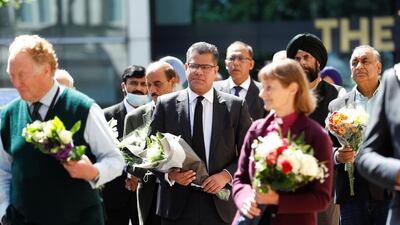
Britain's Secretary of State for Business, Energy and Industrial Strategy, Alok Sharma, holds flowers to place them near to the scene of reported multiple stabbings, as he is surrounded by faith leaders, in Reading, Britain, June 22, 2020. REUTERS -
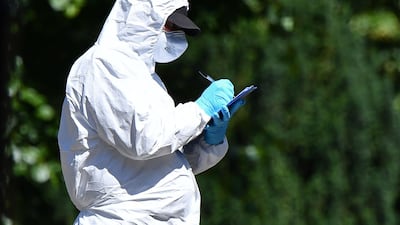
A police forensics officer works inside Forbury Gardens park in Reading, west of London, on June 22, 2020, the scene of the June 20 stabbing spree. AFP -

Tributes to the murdered school teacher James Furlong are seen outside The Holt School, on June 22, 2020 in Wokingham, England. Getty Images -
A suspect held on suspicion of stabbing three people to death in a British park at the weekend was known to the security services, media reported on Monday. AFP -
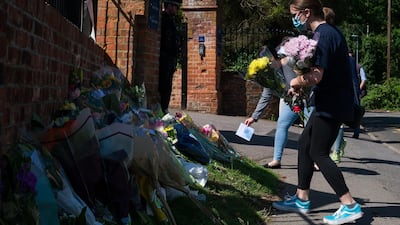
hairi Saadallah, a 25-year-old refugee from Libya, was arrested on Saturday evening suspected of stabbing three people to death in Forbury Gardens in the centre of Reading. Getty Images -

Britain's Secretary of State for Business, Energy and Industrial Strategy, Alok Sharma, and Britain's Labour MP for Reading East, Matt Rodda, are seen near the scene of reported multiple stabbings, in Reading, Britain, June 22, 2020. REUTERS -
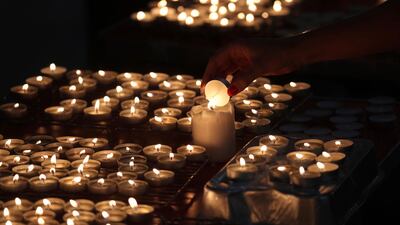
Candles are lit at St Paul's Parish Church in Wokingham, England, for the victims of a multiple fatal stabbing attack, and local teacher James Furlong who was killed Saturday with two other people in Reading town centre, Monday June 22, 2020. PA via AP -
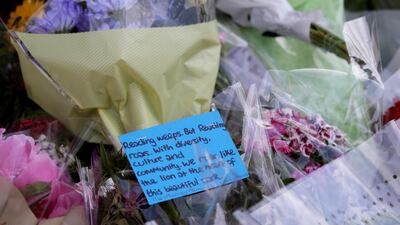
A message is shown on flowers near the scene of a fatal multiple stabbing attack in Forbury Gardens, central Reading, England, Monday June 22, 2020. AP Photo -
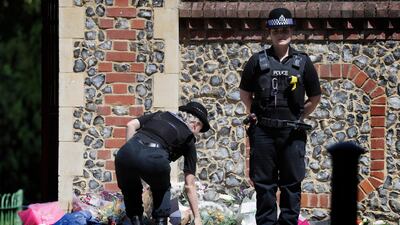
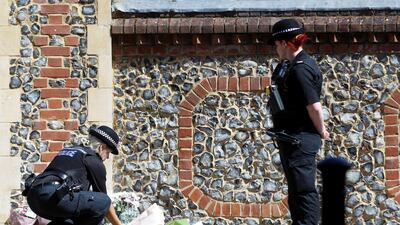
A Police officer places flowers from a woman at the scene of a fatal multiple stabbing attack in Forbury Gardens, central Reading, England, Monday June 22, 2020. AP Photo -
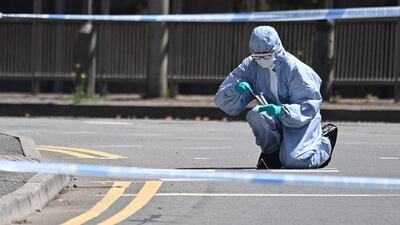
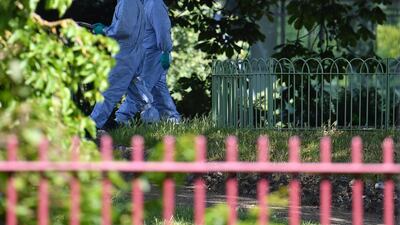
A forensic officer uses a swab outside Forbury Gardens, on June 22, 2020 in Wokingham, England. Getty Images


But what are we heading towards? In the new normal, we must reflect on lessons from history and turn them into policies so that societies become safer. If we manage to do that, we might address factors that allowed crises of terror to emerge in the first place.
Here, however, a new challenge arises: many competing voices will promote different lessons from history to further their own political agendas.
Those on the far-right and their cohorts will try to exploit people's natural fears of terrorism, that would then justify clamping down further on citizens' freedoms and fundamental rights.
These politicians on the far-right will play on people’s worries and garner sympathy for populists, just as we have seen in different European countries in recent years with regards to the mainstreaming of far-right bigotry against Muslims and refugees.
As extremists of all shades adapt to the new arena, and if we are serious about avoiding violence in the future, we need to adapt better ourselves. That means taking seriously the need to review our security needs. Covid-19 has given us the opportunity to be more rigorous in redefining security, so that when the necessary restrictions are relieved, we emerge stronger, and more resilient than before.
Dr HA Hellyer is a senior associate fellow at the Royal United Services Institute and the Carnegie Endowment for International Peace

