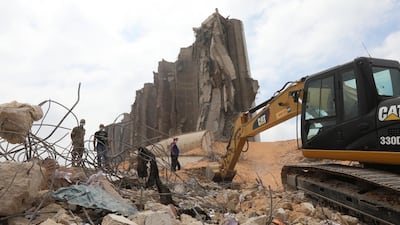
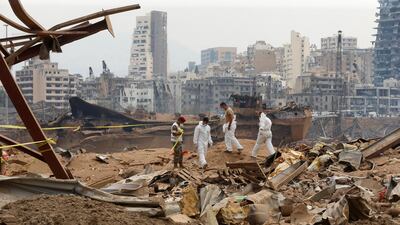
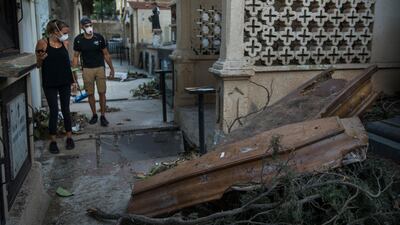
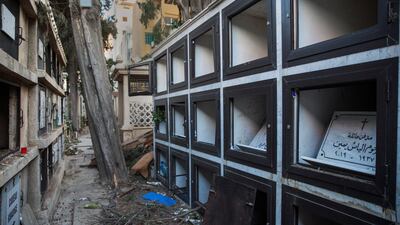
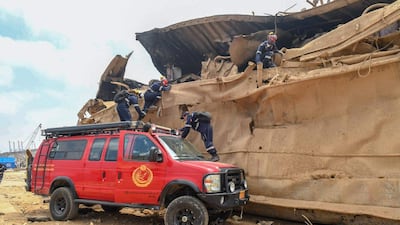
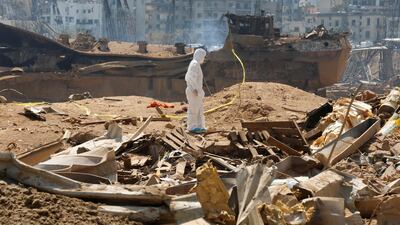
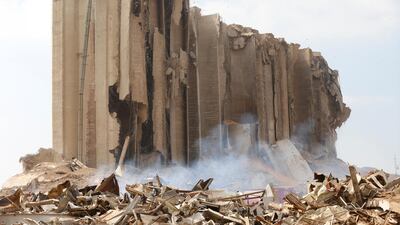
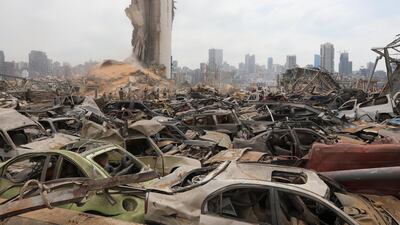
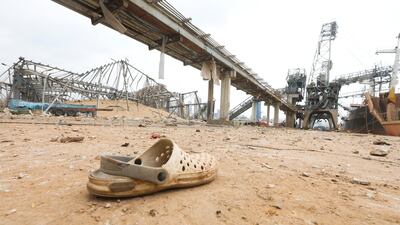
The explosion that devastated much of Beirut last week did far more than kill at least 160 people and injure thousands. It also led to the resignation of Lebanon's government by showing the criminality of the country's political class and tightened the bind in which Hezbollah has found itself.
There are two broad versions of what happened in Beirut's port on August 4 – the official explanation put out by the government, and one circulating among many Lebanese. Both placed the political leadership in a bad light.
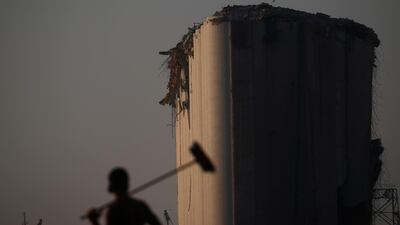
The official explanation is that a large quantity of ammonium nitrate was left at the port for several years, despite the risks this entailed. An accidental fire ignited fireworks stored in a hangar, which in turn set off the ammonium nitrate, destroying a large part of the Lebanese capital.
The second version, which is more widespread among the population, is that it was a Hezbollah arms depot that blew up. The ammonium nitrate had been placed inside or nearby, so that when Hezbollah’s weapons began igniting for some as yet unknown reason, it triggered the ammonium nitrate.
The reality is unclear and no independent international investigation will take place because the Lebanese authorities have rejected one. Most probably, the domestic investigation will confirm the government’s version of an accident and the file will be closed.
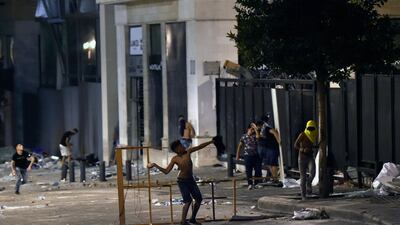
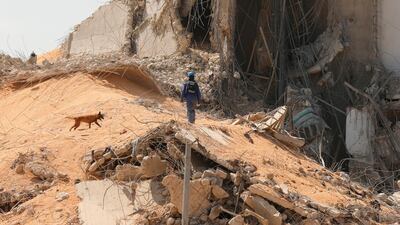
However, the broader repercussions may be far-reaching. The government's reaction to the blast was inept and coldblooded. No officials visited the victims in the early hours after the blast, nor did any walk around devastated quarters to commiserate with the inhabitants. Searches were delayed, leaving buried victims to die. When a minister did try to go to the area some days later, she was insulted and chased away.
The possibility that the ammonium nitrate was situated near or in a Hezbollah arms cache hardly alleviated matters. That the party might have stored its weapons near residential areas only served to reinforce the view of many Lebanese that Hezbollah can do what it wants and that the country's governments are under its thumb.
No independent international investigation into the blast will take place because the Lebanese authorities have rejected one
Last October, when anti-government protests broke out, Hezbollah's secretary general, Hassan Nasrallah, tried to neutralise public protests against the political class. By protecting the corrupt politicians, Hezbollah was seen as the final pillar of a discredited political system.
The growing public hostility to the party since that time rapidly eroded the facade of unanimity Hezbollah had set up, through a combination of alliances and intimidation, after Syria's withdrawal from Lebanon in 2005. For many people Lebanon's political and economic problems have been exacerbated by the fact that Arab states, the country's traditional financial benefactors, refuse to assist a Hezbollah-controlled order.
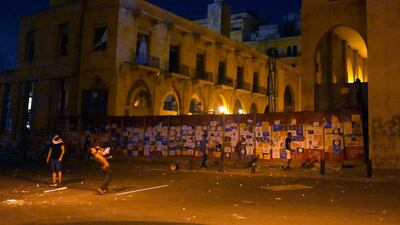
In the aftermath of the port explosion there were no restraints on attacking the party. In a mock hanging organised by anti-government protesters on August 8, one effigy on the gallows was that of Nasrallah. The party has faced great domestic criticism, even from quarters that were considered its constituency. Lebanon’s grave financial crisis and ensuing poverty essentially have undermined Hezbollah’s ability to fight Israel in any future conflict.
In recent months, the general dissatisfaction with Hezbollah and the political class steadily weakened the government of Hassan Diab, which was under Hezbollah’s influence. Nor did the party’s alliances provide respite. Hezbollah’s ties with the Free Patriotic Movement and its leader Gebran Bassil, widely regarded as one of Lebanon’s most corrupt politicians, only heightened animosity towards the party.
Then came the port explosion. In a speech on August 7, Nasrallah had to deny that it was caused by a Hezbollah arms cache. No one expected him to do less, but his denials also revealed unusual defensiveness. What they implicitly indicated was that in a future Hezbollah conflict with Israel fought on Iran’s behalf, many Lebanese were likely to turn against the party and refuse to pay a price for its fealty to Tehran.
French President Emmanuel Macron may have offered Hezbollah and Lebanon a way out of their impasse. According to reports, Mr Macron brought a package deal when he visited Beirut on August 6. It included the party's abandonment of the Diab government and the formation of a new national unity government that would organise early elections. This would be followed by measures to facilitate a deal between Lebanon and the International Monetary Fund, as well as donors.
The Iranian order in Lebanon is at a crossroads. Hezbollah has used the political system as a front to protect its arms and independence. However, the politicians became too much of a liability. If Mr Macron’s package deal is implemented, it could provide a vital lifeline to Hezbollah. But it could also save Lebanon from disintegration – a French fear.
Much can still go wrong for Hezbollah. The outcome of the US elections will be watched closely by the party and Iran to see if the policy of maximum pressure against Tehran will continue. Inside Lebanon, public anger with the politicians will not subside anytime soon. But the desire of the French to avoid Lebanon’s destruction in the US-Iranian standoff has allowed them to exploit Hezbollah’s setbacks and prepare for a new phase that just may buy the country some much-needed respite.
Michael Young is editor of Diwan, the blog of the Carnegie Middle East programme, in Beirut

MATCH INFO
Rugby World Cup (all times UAE)
Third-place play-off: New Zealand v Wales, Friday, 1pm
Shubh Mangal Saavdhan
Directed by: RS Prasanna
Starring: Ayushmann Khurrana, Bhumi Pednekar
Mobile phone packages comparison
Mercer, the investment consulting arm of US services company Marsh & McLennan, expects its wealth division to at least double its assets under management (AUM) in the Middle East as wealth in the region continues to grow despite economic headwinds, a company official said.
Mercer Wealth, which globally has $160 billion in AUM, plans to boost its AUM in the region to $2-$3bn in the next 2-3 years from the present $1bn, said Yasir AbuShaban, a Dubai-based principal with Mercer Wealth.
“Within the next two to three years, we are looking at reaching $2 to $3 billion as a conservative estimate and we do see an opportunity to do so,” said Mr AbuShaban.
Mercer does not directly make investments, but allocates clients’ money they have discretion to, to professional asset managers. They also provide advice to clients.
“We have buying power. We can negotiate on their (client’s) behalf with asset managers to provide them lower fees than they otherwise would have to get on their own,” he added.
Mercer Wealth’s clients include sovereign wealth funds, family offices, and insurance companies among others.
From its office in Dubai, Mercer also looks after Africa, India and Turkey, where they also see opportunity for growth.
Wealth creation in Middle East and Africa (MEA) grew 8.5 per cent to $8.1 trillion last year from $7.5tn in 2015, higher than last year’s global average of 6 per cent and the second-highest growth in a region after Asia-Pacific which grew 9.9 per cent, according to consultancy Boston Consulting Group (BCG). In the region, where wealth grew just 1.9 per cent in 2015 compared with 2014, a pickup in oil prices has helped in wealth generation.
BCG is forecasting MEA wealth will rise to $12tn by 2021, growing at an annual average of 8 per cent.
Drivers of wealth generation in the region will be split evenly between new wealth creation and growth of performance of existing assets, according to BCG.
Another general trend in the region is clients’ looking for a comprehensive approach to investing, according to Mr AbuShaban.
“Institutional investors or some of the families are seeing a slowdown in the available capital they have to invest and in that sense they are looking at optimizing the way they manage their portfolios and making sure they are not investing haphazardly and different parts of their investment are working together,” said Mr AbuShaban.
Some clients also have a higher appetite for risk, given the low interest-rate environment that does not provide enough yield for some institutional investors. These clients are keen to invest in illiquid assets, such as private equity and infrastructure.
“What we have seen is a desire for higher returns in what has been a low-return environment specifically in various fixed income or bonds,” he said.
“In this environment, we have seen a de facto increase in the risk that clients are taking in things like illiquid investments, private equity investments, infrastructure and private debt, those kind of investments were higher illiquidity results in incrementally higher returns.”
The Abu Dhabi Investment Authority, one of the largest sovereign wealth funds, said in its 2016 report that has gradually increased its exposure in direct private equity and private credit transactions, mainly in Asian markets and especially in China and India. The authority’s private equity department focused on structured equities owing to “their defensive characteristics.”
BORDERLANDS
Starring: Cate Blanchett, Kevin Hart, Jamie Lee Curtis
Director: Eli Roth
Rating: 0/5
The specs: 2018 Ford Mustang GT
Price, base / as tested: Dh204,750 / Dh241,500
Engine: 5.0-litre V8
Gearbox: 10-speed automatic
Power: 460hp @ 7,000rpm
Torque: 569Nm @ 4,600rpm
Fuel economy, combined: 10.3L / 100km
Zayed Sustainability Prize
The%20specs%20
%3Cp%3E%3Cstrong%3EEngine%3A%20%3C%2Fstrong%3E2.0-litre%204cyl%20turbo%0D%3Cbr%3E%3Cstrong%3EPower%3A%20%3C%2Fstrong%3E261hp%20at%205%2C500rpm%0D%3Cbr%3E%3Cstrong%3ETorque%3A%20%3C%2Fstrong%3E400Nm%20at%201%2C750-4%2C000rpm%0D%3Cbr%3E%3Cstrong%3ETransmission%3A%20%3C%2Fstrong%3E7-speed%20dual-clutch%20auto%0D%3Cbr%3E%3Cstrong%3EFuel%20consumption%3A%20%3C%2Fstrong%3E10.5L%2F100km%0D%3Cbr%3E%3Cstrong%3EOn%20sale%3A%20%3C%2Fstrong%3ENow%0D%3Cbr%3E%3Cstrong%3EPrice%3A%20%3C%2Fstrong%3EFrom%20Dh129%2C999%20(VX%20Luxury)%3B%20from%20Dh149%2C999%20(VX%20Black%20Gold)%3C%2Fp%3E%0A
'Cheb%20Khaled'
%3Cp%3E%3Cstrong%3EArtist%3A%20%3C%2Fstrong%3EKhaled%3Cbr%3E%3Cstrong%3ELabel%3A%20%3C%2Fstrong%3EBelieve%3Cbr%3E%3Cstrong%3ERating%3A%3C%2Fstrong%3E%204%2F5%3C%2Fp%3E%0A
ELIO
Starring: Yonas Kibreab, Zoe Saldana, Brad Garrett
Directors: Madeline Sharafian, Domee Shi, Adrian Molina
Rating: 4/5
Dates for the diary
To mark Bodytree’s 10th anniversary, the coming season will be filled with celebratory activities:
- September 21 Anyone interested in becoming a certified yoga instructor can sign up for a 250-hour course in Yoga Teacher Training with Jacquelene Sadek. It begins on September 21 and will take place over the course of six weekends.
- October 18 to 21 International yoga instructor, Yogi Nora, will be visiting Bodytree and offering classes.
- October 26 to November 4 International pilates instructor Courtney Miller will be on hand at the studio, offering classes.
- November 9 Bodytree is hosting a party to celebrate turning 10, and everyone is invited. Expect a day full of free classes on the grounds of the studio.
- December 11 Yogeswari, an advanced certified Jivamukti teacher, will be visiting the studio.
- February 2, 2018 Bodytree will host its 4th annual yoga market.
'The worst thing you can eat'
Trans fat is typically found in fried and baked goods, but you may be consuming more than you think.
Powdered coffee creamer, microwave popcorn and virtually anything processed with a crust is likely to contain it, as this guide from Mayo Clinic outlines:
Baked goods - Most cakes, cookies, pie crusts and crackers contain shortening, which is usually made from partially hydrogenated vegetable oil. Ready-made frosting is another source of trans fat.
Snacks - Potato, corn and tortilla chips often contain trans fat. And while popcorn can be a healthy snack, many types of packaged or microwave popcorn use trans fat to help cook or flavour the popcorn.
Fried food - Foods that require deep frying — french fries, doughnuts and fried chicken — can contain trans fat from the oil used in the cooking process.
Refrigerator dough - Products such as canned biscuits and cinnamon rolls often contain trans fat, as do frozen pizza crusts.
Creamer and margarine - Nondairy coffee creamer and stick margarines also may contain partially hydrogenated vegetable oils.
Who's who in Yemen conflict
Houthis: Iran-backed rebels who occupy Sanaa and run unrecognised government
Yemeni government: Exiled government in Aden led by eight-member Presidential Leadership Council
Southern Transitional Council: Faction in Yemeni government that seeks autonomy for the south
Habrish 'rebels': Tribal-backed forces feuding with STC over control of oil in government territory
Desert Warrior
Starring: Anthony Mackie, Aiysha Hart, Ben Kingsley
Director: Rupert Wyatt
Rating: 3/5
Eyasses squad
Charlie Preston (captain) – goal shooter/ goalkeeper (Dubai College)
Arushi Holt (vice-captain) – wing defence / centre (Jumeriah English Speaking School)
Olivia Petricola (vice-captain) – centre / wing attack (Dubai English Speaking College)
Isabel Affley – goalkeeper / goal defence (Dubai English Speaking College)
Jemma Eley – goal attack / wing attack (Dubai College)
Alana Farrell-Morton – centre / wing / defence / wing attack (Nord Anglia International School)
Molly Fuller – goal attack / wing attack (Dubai College)
Caitlin Gowdy – goal defence / wing defence (Dubai English Speaking College)
Noorulain Hussain – goal defence / wing defence (Dubai College)
Zahra Hussain-Gillani – goal defence / goalkeeper (British School Al Khubairat)
Claire Janssen – goal shooter / goal attack (Jumeriah English Speaking School)
Eliza Petricola – wing attack / centre (Dubai English Speaking College)
MATCH INFO
What: 2006 World Cup quarter-final
When: July 1
Where: Gelsenkirchen Stadium, Gelsenkirchen, Germany
Result:
England 0 Portugal 0
(Portugal win 3-1 on penalties)
UAE currency: the story behind the money in your pockets
Tonight's Chat on The National
Tonight's Chat is a series of online conversations on The National. The series features a diverse range of celebrities, politicians and business leaders from around the Arab world.
Tonight’s Chat host Ricardo Karam is a renowned author and broadcaster who has previously interviewed Bill Gates, Carlos Ghosn, Andre Agassi and the late Zaha Hadid, among others.
Intellectually curious and thought-provoking, Tonight’s Chat moves the conversation forward.
Facebook | Our website | Instagram
Winners
Best Men's Player of the Year: Kylian Mbappe (PSG)
Maradona Award for Best Goal Scorer of the Year: Robert Lewandowski (Bayern Munich)
TikTok Fans’ Player of the Year: Robert Lewandowski
Top Goal Scorer of All Time: Cristiano Ronaldo (Manchester United)
Best Women's Player of the Year: Alexia Putellas (Barcelona)
Best Men's Club of the Year: Chelsea
Best Women's Club of the Year: Barcelona
Best Defender of the Year: Leonardo Bonucci (Juventus/Italy)
Best Goalkeeper of the Year: Gianluigi Donnarumma (PSG/Italy)
Best Coach of the Year: Roberto Mancini (Italy)
Best National Team of the Year: Italy
Best Agent of the Year: Federico Pastorello
Best Sporting Director of the Year: Txiki Begiristain (Manchester City)
Player Career Award: Ronaldinho