

Even as the coronavirus-infected world has witnessed numerous examples of collaboration and co-operation between individuals, organisations and nations, there are also worrying signs of confrontation between key actors in the region and on the global stage.
The recent escalation in US-Iran tensions in the Gulf waters is an important example. Incidents of Iranian gunboats harassing American warships, which have prompted a stern warning from US President Donald Trump, are related to several factors. They include the recent collapse in oil prices, the US presidential election in November and the holy month of Ramadan.
Indeed, some Iranian leaders see Ramadan as an opportunity to mobilise public support for the regime in Tehran, especially if Mr Trump delivers on his threat to "destroy" any of their gunboats. They are probably also hoping that the escalation will lead to an increase in oil prices, which should presumably benefit oil-producing countries such as theirs, while dragging Mr Trump into a military confrontation that could prove costly in an election year.
-
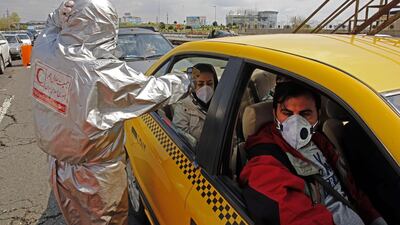
Members of Iranian Red Crescent test people with possible coronavirus Covid-19 symptoms, as police blocked Tehran to Alborz highway to check every car following ordered by the Iranian government, outside Tehran. AFP -
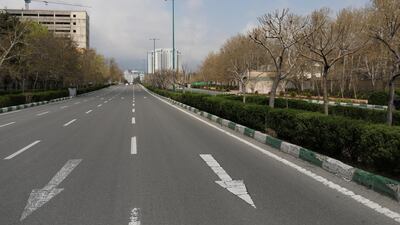
General view of a deserted street, during the intercity ban, amid fear of coronavirus disease (COVID-19), in Tehran, Iran. REUTERS -
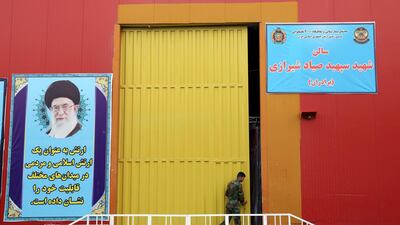
A member of the Iranian Army works at a temporary hospital in Tehran, Iran. AP Photo -
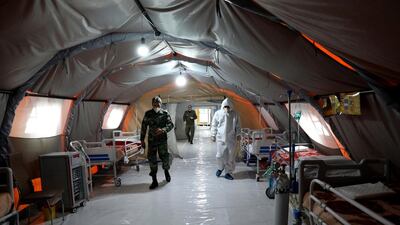
Iranian army soldiers work in a temporary 2,000-bed hospital for COVID-19 coronavirus patients set up by the army at the international exhibition center in northern Tehran, Iran. AP Photo -
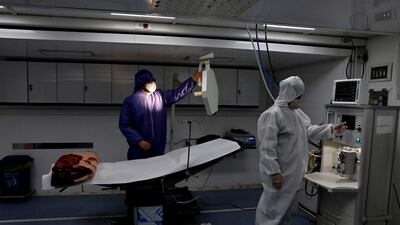
People in protective clothing work in a temporary 2,000-bed hospital for COVID-19 coronavirus patients set up by the Iranian army at the international exhibition center in northern Tehran, Iran. AP Photo -
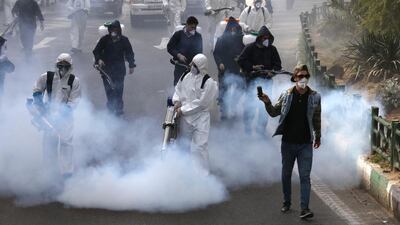
Firefighters disinfect a square against the new coronavirus as a man takes film, in western Tehran, Iran. AP Photo -
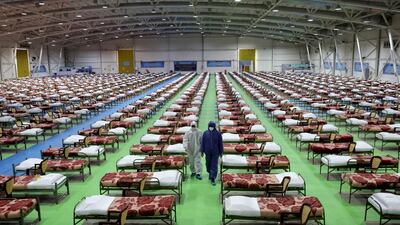
People in protective clothing walk past rows of beds at a temporary 2,000-bed hospital for COVID-19 coronavirus patients set up by the Iranian army at the international exhibition center in northern Tehran, Iran. AP Photo -
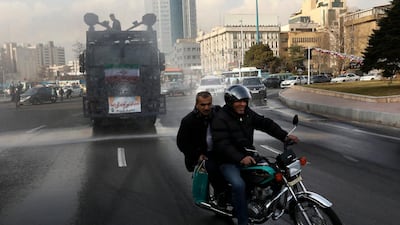
A police vehicle disinfects streets against the coronavirus, in Tehran, Iran. AP Photo -
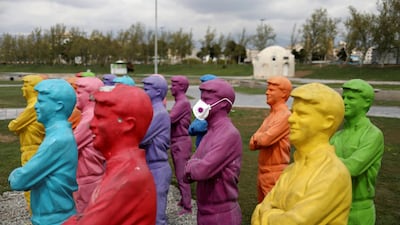
A statue wearing a protective face mask is pictured, amid fear of coronavirus disease (COVID-19), in Azadi square, in Tehran, Iran. REUTERS -
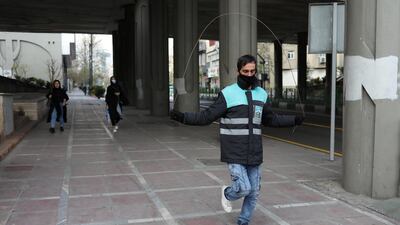
A man wearing a protective face mask and gloves, amid fear of coronavirus disease (COVID-19), jumps rope at Valiasr street in Tehran, Iran. REUTERS -
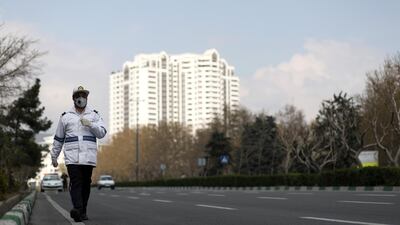
A traffic police officer wears a protective face mask and gloves, amid fear of coronavirus disease (COVID-19), as he walks in Tehran, Iran. REUTERS -
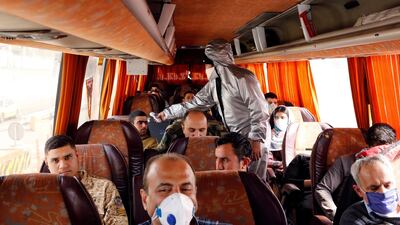
A member of Iranian red crescents test passengers of a bus for possible coronavirus Covid-19 symptoms, as police blocked Tehran to Alborz highway to check every car following ordered by Iranian government, outside of Tehran. EPA -
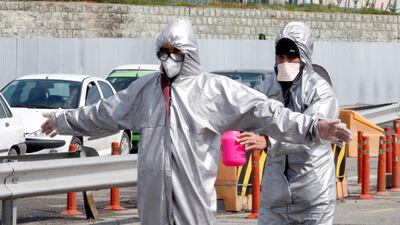
Members of Iranian Red Crescent get themselves disinfected after testing people for possible coronavirus Covid-19 symptoms, outside of Tehran. EPA


A confrontation is being "cooked up in Tehran" right now, I have reliably been informed, with the purpose of deflecting internal social pressures. Ordinary Iranians are said to be preparing for what is likely to be "a difficult post-Ramadan phase” because of the punishing effect of the coronavirus pandemic on an economy already battered by US-led sanctions.
Having concluded that Covid-19 will not lead to an end to American sanctions or the implementation of the European mechanism for circumventing those sanctions, the regime has seemingly opted to rely on military confrontation. According to reports, Iran could target tankers in the Gulf in the coming week.
It would therefore be foolhardy to expect the regime to reconsider its expansionary policies in the region. A visit to Damascus by Iran's Foreign Minister Mohammad Javad Zarif last week has only re-affirmed Tehran's support for Syrian President Bashar Al Assad's regime.
That meeting received negative coverage in the Russian media, with Moscow being a key ally of Damascus. However, Iran and Russia have since renewed their pledge to co-operate in the war-torn country. It has also been reliably learnt that Russia – which is currently wrestling with the pandemic and the oil shock – will resume its support for the Assad regime over a new offensive in the north-western province of Idlib, parts of which are still held by rebels.
Russia is indeed reeling as a result of the virus – primarily because of the oil prices. Last week, the former deputy foreign minister Dr Andrei Fedorov had correctly predicted in this column that prices would crash below zero. His view was that this crisis is troubling for Russia, which lacks the economic resilience that Saudi Arabia, for instance, enjoys. "We are on the verge of an economic crisis that will last for at least two years," Dr Andrei Fedorov said.
These days, there is concern among many governments – particularly the Trump administration – that the crisis could lead to social unrest, uprisings and protests, many of which have already begun in the virtual sphere. The growth of these protests is likely to encourage leaders to ease lockdowns, which exacerbate unemployment levels and stoke feelings of restlessness.
-
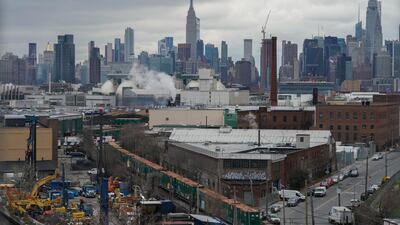
The Manhattan skyline rises over the Borough of Brooklyn on March 31, 2020 in New York. AFP -
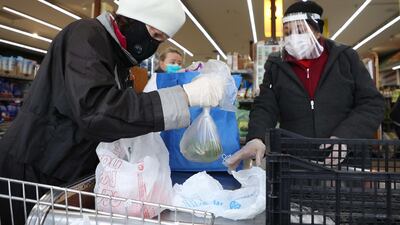
A shopper and cashier wear protective equipment at the checkout station at Pat's Farms grocery store in Merrick, New York. AFP -
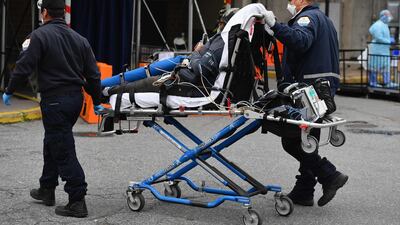
Paramedics push a gurney with a patient to Brooklyn Hospital Centre Emergency Room in the Brooklyn borough of New York. AFP -
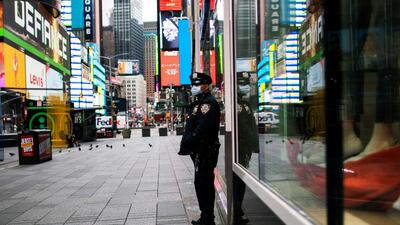
A New York Police officer stands guard in an almost empty Times Square during the outbreak of the coronavirus disease. Reuters -
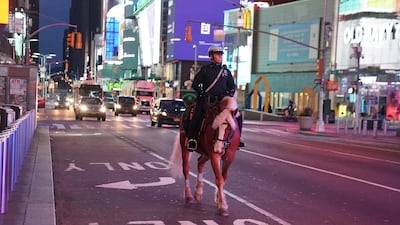
A mounted police officer rides though a mostly deserted Times Square during the outbreak of the coronavirus disease in the Manhattan. Reuters -
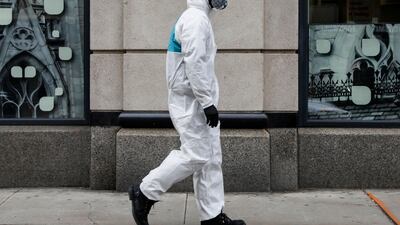
A man wears personal protective equipment as he walks on First Avenue, during the coronavirus disease outbreak in New York City. Reuters -
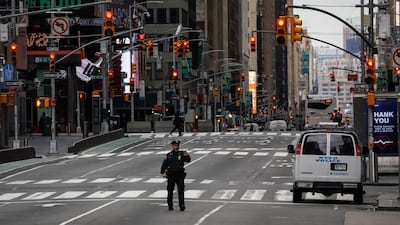
A New York City Police officer takes a selfie while in the middle of the street in an almost empty Times Square. Reuters -
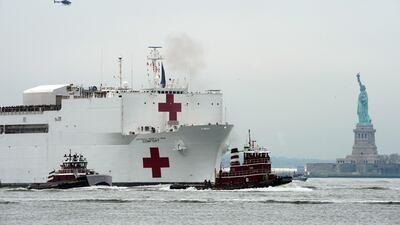
The US Navy hospital ship carrying 1,000 hospital beds moves past the Statue of Liberty as it arrives in New York. AFP -
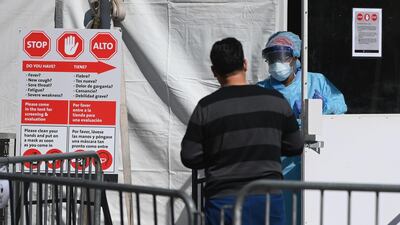
A medical worker walks out of a coronavirus testing tent at Brooklyn Hospital Centre in New York City. AFP -
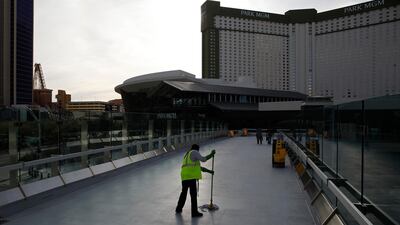
A worker cleans along the Las Vegas Strip devoid of the usual crowds as casinos and other business are shuttered due to the coronavirus outbreak. AP -
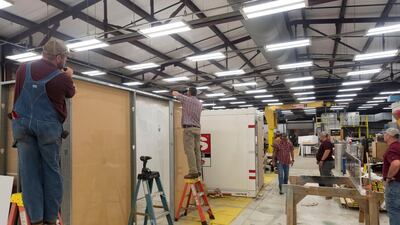
Members of the US Army Corps of Engineer Research Development Centre’s Directorate of Public Works construct two temporary hospital room prototypes in Vicksburg. The Vicksburg Post via AP -
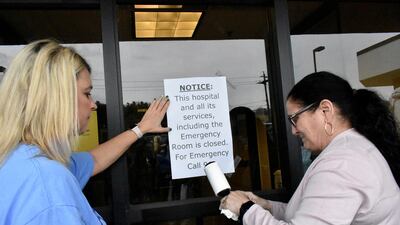
Carol Talkington helps Terri Bonasso tape a notice on the emergency room door following a vigil at the closing of the Fairmont Regional Medical Centre in Fairmont. Times-West Virginian via AP -

A motel sign is lit along a quiet Sunset Boulevard at dusk amid the coronavirus pandemic on March 31, 2020 in Los Angeles. AFP -
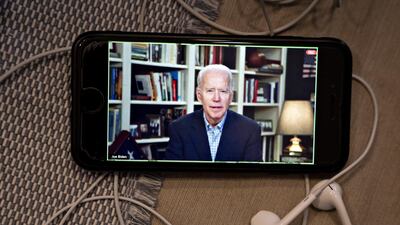
Democratic presidential candidate Joe Biden speaks during a virtual press briefing on March 25, 2020. Bloomberg


This has put a tremendous amount of pressure on the administration, with the US having become the eye of the storm in recent weeks; the death toll just passed the 50,000 mark this week. The current oil prices could well bankrupt major American oil companies and crash the strategic hydrocarbon sector, which could also have negative implications for Mr Trump's election chances – although a second term is still within reach for the President.
The US-China relations could prove to be a key factor in the presidential election. The opposition Democratic Party has accused Mr Trump of excessively blaming Beijing for the sake of electoral calculations. But the fact that Germany, the UK, France and other European nations are also holding China partly responsible for the spread of the virus has made it look weak.
On the other hand, the Trump-led Republican Party supports the idea of confronting China, with US Secretary of State Mike Pompeo's allegation that the virus originated in a Chinese lab receiving support within the party. All this is unlikely to bode well for Beijing's reputation. And even though there are signs of an economic revival in China, authorities recently had to shut down the city of Harbin. All eyes will therefore be on the outcome of the Communist Party Central Committee meeting in the coming weeks, with speculation that Beijing could suspend projects under its Belt and Road Initiative.
It is important to point out that leaders and followers all over the world have been left anxious by the terrible tempest unleashed by this virus. And the problem is that there is little to indicate that tensions – be they military, economic or social in nature – will recede quickly in the post-coronavirus world.
Raghida Dergham is the founder and executive chairwoman of the Beirut Institute

