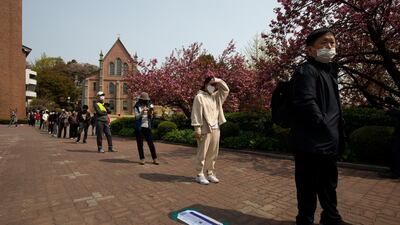
Voters wearing masks maintain social distancing while waiting in line at a polling station during parliamentary elections in Seoul last week. Bloomberg
Coronavirus: South Korea shows elections are feasible – but change is inevitable
In the short term, Covid-19 will cause great uncertainty for candidates and the public alike. But they will find new and novel ways to campaign and even vote
How do you hold elections when much of the globe is in lockdown? This is a question that has had to be confronted in several different parts of the world very recently. In mid-March, France went to the polls for the first round of local elections for cities, towns and villages; but then President Emmanuel Macron announced restrictions on movement, which meant that the second, conclusive round will not now be held before June at the earliest.
South Korea has just held what is generally considered to be a model for how to conduct a general election during the pandemic. Every person turning up to vote had their temperature taken, had to wear a mask, had their hands sanitised and was then given a clean pair of gloves to wear. Markers were laid out for people to distance socially, with wardens ensuring this was observed. Separate polling stations were set up for coronavirus patients with mild symptoms. Those with more serious symptoms could vote via post, while people who were in quarantine had an hour to vote after the polls had closed for everyone else.
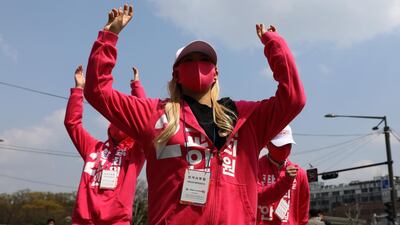
Supporters of parliamentary election candidate Hwang Kyo-ahn of the main opposition United Future Party cheer during his street campaign, April 10, Seoul, South Korea. Chung Sung-Jun/Getty
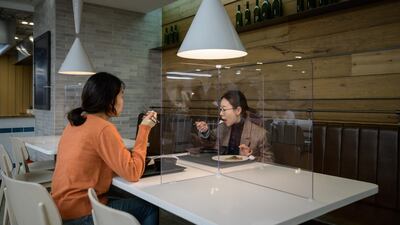
At a cafeteria in Seoul on April 9, employees eat behind protective screens as part of preventative measures at the offices of Hyundai Card credit card company that has implemented reduced working hours and staggered lunch breaks, while South Korea has seen a continued decline in new virus cases. Ed Jones/ AFP
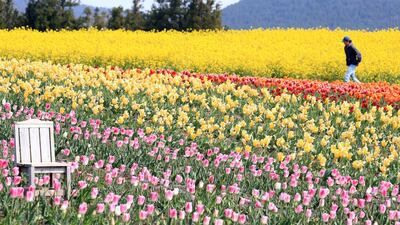
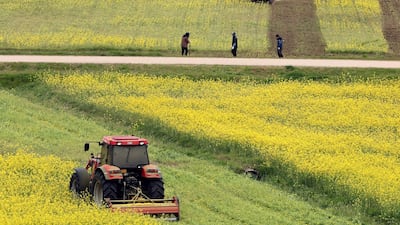
A visitor walks through a field of tulips and rapeseed flowers on Jeju Island, South Korea, 09 April 2020. South Korea on 08 April carried out the destruction of one Jeju's most popular rapeseed flower fields to prevent tourists from flocking to the area amid the ongoing coronavirus pandemic EPA
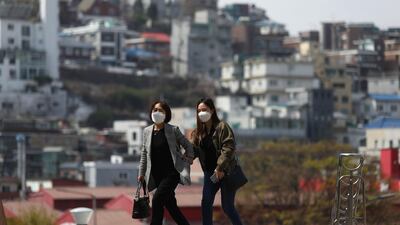
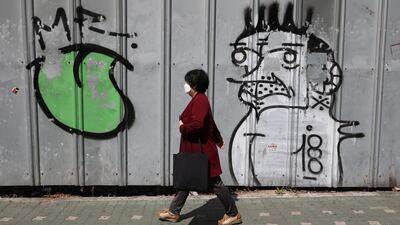
Masks are a common sight on the streets of Seoul, April 10. Chung Sung-Jun/Getty
Supporters of South Korean parliamentary election candidate Lee Nak-yon of the ruling Democratic Party applaud his speech on April 10. Chung Sung-Jun/Getty
People are back on the streets, albeit with masks to protect themselves. Chung Sung-Jun/Getty
Gongpyeong road in downtown Daegu, some 300km southeast of Seoul, South Korea, 10 April, after the city reported zero new Covid-19 cases the day before. The city that has been the center of the coronavirus outbreak in the country is starting to show signs of returning to normal. EPA
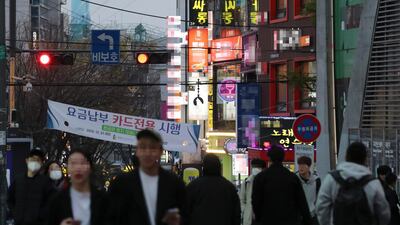
Hongdae, an area of western Seoul popular for its vibrant, youthful atmosphere, South Korea, 10 April. EPA
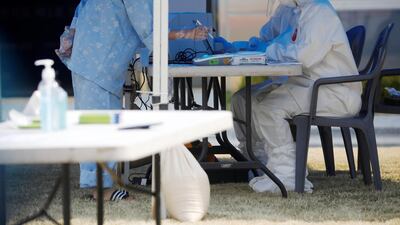
A South Korean patient of Covid-19 arrives to cast her ballot for the parliamentary election at a polling station set up at a quarantine centre in Yongin, April 11. Kim Hong-Ji/ Reuters
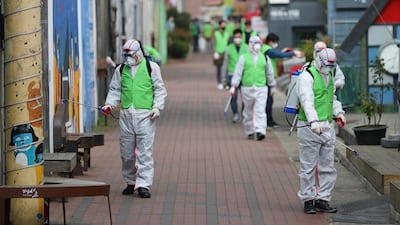
Health workers disinfect a street to curb the spread of coronavirus, Daegu, South Korea, 11 April. EPA
Workers drive tractors to upend a rapeseed flower field in Busan, South Korea, 10 April. The flowers were destroyed to prevent tourists from flocking to the area. EPA
By contrast, in America, the vote for the Supreme Court in the state of Wisconsin, which took place earlier this month, was seen as a disaster. The Democratic Party wanted it to be postponed as non-essential businesses had already been ordered to shut down, but the Republican Party lawmakers insisted it go ahead anyway.
Hundreds of thousands of postal votes had to be discounted or did not arrive in time. In the city of Milwaukee, there was such a shortage of polling workers that the city could only run five election stations compared with the 180 it normally has open. Lines were long and the state was able to provide nothing like the safeguards that were insisted upon in South Korea, leading to accusations that citizens were having to risk their lives in order to exercise their right to vote.
This is a dilemma that many others will have to face sooner or later. Singapore is expected to hold elections soon. Americans are due to vote for their next president in November. And even if most countries decide not to delay, it is clear that the nature of these elections is going to be very different.
Singapore Prime Minister Lee Hsien Loong might announce holding elections earlier than usual. AP Photo
The US race for the White House effectively lasts almost two years – Senator Bernie Sanders announced his bid for the Democratic nomination in February 2019, for instance – so we have had plenty of time to witness the stark contrast between the rallies and press-fleshing of retail politics as we have always known it, and the new normal.
If the candidates are responsible, there can be no more mass gatherings, no more knocking on doors or meeting-and-greeting. This is bad news for the Democratic presumptive nominee, Joe Biden, whose greatest strength is supposed to be his personal touch. President Donald Trump, meanwhile, gets to speak to the nation every day when he provides his coronavirus updates.
People listen as Democratic presidential candidate, and former vice president, Joe Biden speaks during an event in Ames, Iowa. AFP
With no traditional campaigning going on, exposure in the media – both new and old – will matter all the more. Psephologists have long argued about the extent to which newspapers influence voting behaviour, but there is no doubt that coverage can shape opinion to a certain extent – as the UK's former Labour leader, Jeremy Corbyn, found to his cost after being consistently trashed not only by journals of the right but also by the country's left-leaning Guardian newspaper.
There is the potential while this pandemic remains with us for incumbents to look authoritative and presidential, to strike a “father of the nation” pose. In their very different ways, President Trump and the British Prime Minister Boris Johnson have both assumed this mantle, and many think that Singapore’s leader Lee Hsien Loong may be counting on this if he holds polls many months before April 2021 when he legally has to.
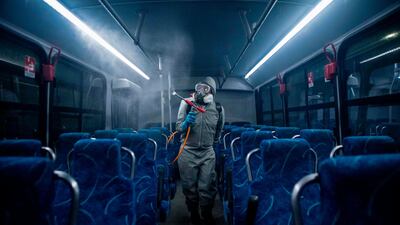
A cleaner wearing personal protective equipment disinfects a bus at a terminal in Coatepec, Veracruz state, on the coast of the Gulf of Mexico. AFP
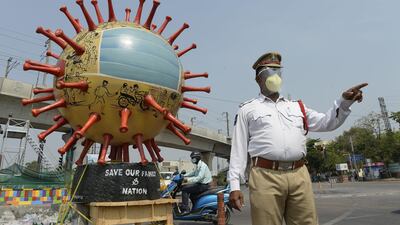
An Indian traffic officer stands beside a coronavirus-themed globe at a traffic junction as he checks commuters travelling during a government-imposed nationwide lockdown in Hyderabad. AFP
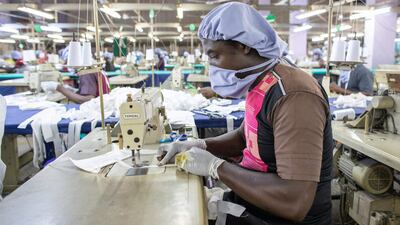
A man uses a sewing machine to assemble a piece of personal protective equipment at a factory in Accra, Ghana. AFP
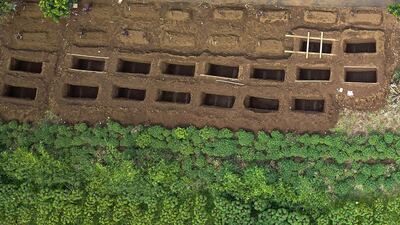
Graves for Indonesian victims of the coronavirus are seen from the air in Bogor, West Java. AFP
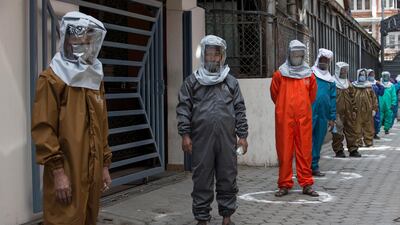
Nepalese sanitation workers in Kathmandu line up after receiving new personal protective equipment. EPA
A nurse arrives to test a resident of the Christalain home for the elderly in Brussels, Belgium. AFP
A 2,500-bed field hospital for victims of the coronavirus has been set up inside Tecnopolis, a science, technology and culture park, in Villa Martelli, Buenos Aires, Argentina. AFP
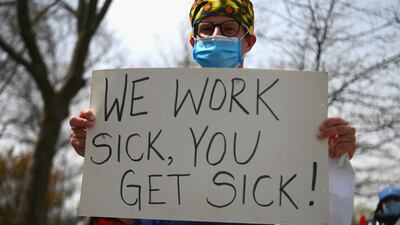
Healthcare workers of Jacobi Medical Center hold a rally against a new paid sick leave policy by NYC Health + Hospitals that mandates staff who are sick present a doctor's note. AFP
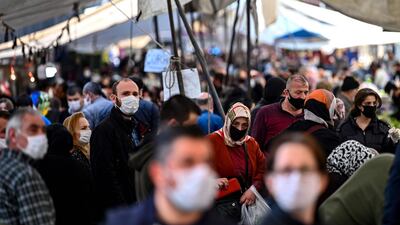
People walk through a market in Bayrampasa, Istanbul, Turkey. AFP
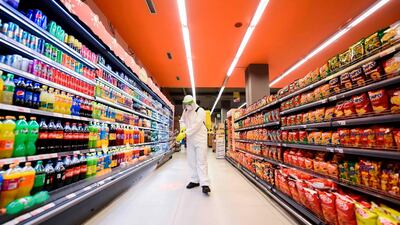
A worker disinfects the floor of a supermarket in Pristina, Kosovo. AFP
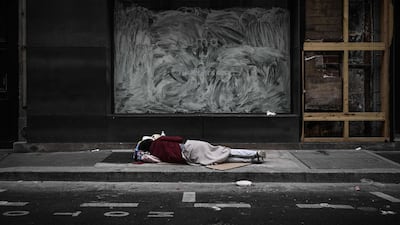
A homeless sleeps in front of closed shops in Paris, France. AFP
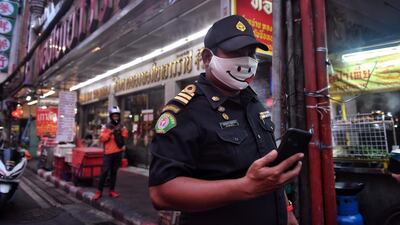
A policeman patrols Chinatown in Bangkok, Thailand. AFP
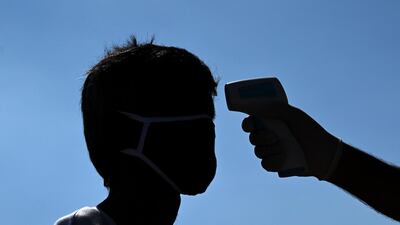
A security officer checks the temperature of a porter before taking him to a quarantine centre in Colombo, Sri Lanka. AFP
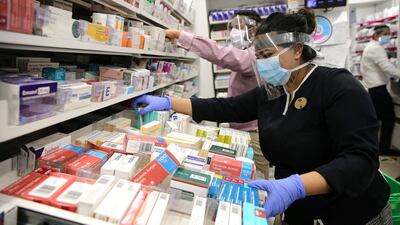
A pharmacy assistant inside a UK Boots store prepares medicines for a cyclist to deliver to vulnerable people in east London. AFP
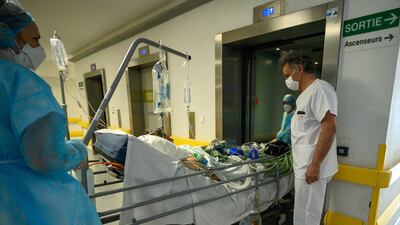
A patient infected with the coronavirus is transferred back to intensive care after his condition worsened at the Emile Muller hospital in Mulhouse, France. AFP
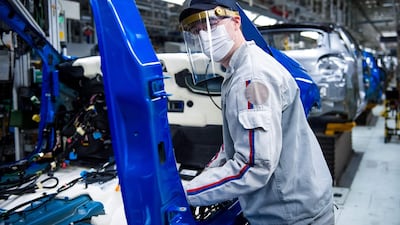
An employee demonstrates precautionary measures on the assembly line at the PSA Peugeot Citroen plant in Trnava, Slovakia. AFP
This inevitably sidelines opposition leaders, who are also hampered by the fact that if we are all supposed to be banding together, it is tricky for anyone to criticise too harshly without sounding overly and inappropriately partisan.
South Korea's Moon Jae-in, whose approval ratings only last October were at a record low, appears to have benefited from the greater platform the pandemic has given him. But it helps, of course, that his country looks to have handled the virus more successfully so far than any other. If the US has an outsize number of deaths as 2020 draws to an end, Mr Trump may get the blame instead of the laurels.
Our cartoonist Shadi Ghanim's take on the recent Wisconsin election.
Then there is the question of voting itself. There is the possibility of going 100 per cent postal. But in an age of ever higher internet penetration, and to minimise the risk of infection, it surely makes sense for populations to be able to vote via mobile phones and computers. If much of importance was already being conducted online, we are now having to do even more. Why not elections – which would also benefit from greater speed and, one hopes, accuracy?
Part of me wonders whether casting a ballot electronically can feel as weighty as travelling to a polling station, proving your identity and making your decision in the privacy of the booth. Similarly, as a former teenage party activist, politics without canvassing, personal interaction with voters, the camaraderie of the committed and the long agonies of election night as the results take hours to come in, sounds sterile and lacking in passion by comparison.
A politics without canvassing, personal interaction with voters, the camaraderie of the committed and the long agonies of election night sounds sterile. Reuters
And yet, a more sterile world is just what are all going to have to get used to, for months if not years. If elections are to continue and countries cannot manage the full-service South Korea brought to theirs, e-voting could become the norm. Older people may find it somewhat soulless. But on a more optimistic note, the young may soon find stories of how we used to cast our ballots as quaint – and incomprehensible – as recollections of how we once had to tune television sets and ask the operator to connect an international telephone call.
Coronavirus will force us to adapt again. The good news is that this is something humanity has proved quite good at, even if we grumble as we do it.
Sholto Byrnes is a commentator and consultant in Kuala Lumpur and a corresponding fellow of the Erasmus Forum

A homegrown card payment scheme launched by the National Payments Corporation of India and backed by the Reserve Bank of India, the country’s central bank
RuPay process payments between banks and merchants for purchases made with credit or debit cards
It has grown rapidly in India and competes with global payment network firms like MasterCard and Visa.
In India, it can be used at ATMs, for online payments and variations of the card can be used to pay for bus, metro charges, road toll payments
The name blends two words rupee and payment
Some advantages of the network include lower processing fees and transaction costs
BeIN Sports currently has the rights to show
- Champions League
- English Premier League
- Spanish Primera Liga
- Italian, French and Scottish leagues
- Wimbledon and other tennis majors
- Formula One
- Rugby Union - Six Nations and European Cups
Mercer, the investment consulting arm of US services company Marsh & McLennan, expects its wealth division to at least double its assets under management (AUM) in the Middle East as wealth in the region continues to grow despite economic headwinds, a company official said.
Mercer Wealth, which globally has $160 billion in AUM, plans to boost its AUM in the region to $2-$3bn in the next 2-3 years from the present $1bn, said Yasir AbuShaban, a Dubai-based principal with Mercer Wealth.
“Within the next two to three years, we are looking at reaching $2 to $3 billion as a conservative estimate and we do see an opportunity to do so,” said Mr AbuShaban.
Mercer does not directly make investments, but allocates clients’ money they have discretion to, to professional asset managers. They also provide advice to clients.
“We have buying power. We can negotiate on their (client’s) behalf with asset managers to provide them lower fees than they otherwise would have to get on their own,” he added.
Mercer Wealth’s clients include sovereign wealth funds, family offices, and insurance companies among others.
From its office in Dubai, Mercer also looks after Africa, India and Turkey, where they also see opportunity for growth.
Wealth creation in Middle East and Africa (MEA) grew 8.5 per cent to $8.1 trillion last year from $7.5tn in 2015, higher than last year’s global average of 6 per cent and the second-highest growth in a region after Asia-Pacific which grew 9.9 per cent, according to consultancy Boston Consulting Group (BCG). In the region, where wealth grew just 1.9 per cent in 2015 compared with 2014, a pickup in oil prices has helped in wealth generation.
BCG is forecasting MEA wealth will rise to $12tn by 2021, growing at an annual average of 8 per cent.
Drivers of wealth generation in the region will be split evenly between new wealth creation and growth of performance of existing assets, according to BCG.
Another general trend in the region is clients’ looking for a comprehensive approach to investing, according to Mr AbuShaban.
“Institutional investors or some of the families are seeing a slowdown in the available capital they have to invest and in that sense they are looking at optimizing the way they manage their portfolios and making sure they are not investing haphazardly and different parts of their investment are working together,” said Mr AbuShaban.
Some clients also have a higher appetite for risk, given the low interest-rate environment that does not provide enough yield for some institutional investors. These clients are keen to invest in illiquid assets, such as private equity and infrastructure.
“What we have seen is a desire for higher returns in what has been a low-return environment specifically in various fixed income or bonds,” he said.
“In this environment, we have seen a de facto increase in the risk that clients are taking in things like illiquid investments, private equity investments, infrastructure and private debt, those kind of investments were higher illiquidity results in incrementally higher returns.”
The Abu Dhabi Investment Authority, one of the largest sovereign wealth funds, said in its 2016 report that has gradually increased its exposure in direct private equity and private credit transactions, mainly in Asian markets and especially in China and India. The authority’s private equity department focused on structured equities owing to “their defensive characteristics.”
The company offers payments/bribes to win key contracts in the Middle East
May 2017
The UK SFO officially opens investigation into Petrofac’s use of agents, corruption, and potential bribery to secure contracts
September 2021
Petrofac pleads guilty to seven counts of failing to prevent bribery under the UK Bribery Act
October 2021
Court fines Petrofac £77 million for bribery. Former executive receives a two-year suspended sentence
December 2024
Petrofac enters into comprehensive restructuring to strengthen the financial position of the group
May 2025
The High Court of England and Wales approves the company’s restructuring plan
July 2025
The Court of Appeal issues a judgment challenging parts of the restructuring plan
August 2025
Petrofac issues a business update to execute the restructuring and confirms it will appeal the Court of Appeal decision
October 2025
Petrofac loses a major TenneT offshore wind contract worth €13 billion. Holding company files for administration in the UK. Petrofac delisted from the London Stock Exchange
November 2025
180 Petrofac employees laid off in the UAE
It's up to you to go green
Nils El Accad, chief executive and owner of Organic Foods and Café, says going green is about “lifestyle and attitude” rather than a “money change”; people need to plan ahead to fill water bottles in advance and take their own bags to the supermarket, he says.
“People always want someone else to do the work; it doesn’t work like that,” he adds. “The first step: you have to consciously make that decision and change.”
When he gets a takeaway, says Mr El Accad, he takes his own glass jars instead of accepting disposable aluminium containers, paper napkins and plastic tubs, cutlery and bags from restaurants.
He also plants his own crops and herbs at home and at the Sheikh Zayed store, from basil and rosemary to beans, squashes and papayas. “If you’re going to water anything, better it be tomatoes and cucumbers, something edible, than grass,” he says.
“All this throwaway plastic - cups, bottles, forks - has to go first,” says Mr El Accad, who has banned all disposable straws, whether plastic or even paper, from the café chain.
One of the latest changes he has implemented at his stores is to offer refills of liquid laundry detergent, to save plastic. The two brands Organic Foods stocks, Organic Larder and Sonnett, are both “triple-certified - you could eat the product”.
The Organic Larder detergent will soon be delivered in 200-litre metal oil drums before being decanted into 20-litre containers in-store.
Customers can refill their bottles at least 30 times before they start to degrade, he says. Organic Larder costs Dh35.75 for one litre and Dh62 for 2.75 litres and refills will cost 15 to 20 per cent less, Mr El Accad says.
But while there are savings to be had, going green tends to come with upfront costs and extra work and planning. Are we ready to refill bottles rather than throw them away? “You have to change,” says Mr El Accad. “I can only make it available.”
What She Ate: Six Remarkable Women & the Food That Tells Their Stories
Laura Shapiro
Fourth Estate
FIXTURES
Thu Mar 15 – West Indies v Afghanistan, UAE v Scotland
Fri Mar 16 – Ireland v Zimbabwe
Sun Mar 18 – Ireland v Scotland
Mon Mar 19 – West Indies v Zimbabwe
Tue Mar 20 – UAE v Afghanistan
Wed Mar 21 – West Indies v Scotland
Thu Mar 22 – UAE v Zimbabwe
Fri Mar 23 – Ireland v Afghanistan
The top two teams qualify for the World Cup
Classification matches
The top-placed side out of Papua New Guinea, Hong Kong or Nepal will be granted one-day international status. UAE and Scotland have already won ODI status, having qualified for the Super Six.
Thu Mar 15 – Netherlands v Hong Kong, PNG v Nepal
Sat Mar 17 – 7th-8th place playoff, 9th-10th place playoff
Why it pays to compare
A comparison of sending Dh20,000 from the UAE using two different routes at the same time - the first direct from a UAE bank to a bank in Germany, and the second from the same UAE bank via an online platform to Germany - found key differences in cost and speed. The transfers were both initiated on January 30.
Route 1: bank transfer
The UAE bank charged Dh152.25 for the Dh20,000 transfer. On top of that, their exchange rate margin added a difference of around Dh415, compared with the mid-market rate.
Total cost: Dh567.25 - around 2.9 per cent of the total amount
Total received: €4,670.30
Route 2: online platform
The UAE bank’s charge for sending Dh20,000 to a UK dirham-denominated account was Dh2.10. The exchange rate margin cost was Dh60, plus a Dh12 fee.
Total cost: Dh74.10, around 0.4 per cent of the transaction
Total received: €4,756
The UAE bank transfer was far quicker – around two to three working days, while the online platform took around four to five days, but was considerably cheaper. In the online platform transfer, the funds were also exposed to currency risk during the period it took for them to arrive.
Indoor cricket in a nutshell
Indoor Cricket World Cup - Sep 16-20, Insportz, Dubai
16 Indoor cricket matches are 16 overs per side
8 There are eight players per team
9 There have been nine Indoor Cricket World Cups for men. Australia have won every one.
5 Five runs are deducted from the score when a wickets falls
4 Batsmen bat in pairs, facing four overs per partnership
Scoring In indoor cricket, runs are scored by way of both physical and bonus runs. Physical runs are scored by both batsmen completing a run from one crease to the other. Bonus runs are scored when the ball hits a net in different zones, but only when at least one physical run is score.
Zones
A Front net, behind the striker and wicketkeeper: 0 runs
B Side nets, between the striker and halfway down the pitch: 1 run
C Side nets between halfway and the bowlers end: 2 runs
D Back net: 4 runs on the bounce, 6 runs on the full
The smuggler
Eldarir had arrived at JFK in January 2020 with three suitcases, containing goods he valued at $300, when he was directed to a search area. Officers found 41 gold artefacts among the bags, including amulets from a funerary set which prepared the deceased for the afterlife. Also found was a cartouche of a Ptolemaic king on a relief that was originally part of a royal building or temple. The largest single group of items found in Eldarir’s cases were 400 shabtis, or figurines.
Khouli conviction
Khouli smuggled items into the US by making false declarations to customs about the country of origin and value of the items. According to Immigration and Customs Enforcement, he provided “false provenances which stated that [two] Egyptian antiquities were part of a collection assembled by Khouli's father in Israel in the 1960s” when in fact “Khouli acquired the Egyptian antiquities from other dealers”. He was sentenced to one year of probation, six months of home confinement and 200 hours of community service in 2012 after admitting buying and smuggling Egyptian antiquities, including coffins, funerary boats and limestone figures.
For sale
A number of other items said to come from the collection of Ezeldeen Taha Eldarir are currently or recently for sale. Their provenance is described in near identical terms as the British Museum shabti: bought from Salahaddin Sirmali, "authenticated and appraised" by Hossen Rashed, then imported to the US in 1948.
- An Egyptian Mummy mask dating from 700BC-30BC, is on offer for £11,807 ($15,275) online by a seller in Mexico
- A coffin lid dating back to 664BC-332BC was offered for sale by a Colorado-based art dealer, with a starting price of $65,000
- A shabti that was on sale through a Chicago-based coin dealer, dating from 1567BC-1085BC, is up for $1,950
MATCH INFO
Uefa Champioons League semi-final, first leg:
Liverpool 5
Salah (35', 45 1'), Mane (56'), Firmino (61', 68')
Roma 2
Dzeko (81'), Perotti (85' pen)
Second leg: May 2, Stadio Olimpico, Rome
Ten tax points to be aware of in 2026
1. Domestic VAT refund amendments: request your refund within five years
If a business does not apply for the refund on time, they lose their credit.
2. E-invoicing in the UAE
Businesses should continue preparing for the implementation of e-invoicing in the UAE, with 2026 a preparation and transition period ahead of phased mandatory adoption.
3. More tax audits
Tax authorities are increasingly using data already available across multiple filings to identify audit risks.
4. More beneficial VAT and excise tax penalty regime
Tax disputes are expected to become more frequent and more structured, with clearer administrative objection and appeal processes. The UAE has adopted a new penalty regime for VAT and excise disputes, which now mirrors the penalty regime for corporate tax.
5. Greater emphasis on statutory audit
There is a greater need for the accuracy of financial statements. The International Financial Reporting Standards standards need to be strictly adhered to and, as a result, the quality of the audits will need to increase.
6. Further transfer pricing enforcement
Transfer pricing enforcement, which refers to the practice of establishing prices for internal transactions between related entities, is expected to broaden in scope. The UAE will shortly open the possibility to negotiate advance pricing agreements, or essentially rulings for transfer pricing purposes.
7. Limited time periods for audits
Recent amendments also introduce a default five-year limitation period for tax audits and assessments, subject to specific statutory exceptions. While the standard audit and assessment period is five years, this may be extended to up to 15 years in cases involving fraud or tax evasion.
8. Pillar 2 implementation
Many multinational groups will begin to feel the practical effect of the Domestic Minimum Top-Up Tax (DMTT), the UAE's implementation of the OECD’s global minimum tax under Pillar 2. While the rules apply for financial years starting on or after January 1, 2025, it is 2026 that marks the transition to an operational phase.
9. Reduced compliance obligations for imported goods and services
Businesses that apply the reverse-charge mechanism for VAT purposes in the UAE may benefit from reduced compliance obligations.
10. Substance and CbC reporting focus
Tax authorities are expected to continue strengthening the enforcement of economic substance and Country-by-Country (CbC) reporting frameworks. In the UAE, these regimes are increasingly being used as risk-assessment tools, providing tax authorities with a comprehensive view of multinational groups’ global footprints and enabling them to assess whether profits are aligned with real economic activity.
Contributed by Thomas Vanhee and Hend Rashwan, Aurifer
Living in...
This article is part of a guide on where to live in the UAE. Our reporters will profile some of the country’s most desirable districts, provide an estimate of rental prices and introduce you to some of the residents who call each area home.
Men: Hamad Nawad and Khalid Al Balushi (56kg), Omar Al Fadhli and Saeed Al Mazroui (62kg), Taleb Al Kirbi and Humaid Al Kaabi (69kg), Mohammed Al Qubaisi and Saud Al Hammadi (70kg), Khalfan Belhol and Mohammad Haitham Radhi (85kg), Faisal Al Ketbi and Zayed Al Kaabi (94kg)
Women: Wadima Al Yafei and Mahra Al Hanaei (49kg), Bashayer Al Matrooshi and Hessa Al Shamsi (62kg)
2010: A restaurant attack in Kampala Uganda kills 74 people watching a Fifa World Cup final football match.
2013: The Westgate shopping mall attack, 62 civilians, five Kenyan soldiers and four gunmen are killed.
2014: A series of bombings and shootings across Kenya sees scores of civilians killed.
2015: Four gunmen attack Garissa University College in northeastern Kenya and take over 700 students hostage, killing those who identified as Christian; 148 die and 79 more are injured.
2016: An attack on a Kenyan military base in El Adde Somalia kills 180 soldiers.
2017: A suicide truck bombing outside the Safari Hotel in Mogadishu kills 587 people and destroys several city blocks, making it the deadliest attack by the group and the worst in Somalia’s history.