
As parts of Europe and North America come out of lockdown, there has been plenty of debate about which countries have been tackling the pandemic in the best manner – with a particular focus on Sweden, which stands out for its more relaxed approach. But a far better comparison is with states in the Asia-Pacific, many of which had to deal with the virus earlier and have, by and large, managed to contain it far more successfully than most.
The death toll in Sweden, after all, has now passed 2,000 in a country of 10 million. In the UK, over 20,000 have died out of a population of 67 million, while the figures for the US are 55,000 out of 328 million.
-

A sign assures people that the bar is open during the coronavirus outbreak, outside a pub in Stockholm, Sweden March 26, 2020. Reuters -
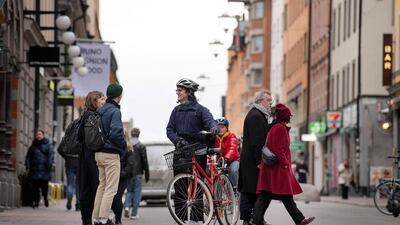
People talk on a street in the Sodermalm district of Stockholm, Sweden, as the spread of the coronavirus continues in the country, on April 1, 2020. Reuters -
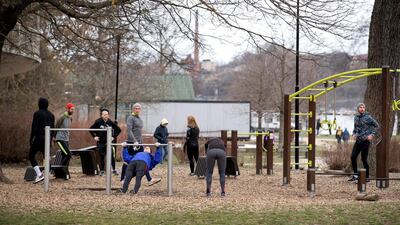
People exercise at an outdoor gym in a park in central Stockholm, Sweden, on April 1, 2020. Reuters -
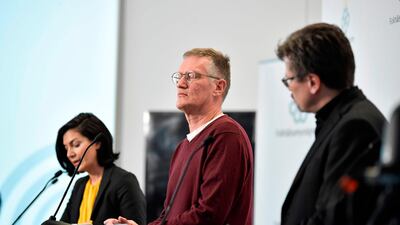
(L to R) Taha Alexandersson of the National Board of Health and Welfare in Sweden, epidemiologist Anders Tegnell of the Public Health Agency of Sweden and Svante Werger of the Swedish Civil Contingencies Agency attend a press conference to update on the coronavirus situation on April 2, 2020 in Stockholm, Sweden. AFP -
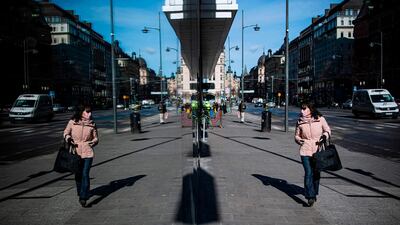
A woman wearing a protective face mask checks her reflection on a window in Stockholm, Sweden, on April 2, 2020. AFP -
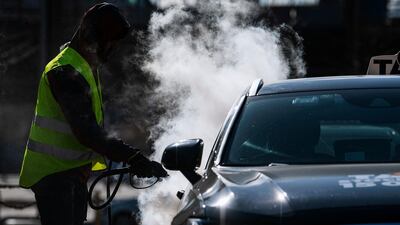
A man cleans and desinfects a taxi car in Stockholm, Sweden, on April 2, 2020, to prevent the spread of the coronavirus, AFP -
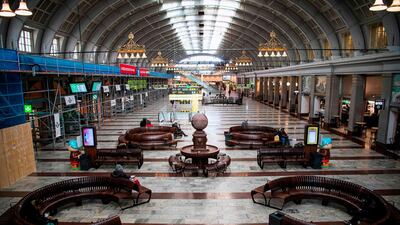
A general view of a quite central station in Stockholm, Sweden, on April 2, 2020. AFP -
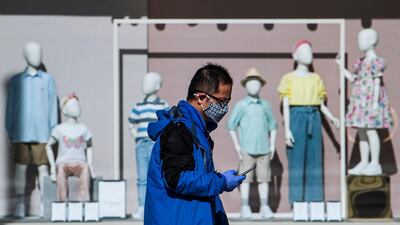
A man wearing a protective face mask looks on his cell phone in Stockholm, Sweden, on April 2, 2020. AFP -
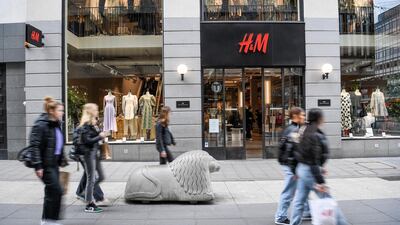
Shoppers pass an H&M shop in central Stockholm, Sweden, on April 2, 2020. The retailer has started dialogue with with tens of thousands of staff about cutting working hours due to the coronavirus pandemic's effect on the market. EPA


Look east and the contrast is stark. There have been only 243 deaths in South Korea (population 52 million), 99 in Malaysia (population 33 million), and a mere 19 in New Zealand (population five million).
We cannot be certain how accurate any of these numbers are; the demographics, and hence the risk of fatalities, vary from country to country; and I have not mentioned infection rates. But as China announces that it has no remaining coronavirus hospital patients in Wuhan, the centre of the virus, and the city comes back to life; and as investors are reported to be "flocking" to South Korea, it is obvious that those two countries – and many of their neighbours – have been doing something right.
Taking the cases of China and South Korea is instructive, because they did not adopt the same approach: China locked down Wuhan and other cities in Hubei province in January with a brutal totality that seemed unconscionable to the outside world – until many countries followed suit. South Korea, on the other hand, may have closed schools and recommended gyms, clubs and churches do the same, but it flattened the curve, as a government publication puts it, “without enforcing draconian measures that restrict freedom and movement of people”.
-
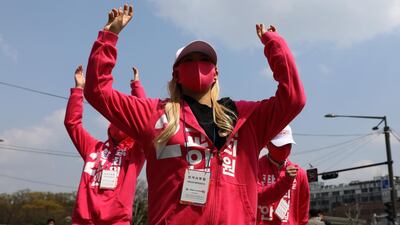
Supporters of parliamentary election candidate Hwang Kyo-ahn of the main opposition United Future Party cheer during his street campaign, April 10, Seoul, South Korea. Chung Sung-Jun/Getty -

At a cafeteria in Seoul on April 9, employees eat behind protective screens as part of preventative measures at the offices of Hyundai Card credit card company that has implemented reduced working hours and staggered lunch breaks, while South Korea has seen a continued decline in new virus cases. Ed Jones/ AFP -
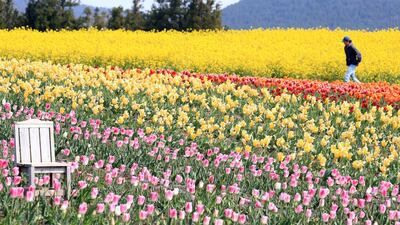
A visitor walks through a field of tulips and rapeseed flowers on Jeju Island, South Korea, 09 April 2020. South Korea on 08 April carried out the destruction of one Jeju's most popular rapeseed flower fields to prevent tourists from flocking to the area amid the ongoing coronavirus pandemic EPA -
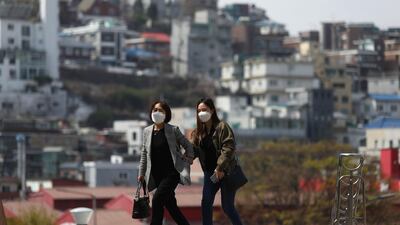
Masks are a common sight on the streets of Seoul, April 10. Chung Sung-Jun/Getty -

Supporters of South Korean parliamentary election candidate Lee Nak-yon of the ruling Democratic Party applaud his speech on April 10. Chung Sung-Jun/Getty -
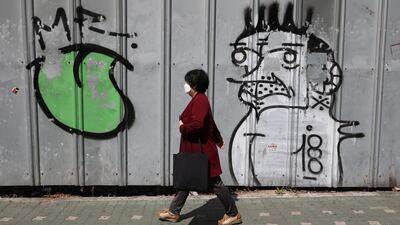
People are back on the streets, albeit with masks to protect themselves. Chung Sung-Jun/Getty -

Gongpyeong road in downtown Daegu, some 300km southeast of Seoul, South Korea, 10 April, after the city reported zero new Covid-19 cases the day before. The city that has been the center of the coronavirus outbreak in the country is starting to show signs of returning to normal. EPA -
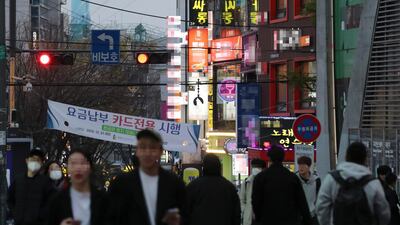
Hongdae, an area of western Seoul popular for its vibrant, youthful atmosphere, South Korea, 10 April. EPA -
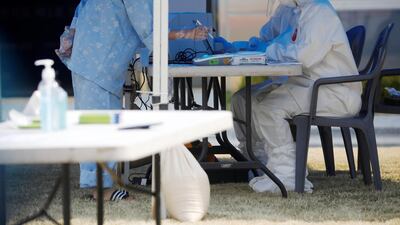
A South Korean patient of Covid-19 arrives to cast her ballot for the parliamentary election at a polling station set up at a quarantine centre in Yongin, April 11. Kim Hong-Ji/ Reuters -
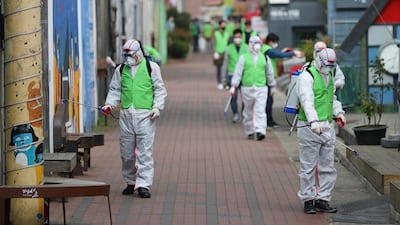
Health workers disinfect a street to curb the spread of coronavirus, Daegu, South Korea, 11 April. EPA -
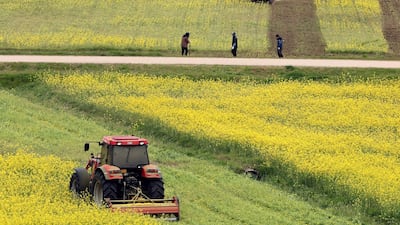
Workers drive tractors to upend a rapeseed flower field in Busan, South Korea, 10 April. The flowers were destroyed to prevent tourists from flocking to the area. EPA


Both countries, however, acted swiftly and determinedly. Wuhan was physically cut off from the outside world for 76 days. South Korea tested tens of thousands of people a day, made temperature-taking and hand-sanitising part of daily life, and used mobile technology to keep its highly connected population fully informed, right down to which shops had been visited and when by infected persons. Its citizens followed government advice on social distancing and working from home.
It is countries that have been more easy-going that are in trouble. Japan's Prime Minister Shinzo Abe did not declare a state of emergency until early-April, by which time hospitals were already overwhelmed. Myanmar and Indonesia both denied they had any cases for weeks; the worry now is that the virus may be spreading far and wide in two countries with very limited healthcare facilities.
What explains the success – so far – of the Asia-Pacific countries I mentioned earlier? In south-east and east Asia there is the memory of Sars, which broke out in China in 2002 and later spread to a total of 29 territories. In this part of the world, we are very aware of our proximity to China, so when the coronavirus emerged we knew we would be on the frontline. It is also quite normal to see people wearing masks, whether out of a heightened sense of personal hygiene or to protect against air pollution. Some have argued that east and south-east Asian populations are more likely to comply with government advice, and that may well be true in countries that tend to place the rights of the community over those of the individual.
-
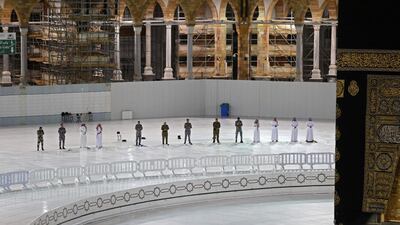
Worshipers perform Isha prayer while keeping distance between them next to the Kaaba in Mecca's Grand Mosque, Islam's holiest site. Saudi Authorities allowed for limit number of worshipers to enter the Grand mosque to perform prayers during the Islamic holy fasting month of Ramadan, amid unprecedented bans on family gatherings and mass prayers due to the coronavirus (COVID-19) pandemic. AFP -

Sheikh Junayd Ahmad leads livestreamed Taraweeh evening prayers, normally bringing a crowd of over a thousand, at the Muslim Association of Puget Sound on the first day of Ramadan during the coronavirus disease (COVID-19) outbreak in Redmond, Washington, U.S. REUTERS -
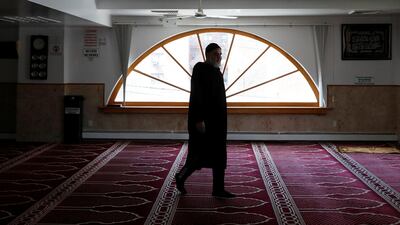
Imam Abdelghani Benyahya arrives to perform the afternoon call to prayer alone during the holiday of Ramadan at the Muslim Center of New York during the outbreak of the coronavirus disease (COVID-19), in the Queens borough of New York City, U.S. REUTERS -

A Palestinian family wearing protective masks walks during the Muslim holy month of Ramadan in an empty alley in the Old City of Jerusalem amid the COVID-19 pandemic. AFP -

Sudanese men wait to break their daytime fast during the Holy Islamic month of Ramadan, amid a curfew due to the coronavirus pandemic, in a street in the capital of Khartoum, Sudan. AP -
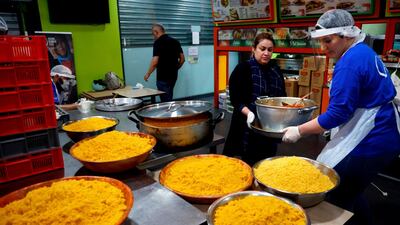
Volunteers of the French Islamic Relief prepare hundreds of meals to offer and distribute to Muslim poor people during the month of Ramadan, in Orly, south of Paris. AFP -

A woman sells dates outside a mosque in Williamsville, Abidjan, Ivory Coast, during the holy month of Muslim Ramadan. Muslims around the world celebrate the holy month of Ramadan by praying at night and abstaining from eating, drinking and sexual acts during the period between sunrise and sunset. Ramadan is the ninth month of the Islamic calendar, and the revelation of the first verse of the Qur'an is believed to have taken place during its last 10 nights. EPA -
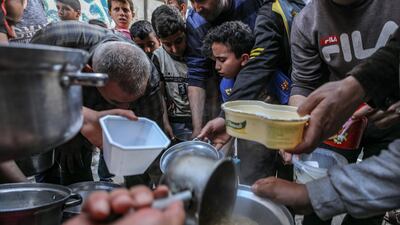
Palestinians gather to get soup offered for free during the Muslim holy month of Ramadan in Gaza City, Gaza Strip. Muslims around the world celebrate the holy month of Ramadan by praying during the night time and abstaining from eating, drinking, and sexual acts during the period between sunrise and sunset. Ramadan is the ninth month in the Islamic calendar, and it is believed that the revelation of the first verse in Koran was during its last 10 nights. EPA -
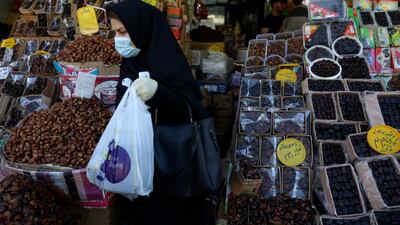
A woman wearing a protective face mask and gloves to help prevent the spread of the coronavirus carries her purchases as she leaves a store which sells dates, a favorite fruit for the Muslim holy fasting month of Ramadan, in southern Tehran, Iran. In Iran, the country that is hit worst in the Middle East by the coronavirus, all religious gathering, congregational prayers and communal Iftar servings, a meal eaten at sunset to break the fast, remain forbidden in the Ramadan and also holy shrines and religious centers also continue to be closed until at least May 4. AP -

A volunteer distributing water, food and juice, signals to fasting drivers on a road in Egypt's Menofia governorate, during the Muslim holy month of Ramadan. AFP -
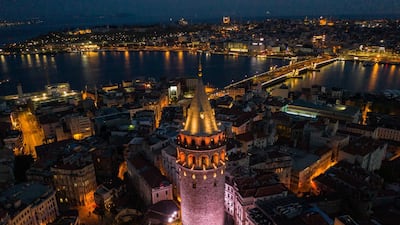
In this aerial photo from a drone, the illuminated roads and square around Istanbul's famous Galata Tower are seen empty on the final day of a four-day lockdown across Istanbul, in Istanbul, Turkey. Turkeys Mosques remain closed due to the spread of the COVID-19 virus as Muslims around the world celebrate Ramadan, the holiest month of the Islamic calendar under lockdown. As of April 26, according to the Health Ministry, Turkey has 2,805 Coronavirus related deaths and confirmed cases have risen to 110,130. Despite the rising numbers Turkey has avoided a full lockdown and continues to implement short lockdowns and constant revisions of current restrictions. The interior ministry continues restrictions on travel between 31 cities, a curfew continues to be in place for anyone over the age of 65 and under 20, schools, cafes, bars and non-essential businesses remain closed. Getty -
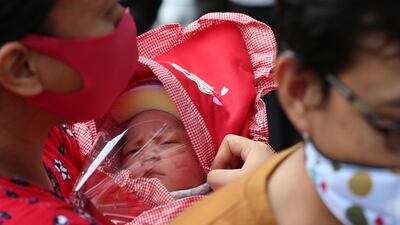
A mother carries her baby with face shield at a hospital in Jakarta, Indonesia. The world's Muslims have begun Ramadan with dawn-to-dusk fasting amid restrictions imposed to slow the pandemic that left many confined to their homes and public venues like parks, malls and even mosques are shuttered. AP -
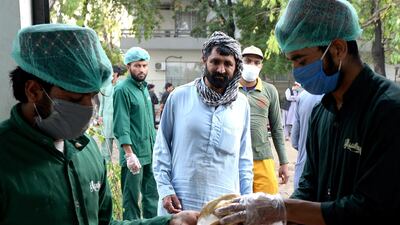
People line up to receive free food as the time to break the fast approaches during the Muslim holy month of Ramadan amid lockdown of the Punjab province due to the ongoing coronavirus COVID-19 disease pandemic in Islamabad, Pakistan. Muslims around the world celebrate the holy month of Ramadan, by praying during the night time and abstaining from eating, drinking, and sexual acts during the period between sunrise and sunset. Ramadan is the ninth month in the Islamic calendar and it is believed that the revelation of the first verse in Koran was during its last 10 nights. EPA -

A woman prays at a mosque during the Muslim holy month of Ramadan in Herat, Afghanistan, amid a lockdown due the ongoing pandemic of the COVID-19 disease caused by the SARS-CoV-2 coronavirus. Muslims around the world prepare to celebrate the holy month of Ramadan, by praying during the ni?ght time and abstaining from eating, drinking, and sexual acts during the period between sunrise and sunset. Ramadan is the ninth month in the Islamic? calendar and it is believed that the revelation of the first verse in Koran was during its last 10 nights EPA -
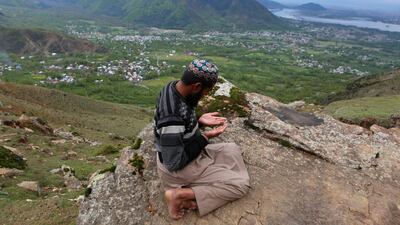
A Kashmiri Muslim man prays on a hill on the third day of fasting month of Ramadan on outskirts of Srinagar, the summer capital of Indian Kashmir. The religious authorities in Kashmir have urged people to pray the congregational Taravih (extended night prayers) and mandatory daily prayers at home to stop the spread of coronavirus in the region. Muslims around the world celebrate the holy month of Ramadan by praying during the night time and abstaining from eating, drinking, and sexual acts during the period between sunrise and sunset. Ramadan is the ninth month in the Islamic calendar. EPA -

A street vendor wears her face mask to help stop the spread of the coronavirus as she sells food for iftar, the breaking of the Ramadan fast, in Tangerang, Indonesia. The world's Muslims have begun Ramadan with dawn-to-dusk fasting amid restrictions imposed to slow the pandemic that left many confined to their homes and public venues like parks, malls and even mosques are shuttered. AP -
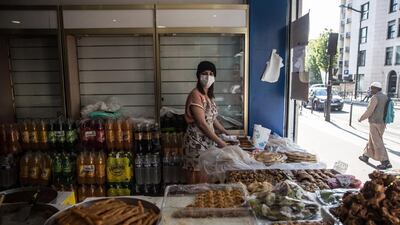
An Algerian shopkeeper with a face mask sells pastry before Iftar time in an Arabic market in Porte de Montreuil area in Paris, France. The majority of the residents around Porte de Montreuil area in Paris are Arab Muslims from North Africa, adherents of Islam across France were unable to take part in the habitual collective prayers this year, as mosques have closed down due to the ongoing pandemic of the COVID-19 disease caused by the SARS-CoV-2 coronavirus. Muslims around the world celebrate the holy month of Ramadan by praying during the night time and abstaining from eating, drinking, and engaging in sexual acts between sunrise and sunset. Ramadan is the ninth month in the Islamic calendar and it is believed that the revelation of the first verse in the Koran occurred during its last 10 nights. EPA -
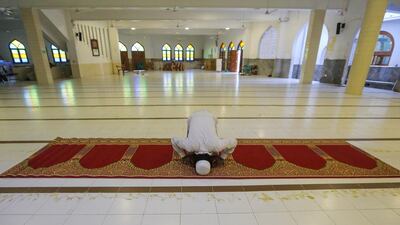
A Sri Lankan Muslim Moulavi prays at the almost deserted Mosque during the Muslim holy month of Ramadan during an island-wide curfew due to the coronavirus pandemic in Colombo , Sri Lanka. Muslims around the world celebrate the holy month of Ramadan, by praying during the night time and abstaining from eating, drinking, and sexual acts during the period between sunrise and sunset. Ramadan is the ninth month in the Islamic calendar and it is believed that the revelation of the first verse in Koran was during its last 10 nights. EPA -
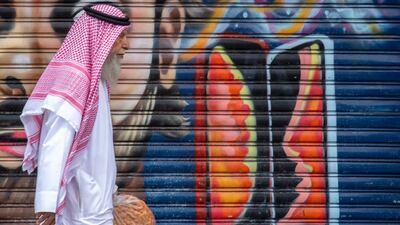
I man holding bread walks past a store mural, in Downtown Amman. Jordanians started the holy month fasting in the context of the COVID-19 Coronavirus curfew, they are allowed outside their homes only between 08 AM and 06 PM. Muslims around the world celebrate the holy month of Ramadan by praying during the night time and abstaining from eating, drinking, and sexual acts during the period between sunrise and sunset. Ramadan is the ninth month in the Islamic calendar and it is believed that the revelation of the first verse in Koran was during its last 10 nights. EPA -
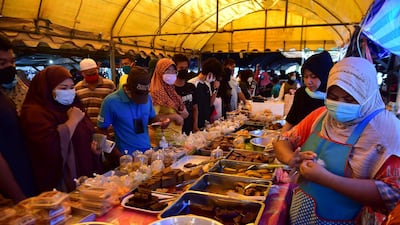
People shop at a food market on the first day of the Muslim holy month of Ramadan in Thailand's southern province of Narathiwat. AFP -
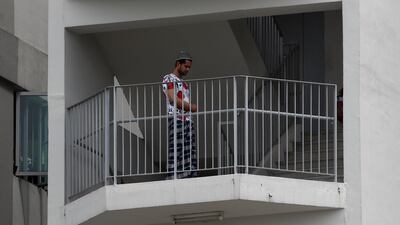
A migrant worker prays during the holy month of Ramadan inside his dormitory, amid the coronavirus disease (COVID-19) outbreak, in Singapore. REUTERS -
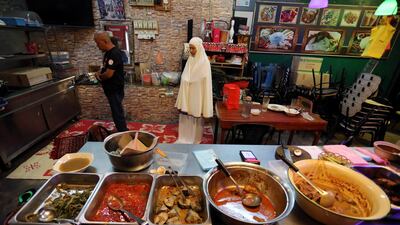
A Muslim family pray inside their restaurant during the holy month of Ramadan, amid the coronavirus disease (COVID-19) outbreak, in Selayang, Malaysia . REUTERS


What unites these countries with faraway New Zealand – to which the above factors do not apply – is, just as with China and South Korea, the measures taken were serious and as complete as they could be. In Malaysia, for instance, we have been under an almost total lockdown for six weeks. It is due to continue for another two, but nobody really expects the Movement Control Order to be lifted until after Eid Al Fitr. That will be nearly 10 weeks during which we cannot leave home at all, except to shop for essentials. Only one person per household is allowed to do so – police have put up roadblocks all over the capital, Kuala Lumpur, and stop any car with more than one person inside.
The order is vigorously enforced – around 20,000 people have been arrested for violations so far, and a deputy minister has been fined 1,000 Ringgit (nearly Dh850) for breaking the MCO – even private gyms and swimming pools are closed, Malaysians are not allowed to leave the country, and any returning must be quarantined in a hotel for two weeks. Life as we know it has changed utterly.
We view with bemusement, then, the half-in, half-out stance that has been taken by the authorities in the US and UK, in particular. Those two countries have taken sufficient measures to cause economic devastation and throw millions out of work, but their actions on social distancing have been so inconsistent that it makes a nonsense of the claim that it was necessary to shut down businesses.
Earlier this month, hundreds of people crammed onto a bridge in London to applaud health workers. They included the UK's police chief, Cressida Dick, whose job was to order them to disperse. She joined in instead. Around 10,000 people are still arriving in the country every day, and then wandering off, unscreened and untraced. Some underground trains were for a time packed, while joggers and cyclists continue to roam apparently unhindered.
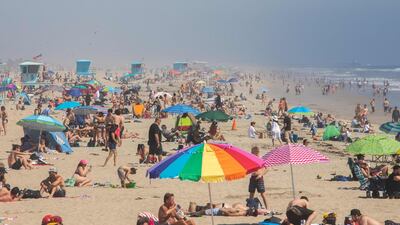
In the US, the Governor of Georgia has allowed gyms, hair salons and even tattoo parlours to open for business. But why not, when nearly 40,000 people were reported to have gone to enjoy the sea air at Newport Beach in southern California last Friday?
Look again at the numbers of deaths I quoted above, and the lesson appears to be simple. It is summed up in a phrase most of us were taught as young children: if something is worth doing, it is worth doing properly. Yes, I would love to go for a swim, and I long to be able to join friends for satay from a roadside stall again. But I cannot, or not for a while anyway. And maybe that is why only 99 people have died from the coronavirus in Malaysia so far, as opposed to 20,000 in freedom-loving Britain.
Sholto Byrnes is a commentator and consultant in Kuala Lumpur and a corresponding fellow of the Erasmus Forum

