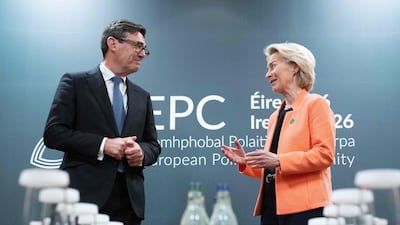

By Friday, UK Prime Minister Andy Burnham will have put a visual backdrop to his most controversial idea since entering office.
Mr Burnham will be in Brussels for a UK-EU summit to seal a new set of accords to align with the bloc’s economy in areas such as agricultural exports.
In his signature foreign policy push, Mr Burnham insists his EU reset is a “win-win” for both sides and something closer to the type of Brexit that people assumed was on the table when they voted to leave in 2016.
What he is actually doing is setting off an information-sphere battle that could easily subsume his premiership in one of the biggest narrative battles anywhere on the planet.
Mr Burnham has displayed strong social media cut-through during his time in office, especially to the types of domestic voters that he wants on his side.
The argument attributed to him, that he ultimately wants the UK back in the EU, is a tough sell to bring many of these with him. One survey at the weekend said that the majority of Labour party MPs will face voters that backed the drive to leave the EU a decade ago.
The Prime Minister nevertheless says a longer-term convergence with the EU is in the UK’s interest. He describes the current situation on the departure from the EU like the emperor’s new clothes in the children’s fable.
Giving his main foreign policy speech of the year on Monday, Mr Burnham asserts that the UK has lost more than it gained in the way that it left the EU.
Already a campaign group has formed called Stay Out. It has recycled one of the hardest-hitting punchlines from the last campaign. Then the opponents of the EU said that £350 million ($462 million) a week was going to Brussels, now the figure is projected at more than £750 million.
Recycled attacks lines are one thing, but where Mr Burnham faces his biggest fight is with AI-generated misinformation.
The EU’s impact on the cost of living is one fruitful area of the headlines that make the raw material for bot-driven content. One newspaper last week suggested that even the starter deal that Mr Burnham is to secure on Friday will result in the UK adopting “two EU laws” a week to align with EU regulations.
The fight has thus begun, even though – for the moment – Mr Burnham adheres to the 2024 Labour party manifesto that pledged no re-entry to the EU’s customs union, single market or freedom of movement.
Instead, Mr Burnham is fighting his battles for the “obvious truth” that Brexit has been harmful and needs repair. In theory, that is a welcome message, with polling showing up to two thirds of voters harbouring misgivings that Brexit was a good thing.
What comes next is a severe contest for whose truth wins.
Research for the British Foreign Policy Group, a non-partisan think tank, profiled the current state of play in misinformation targeted at UK policy.
It found that “the most exploitable fault lines are already apparent and largely unchanged from 2016”. With Mr Burnham’s summit at the end of this week agreeing two deals, one on youth movement between the two areas outside immigration controls as well as an agriculture pact, this finding is immediately relevant.
The policy group’s paper said “claims that EU membership could open the floodgates to unchecked migration and would subject the UK to foreign control” was the most contestable area for bot farms intervening in British politics.
It found that the nature of bot output was becoming more locally focused by adopting regional or hyper-local identities to tailor the messaging to towns or even parts of towns.
With the UK establishing a new National Centre for Information Defence, the implication is that much of this tailored publishing is foreign interference driven by hostile strategies that seek to expand divisions and exacerbate tensions between political actors.
Despite the adoption of the centre, the new disinformation initiative will need to develop locally focused strategies that pick up on sub-regional developments.
This matters because Mr Burnham needs to carry the doubters with him, including the MPs who encounter voters echoing what, at the national level, are unseen propaganda and friction points.
If these are being generated at an industrial scale, the suggestion must be that Mr Burnham’s EU reset, which is necessarily driven by a range of technical arguments, must also have an information strategy alongside.
The campaign group “Stay Out” has already distributed a video. The Return side has not yet got out of the blocks. I heard former Labour leader Neil Kinnock, a fervent advocate of returning to the EU, address the UK in a Changing Europe think tank last week, in which he spoke of the need for trust to get across the “objective truth” about the UK’s relationship to the bloc. Mr Kinnock spoke as the think tank was closing down even if demand for its research could not be more assured of future growth. What is at stake is where the country “could be, should be and needs to be”, he added.
That sound you hear is one of battlelines redrawn on the information sphere around the EU and UK relationship.

