
Brazilian President Luiz Inacio Lula da Silva’s fourth-term victory last month was a change in the global political weather that has lifted the hopes of centrists following a series of setbacks this year. The Halloween trail of riots and destruction across Europe last weekend was just the latest in a succession of generational clashes that shows how high political temperatures are running at this point in history.
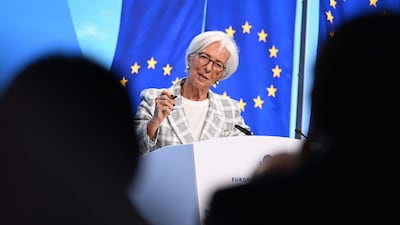
Why, then, does the return to politics of European Central Bank president Christine Lagarde feel like a big moment?
No one is yet talking about Ms Lagarde pulling off a surprise victory in France’s presidential election next April. Yet her availability opens up possibilities that are inspiring Europe’s centrists to hope for a rallying point that has been hard to foresee until now.
Activism has taken on a new intensity in Europe, particularly on the streets. Urban youth and slightly older demonstrators are mobilised. There is a banner in Germany that proclaims: “Gen Z can fix it.”
Within these mass turnouts are more hardened saboteur groups that can light the fuse for confrontation, looting and chaos. The hobby retailer Vinted was among the online resale sites that suddenly adopted new safeguards after a number of the looted fashion brand labels turned up on a Monday for sale following the weekend chaos.
Choices in politics are wide but realistic leadership material is narrow. This is certainly true in Ms Lagarde’s France, where Marine Le Pen is the presidential race frontrunner from the far right. Meanwhile, the odds are rising on a run-off with the ageing leftist Jean-Luc Melenchon. In the middle, there is a handful of former ministers, even prime ministers, looking for the conservative and socialist nominations, who look more and more like also-rans.
So the congealing power of a genuine heavyweight is, even at this late stage, an option in France – even if it is hard to put together a sequence of events to deliver it.
Eyes have also turned to the vacant “thought leadership post” at the World Economic Forum in Switzerland. The organisation has been in an uncertain transition for the past two years, and the availability of Ms Lagarde gives one pathway to finding its feet.
Key EU institutions are also on sketchy ground, with a distinct lack of vision to match the gravity of the times. From Barcelona, through the French cities, into Milan and Frankfurt, the city landscapes are burning. Coping with a repositioning US and China’s second export wave, Brussels is turning inwards to its own corridors.
-

Tear gas rises in the Republic Square as anti-riot police clash with protesters during demonstrations against the cost of living, in Paris. Reuters -

Police officers take cover behind their shields during clashes in the city of Nantes. Reuters -

Protesters climb fences in Nantes. Reuters -

A woman jogs past shells of cars burnt during the unrest in Paris. Reuters -

A McDonald's restaurant after its windows were damaged, in Paris. Reuters -
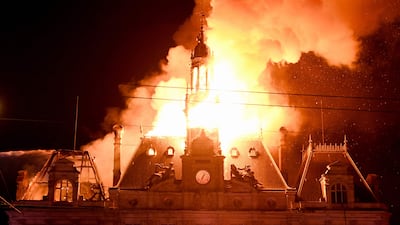
The city hall on fire in Limoges, central France. AFP -
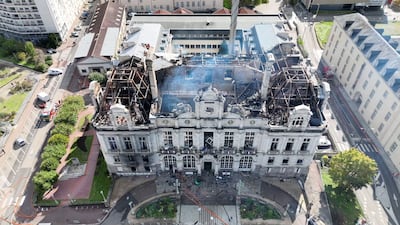
The destroyed Limoges city hall after it was set on fire. AFP -
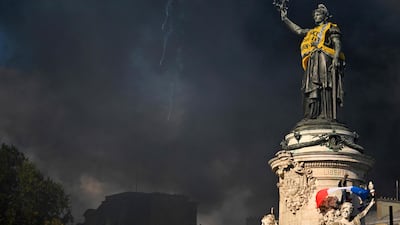
Heavy smoke around the statue in the Republic Square, in Paris. AFP -
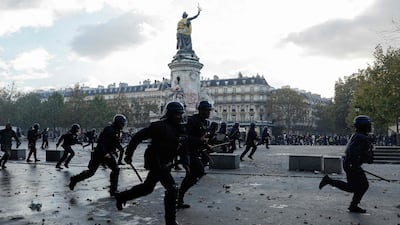
Police officers charge against protesters. AFP -
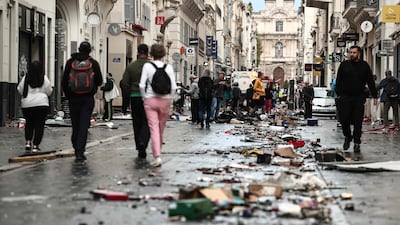
The violence degenerated into looting and burning nationwide. AFP -
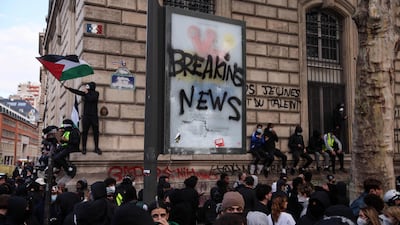
A protester waves a Palestinian flag, in Paris AFP -
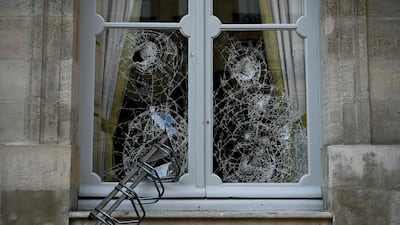
A bicycle rack smashed against a window at the Hotel de Nesmond, the state's official residence in Gironde, in Bordeaux. AFP -
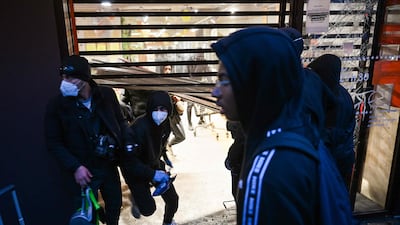
People enter a ransacked Franprix store, in central Paris. AFP -
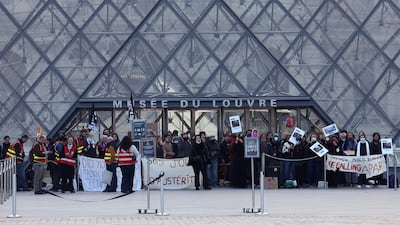
Protesters and students from art and culture schools block the entrance to the Louvre Museum. Reuters


War rumours and the shifting diplomacy of dealing with Russia are steadily devolving to the frontier states. Looking at the consternation when two Scandinavian leaders talked to Russian President Vladimir Putin last week, it was an instructive moment. Finnish President Alexander Stubb and Norwegian Prime Minister Jonas Gahr Store said the discussions were frank and substantive. Peace talks on the war with Ukraine would not happen in silence, the leaders asserted.
Always more of a politician than a central banker at the helm of the ECB, Ms Lagarde, 70, is talking like there is time for one more mission in her public life. By stepping down, she seizes the limelight and makes her availability a political challenge in and of itself.
Her predecessor, former Italian prime minister Mario Draghi, has remained a relevant player with European power circles. The so-called Draghi Report on European Competitiveness has served as something of a political agenda for the centre-right in recent years. It has helped redefine how the European political economy could adapt to the repositioning of the US behind a tariff wall and posed internal questions about competitiveness with China.
It is not hard to discern where Ms Lagarde would come from, should she be entrusted with power. It is equally easy to discern that she sees in current events an expanding vacuum that demands her availability in the coming months. The questions now will centre on how she mobilises a constituency that can rally round what she offers as an alternative to the flailing political veterans who have gained little traction on the campaign trail.

There is an argument that certain qualities of leadership make up for the lack of answers from politicians at the centre.
France has a tradition wherein every few generations, the questions over its direction are settled by a pivot from the streets. It has also a tradition of a transforming leader stepping up at the right time. Sometimes these figures can be transcending leaders, such as Charles de Gaulle, and in other cases, such as with President Emmanuel Macron, the transformation agenda becomes just another political instalment.
With Ms Lagarde’s move last week – and she won’t formally step down until early in the new year – she has presented the opening for France and perhaps Europe more broadly. At the very least, a new voice has been unleashed to take on the competitiveness issues that lie at the heart of the conundrum that Europe presents to the world.
Significant in and of itself, the Lagarde announcement sets the stage for a year of realignment across the continent.

