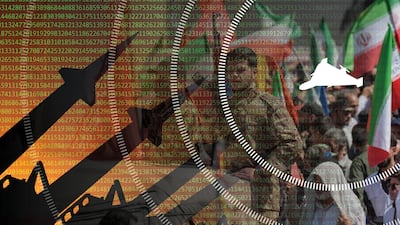

On March 1, one day after the US-Israeli war with Iran began, President Donald Trump declared that the conflict would last about four weeks and end with regime change in Tehran. This was to be a “shock and awe” war, fought at distance and relying on technological superiority to deliver a transformative goal within an ambitious timeline.
America’s qualitative military edge soon delivered results as precision strikes devastated Iran’s armed forces and decapitated its political leadership. This was achieved without ground troops. Nor did the US rely solely on its network of bases in the Middle East – its operations were supported from locations as far afield as Europe and the American mainland.
Yet in retrospect, Washington walked into an avoidable trap. It sought to achieve more, in a short time, from far away. This reveals a vulnerability of advanced militaries in so-called asymmetric conflicts – technology and distance make it easier to start wars but they do not necessarily make them easier to win. The Iran war is but the latest example of an advanced military power falsely perceiving that technological superiority and an unparalleled ability to cause damage from afar can substitute for resolve. The results were as predictable as they are likely to repeat themselves.
Commentators often measure asymmetry in warfare through crude comparisons: who has more and better firepower, aircraft, ships and artillery on paper? However, this heuristic ignores the asymmetry of resolve, which often manifests in the opposite direction. What seems like a far-flung intervention for the stronger party can constitute an existential struggle for the weaker one. If the stronger party is willing only to use a small fraction of its fighting power for a short time, its coercive power is significantly mitigated. The result is that the ostensibly weaker party can win or at least survive by demonstrating more staying power. Each party’s level of resolve, therefore, determines how much mass – the quantity and concentration of combat assets and firepower – they are willing to mobilise and sustain to achieve victory.
Resolve is also as much about the ability to absorb pain as it is the ability to deliver it. If a stronger party practises “shock and awe”, but their adversary refuses to yield, the stronger party often flounders. American journalist Walter Lippmann famously warned that states face failure when their objectives exceed the resources they devote to them. Technological superiority can obscure this mismatch by allowing states to pursue expansive political objectives, whilst committing only a fraction of the resources those objectives require. Worse still, it can also exacerbate it, by feeding a false hope that wars can be fought and won quickly and from far away, with little need for sacrifice.
-

To mark the fourth anniversary of the outbreak of the Ukraine-Russia war, The National looks back at some of the striking images captured during the conflict. Getty Images -

The graves of thousands of fallen Ukrainian military personnel are crammed into a cemetery in Kharkiv. Getty Images -

Wrecked cars and destroyed buildings in a scene of devastation after a Russian air attack on the outskirts of Kyiv in 2025. AFP -

Ukrainians burn flares during a farewell ceremony in Kyiv for servicemen killed on duty in 2025. EPA -

Rescuers work at the site of a Russian strike on a residential building in Kharkiv in 2024. EPA -

A memorial wall dedicated to fallen defenders of Ukraine in central Kyiv in 2024. EPA -

Ukrainians working at the site of a rocket strike on Okhmadyt children's hospital in Kyiv in 2024. EPA -

A damaged sign in the town of Orikhiv, near the front line in the Zaporizhzhia region in 2024. EPA -

Gravediggers prepare the burial site for victims of a Russian missile strike in Hroza in 2023. Getty Images -

Widow Lubov Doroshenko, 67, returns to her destroyed home in 2023 in Bohorodychne. Getty Images -

A Ukrainian serviceman of the 24 Separate Mechanised Brigade fires a mortar towards Russian positions in Donetsk region in 2023. EPA -

Emergency workers search the remains of a residential building struck by a Russian missile in Dnipro in 2023. Getty Images -

Ukrainian national flags fly over the graves of fallen Ukrainian soldiers in a military cemetery in Kharkiv in 2023. EPA -

Destroyed buildings west of the front line in Donetsk in 2023. Getty Images -

A view through a broken window of a damaged residential building in Dnipro in 2023. EPA -

Numbers mark the graves of unidentified people killed during fighting, in Mariupol in 2022. EPA -

Ukrainian servicemen shoot from a captured Russian howitzer on a front line near Kupyansk city in 2022. EPA -

A badly injured soldier at a rehabilitation centre in Kyiv in 2022. EPA -

Part of a rocket shell in Shevchenkove, Kharkiv, in 2022. EPA -

A Ukrainian serviceman rests while travelling with a team of humanitarian volunteers in the Kherson area in 2022. EPA -

A destroyed bridge in Kupiansk in 2022. Getty Images -

A girl arrives at an evacuation point for people fleeing Mariupol, Melitopol and the surrounding towns under Russian control in 2022. Getty Images -

The mother of a Ukrainian serviceman holds her son's portrait during his funeral ceremony in Kyiv in 2022. EPA -

A self-proclaimed Donetsk People's Republic militia monitors a section of the road near Avdiivka in 2022. EPA -

Firefighters work to extinguish flames at a warehouse hit by Russian shelling in Kharkiv in 2022. Getty Images -

A Ukrainian soldier waves the national flag in Hostomel in 2022. Getty Images -

Debris and destroyed Russian military vehicles in Bucha in 2022. Getty Images -

Residents of Irpin flee heavy fighting in 2022. Getty Images -

Life goes on outside a residential building damaged by a missile in Kyiv in 2022. Getty Images


All the above characteristics manifested in the recent US-led war against Iran. Israeli Prime Minister Benjamin Netanyahu allegedly sold Mr Trump a quick, cheap and easy victory. By combining US and Israeli firepower, the Islamic Republic was supposed to fall without the need for ground troops. Iran would not close the Strait of Hormuz, nor would it be able to cause significant damage to the global economy or America’s regional allies.
Tehran, of course, saw it differently. Faced with the threat of regime collapse, it engaged in an existential struggle. With resolve came mass. During the Iran-Iraq war of 1980-1988, Iran employed human-wave assaults, sending thousands of conscripts on a one-way journey to overwhelm enemy positions. In 2026, it modernised the same logic, sending waves of cheap Shahed drones up against cutting-edge interceptors that cost much more to operate. That most of the drones were shot down did not matter – Iran had demonstrated its ability to fight a prolonged struggle. This example also demonstrates that technological innovation is not limited to the so-called stronger party.
This dynamic is far from unique to the recent Iran conflict. During the Vietnam War, the US dropped more than 7.5 million tonnes of munitions, over three times more than it used throughout the entire Second World War. This did not, however, deliver victory. Later, in Afghanistan, a remarkably small US footprint and overwhelming qualitative superiority quickly toppled the Taliban regime. However, the US then sank into “mission creep”, increasing its troop presence in the country while adopting the overly ambitious goal of turning Afghanistan into a liberal democracy. This in turn widened the Lippmann Gap – despite more boots on the ground, the US never committed sufficient troops to win a counterinsurgency campaign, let alone achieve societal transformation.

This is not a uniquely American problem. The war in Ukraine looks, at first glance, to be a very different case. Russia has clearly demonstrated resolve and deployed mass – according to the Centre for Strategic and International Studies, it has suffered up to 450,000 fatalities in the conflict. And it can boast neither physical distance from the combat zone, nor overwhelming technological superiority.
Yet in Ukraine, the Kremlin has found itself confronting many of the same strategic dilemmas that have bedevilled Washington in its own wars. Russia is by far the stronger party but it initially mobilised a fraction of its resources probably due to overconfidence and a desire to limit domestic and international blowback – this is also why it calls the war a “special military operation”. Ukraine, by contrast, felt existentially threatened and spent approximately 40 per cent of its gross domestic product on military expenditure last year, according to the Stockholm International Peace Research Institute. It has also raised an army that is nearly one million strong. Like Iran, Ukraine has innovated technologically and demonstrated resolve. As a result, Russia’s hopes for quick, easy regime change proved fleeting and mimics the US in Afghanistan and Vietnam. It has sunk into a quagmire.
The key takeaway from all these conflicts is not that qualitative superiority does not matter, but that the capacity to inflict damage is no substitute for resolve. Drones, artificial intelligence and increasingly autonomous weapons may make wars cheaper to start and reduce the number of soldiers in harm's way. What they cannot do is replace the enduring fundamentals of warfare. This is why technological superiority may lower the price of entry into war, but it cannot guarantee an easier or quicker victory.

