
With daily vessel transits through the Strait of Hormuz still down to a trickle, and now the Red Sea and the Suez Canal routes vulnerable to the Houthis’ threat on the Bab Al Mandeb strait, there is greater interest than ever in alternative shipping routes.
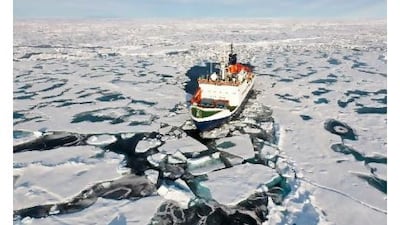
One that has been talked about for years, although with no great expectation that it would amount to much any time soon, is the Northern Sea Route – or NSR – through the Arctic. The key advantage of this route is that when the seas are navigable, ships sailing from north-east Asia to north-west Europe can make the journey in about 20 days – about half the time it would take them going south through the Indian Ocean and then the Suez Canal.
China declared itself a “near-Arctic state” in 2018 and introduced the concept of the “Polar Silk Road” as part of its ambitious connectivity and infrastructure-based Belt and Road Initiative that same year. Much of the commentary since has been sceptical, but earlier this month a Chinese ship completed the first regular commercial – albeit seasonal – container service through the Arctic, arriving at Teesport in the UK on September 9. Bearing a cargo of high-technology goods manufactured in China, the vessel was the first of eight voyages planned between August and October this year.
A few days later, a South Korean ship followed suit. Having departed from the south-eastern port city of Busan on August 22, it arrived in Felixstowe, the UK, three weeks later. South Korean President Lee Jae Myung praised the milestone, posting on X: “I congratulate and thank the captain and crew members who pioneered this historic Arctic route,” adding that he wished the ship “a safe return and a successful exploration” of the NSR. Mr Lee wasn’t just saluting a lone voyage; he wants this to be just the beginning, having adopted Arctic shipping development as a national policy almost exactly one year ago.
India plans to send a pilot vessel through the NSR next year, with an official saying he saw “enormous possibilities” in the route. Vietnam has also been invited by Russia to participate in the development of Moscow’s own infrastructure plan for the region, the Trans-Arctic Transport Corridor, which involves the NSR. As one analysis put it: “China’s Arctic Silk Road Is now a reality.”
Naturally, given the three or four-month window when ships can pass through this route without heavy-duty icebreakers, the number of transits is still quite small – 103 last year, according to the Centre for High North Logistics in Norway, compared to 12,758 through the Suez Canal during the same period. But this is a beginning, and with the Arctic warming up to four times faster than the global average, time is on the side of NSR.
-

Chief officer Ankit Goyal recalls the deafening impact on his cargo ship when missiles and drone attacks struck nearby ships when the Iran war erupted. All photos: Ankit Goyal -

The cargo vessel Manali was carrying 24 sailors from India, Bangladesh and Vietnam -

More than 20,000 seafarers were stranded on commercial ships when the Iran-US war began with maritime organisations pleading for safety of seafarers -

There have been 17 seafarer deaths in 56 attacks in the Gulf and Strait of Hormuz, according to UN International Maritime Organisation figures -

During the initial days of the war, Iranian naval ships sailed close to commercial vessels to shield them from missile attacks -

On most days the sky was thick with smoke from attacks on ships in the conflict zone


One 2024 study concluded that the Arctic Ocean could have its first “ice-free” day before 2030. According to El Pais newspaper, former Spanish foreign minister Arancha Gonzalez Laya made an even bolder prediction in a recent book: “If the 20th century was the century of the Strait of Malacca, the 21st century will be the century of the Bering Strait,” she wrote, referring to the passage from the Pacific to the Arctic Ocean. “One of the greatest reconfigurations of global logistics has begun.”
Even now, during the months of relatively warmer weather, the NSR presents challenges. The South Korean ship had to stop overnight at one point to avoid drifting ice in its path. Russia’s frozen north, which is the nearest land for much of the way, is remote and, apart from industry-specific installations, fairly underdeveloped. Insurance premiums will be sky-high given the difficulty of coming to the aid of any ships in difficulties; naysayers doubt that the route can be genuinely commercially viable. Environmentalists warn of the dangers to fragile ecosystems, the possibility of devastating oil spills and the fact that increased traffic may exacerbate regional warming. They are also dubious about claims that the NSR can reduce carbon emissions by 50 per cent compared to the Suez Canal route.
However, as Dexter Roberts of the Atlantic Council think tank in the US points out: “China is a master at doing things that don’t seem commercial, necessarily, in the beginning.” And China is not doing this on its own. Russia and South Korea are already publicly committed to making the NSR a success. Many other countries in the Asia Pacific are taking note.
Maksim Dankin, general director of the Project Office for Arctic Development at the Indian research centre NatStrat, has another point in the NSR’s favour. “The NSR is becoming a focal point for countries seeking independence from traditional western logistics chains,” he wrote recently. Countries like India, he said, “may view it as a strategic imperative, not simply as a logistical alternative”.
There can be, but doesn’t have to be, a political dimension to the NSR. Countries that have been sanctioning Russia won’t want to have to pay fees to go through what Moscow views as its own internal waters, and it seems inevitable that the NSR will be suspected by the usual suspects of being a Sino-Russian ploy to dominate the region.
Plenty of others, however, may be glad about the opportunity to diversify global shipping routes. The Northern Sea Route or “Arctic Silk Road” is unlikely to ever replace the Suez Canal, and no one suggests that it will. But at a time when maritime disruptions in the Gulf are causing catastrophic effects on economies around the world, a partial alternative may well be welcome – whatever you call it.

