

Bashing China has become part of what currently passes for political debate in the US, with President Donald Trump regularly accusing Joe Biden either of letting China "eat his lunch" or of surrendering American jobs to Beijing. At the same time, this is not disconnected from popular feeling: a Pew survey published a few days ago indicated that public views of China in many countries, including the US, UK, Germany, South Korea and Australia, had reached record levels of unfavourability. So it is more important than ever to see and think clearly about when and if criticism of China is backed by the facts or not.
This is why a report recently issued by the UK's leading international affairs think tank Chatham House, titled Debunking the Myth of 'Debt-trap Diplomacy', deserves to be widely read. As the authors – Lee Jones of Queen Mary University of London, and Shahar Hameiri of the University of Queensland – point out, President Xi Jinping's signature Belt and Road Initiative (BRI) has often been painted as an insidious instrument of Chinese expansionism. Rather than being a benevolent programme to increase global connectivity and to support developing countries build much-needed infrastructure, critics claim Beijing lures poorer nations into taking loans they can't possibly afford and then tries to make them client states when they can't pay up and have to beg for terms.
Trump administration officials such as former national security adviser John Bolton have said the BRI was all about “advancing Chinese global dominance”. Vice President Mike Pence alleged – falsely, as it has since proved – that China’s involvement in financing the debt-laden and unprofitable Hambantota Port in Sri Lanka was in order to establish a forward base for its navy. Secretary of State Mike Pompeo has said that countries “which have signed on to the Belt and Road projects have found Beijing's deals come not with strings attached, but with shackles".
-

A farmer harvests grass seeds in a field in this aerial photograph taken over a farm near Gunnedah, New South Wales, Australia, on last month. Australia’s call for a probe into the origins of the virus have further strained ties. Beijing has labeled calls for the investigation "politically motivated," warning of a potential consumer boycott of Australian products. Bloomberg -

Cows walk through a field during a cattle drive at a farm in Gunnedah, New South Wales, last month. A growing number of Australia's primary producers are mulling the potential for a further tightening of restrictions on Australia's agricultural exports by China. Bloomberg -

A farmer herds Black Angus cows during a cattle drive in this aerial photograph taken over a farm in Gunnedah. A growing number of Australia's primary producers are mulling the potential for a further tightening of restrictions on Australia's agricultural exports by China. Bloomberg -

A student reads while sitting on a ledge at the Quadrangle of the University of Sydney, Australia May 2, 2017. International students are expected to begin returning to Australia next month despite Chinese warnings of pandemic-related racism, the Australian prime minister said on Friday, June 12, 2020. (Paul Miller/AAP Image via AP) -

Office buildings and the Bank of China logo are seen amidst the easing of the coronavirus disease restrictions in the Central Business District of Sydney, Australia. Reuters -
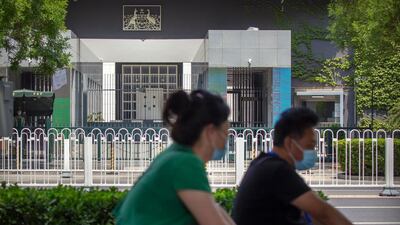
People wearing face masks to protect against the new coronavirus ride past the Australian Embassy in Beijing last week. China is advising its citizens not to visit Australia, citing racial discrimination and violence against Asians, in what appears to be Beijing's latest attempt to punish the country for advocating an investigation into the coronavirus pandemic. AP Photo -
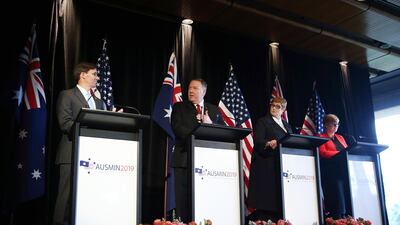
US Secretary of State Mike Pompeo, second left, alongside American and Australian officials during a news conference in Sydney. The two countries agreed to seek a probe into the outbeak of Covid-19. Bloomberg -

University of Queensland student and activist Drew Pavlou, centre, takes part in a protest in support of Hong Kong, outside the Chinese consulate in Brisbane, Australia, last month. EPA -
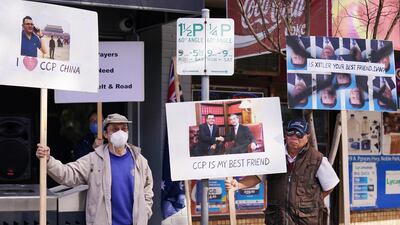
Pro democracy Hong Kong protesters gather outside the electorate office of Victorian Premier Daniel Andrews in Melbourne, Australia, last month. EPA -

The Commanding Officer of HMAS Parramatta, Commander Anita Nemarich, waves at USS America in the South China Sea last month. Australia is a member of the so-called Quadrilateral Security Dialogue. Reuters


I have frequently written that these are absurd, malign and unfair mischaracterisations of the BRI. Nations are not shorn of their agency; they can choose to participate in projects or not. New roads, railways, ports and buildings are desperately needed in much of Asia and Africa; pretty much no one else is willing to come up with the cash. And as anyone who has looked at the history of the BRI will know, it is such a vague and potentially all-encompassing initiative that it could not possibly be called a masterplan of any kind.
The Chatham House report backs this view up by arguing convincingly that it is actually recipient countries that do much of the asking for support in the first place; that the BRI is primarily an economic, not a geopolitical, project; and that it is “too fragmented and poorly co-ordinated to pursue detailed strategic objectives”.
"Developing country governments are not hapless victims of a predatory Beijing," the authors write. "They – and their associated political and economic interests – determine the nature of BRI projects on their territory." This last point cannot be made often enough. The report does good work in thoroughly debunking the foundational debt-trap myth of Hambantota Port. The costly white elephant may have ended up being leased to a Chinese state-owned enterprise (SOE) for 99 years, but, as they point out, the whole sorry project was not even proposed by China, but "was overwhelmingly driven by Sri Lankan actors for their own domestic purposes". Moreover, they argue that Sri Lanka's debt trap "was facilitated by western lending and monetary policy, and not by the policies of the Chinese government".
It is on the subject of whether the BRI is a scheme to achieve global dominance that the report truly skewers the critics. For there is not just no BRI blueprint. There is no official map of BRI projects – and even unofficial ones have been banned since 2017. It is at times so hazy that when the Malaysian government reportedly asked the Chinese authorities to define which projects it considered to be under the BRI and which not in 2018, they were apparently unable to say.
I have always thought that the BRI’s elasticity and capaciousness were advantages. Why be bound by onerous definitions? But as the authors write: “If ‘strategy’ is understood to mean a specification of the goals to be achieved, combined with a set of tactics describing how to reach those goals, clear directions for specific actors, and appropriate resource commitments, then China’s BRI does not qualify.” That is a polite way of saying that there are so many actors, and so many differing projects started for very different reasons, that to think of the BRI as anything as coherent as a plan, let alone an evil one, is to misunderstand it completely.
It is better thought of as a broad umbrella under which an array of bilateral agreements, variously motivated state agency, commercial and government decisions, and current incarnations of old ideas such as China’s “Go Out” policy which encouraged SOEs to seek business abroad, all shelter. As the report notes, the BRI repackages and rebrands many existing projects and supports new ones; and a large part of its aim is to ensure that excess capacity at home finds markets outside China.

There is nothing wrong with that, and there are also real benefits to BRI-participant countries, as I've written about in these pages in the past. It's not a charity, of course, and it would be perverse for China not to expect gains from it. But casting the initiative as anything that needs to be countered – say by America's "free and open Indo-Pacific" strategy – is "seeking to curb a Chinese 'offensive' that the BRI does not really constitute", as the Chatham House report concludes.
Only a few years ago many countries around the world, including numerous US allies, were happy to work with China to form the Asian Infrastructure Investment Bank. In a time of dangerous escalation, western countries would do well to find common cause again. The BRI is just such an opportunity. For while there may be valid reasons to criticise Beijing, this initiative is not one of them. It could in fact just be a way to step back from a brink it would serve no one's interests to cross.
Sholto Byrnes is an East Asian affairs columnist for The National

